Category Film & TV
Published December 9, 2025
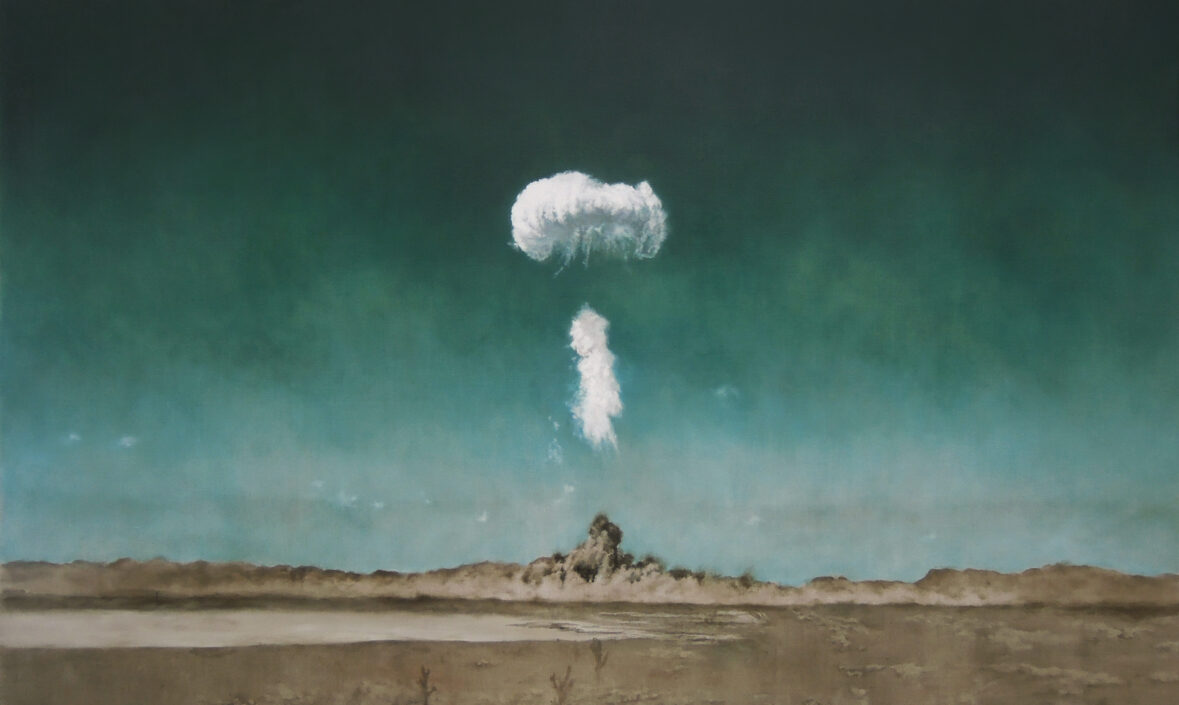
Charlie, by Kirsty Harris, oil on linen, 2017
Play on repeat while reading: “Samuel Barber, Adagio for Strings, Op. 11“, New York Philharmonic, conducted by Leonard Bernstein (1964).
Why are we so drawn to stories of rebellion? Perhaps because they offer a kind of catharsis: a release for our yearning for justice in a world that so often denies it. They reassure us that in the face of overwhelming evil, someone might rise to make things right. That one voice, one act of courage, can tilt the balance.
We’re drawn to them, too, because they show us who we might be: brave, principled, willing to risk everything for something greater than ourselves.
Popular culture offers no shortage of these tales: from The Lord of the Rings to Harry Potter and Star Wars itself, we’ve come to expect resistance told through the lens of destiny, where a chosen one leads the charge and justice arrives on cue.
Perhaps we find these narratives so captivating precisely because they’re fantastical. They let us imagine rebellion as something easy to choose: noble by nature, clear in its cause, and clean in its consequences. But reality is rarely so tidy. And this is where Andor begins.
Set in the Star Wars universe, Andor is a political thriller that follows Cassian Andor, a thief-turned-reluctant revolutionary who will go on to play a pivotal role in the fight against the Galactic Empire. But this is no story of prophesied heroes. It is a slow, searing dissection of how rebellion is born – not in triumph, but in fear, sacrifice, and dangerous acts of defiance. Told through the eyes of the overlooked and the expendable, Andor peels away the myth to reveal resistance in its rawest, most human form. It may well be the most profound piece of Star Wars storytelling since the original trilogy, let alone the sequels.
This reflection contains no major spoilers. It’s not a plot summary, but an invitation to discover Andor for yourself – whether you’re a longtime fan or entirely new to the galaxy far, far away. What follows is a meditation on the existential questions at the heart of the series: how do we create meaning in a world so far from what we hoped it would be? And if we choose to stand for something, how do we bear the cost of staying true to that choice?
As I watched Andor, I found myself returning to the writings of Albert Camus. Something in the show’s moral tension echoed his voice in my mind. For those unfamiliar, Camus was a Nobel Prize–winning French-Algerian writer and philosopher, remembered as one of the most compelling thinkers of the 20th century. Though often associated with existentialism, he carved his own path – beginning with the question of whether a person can live meaningfully in a world that, by all appearances, does not care. Later, in The Rebel, he expanded that inquiry to the collective: what drives people to rise against injustice, and how can that act remain true to the values it claims to uphold?
Through Camus, Andor became something more than a tale of uprising. It became a reflection on how we carry ourselves in the face of darkness – and what it takes to remain whole while choosing to resist.
Andor unfolds in a galaxy where democracy has died a quiet death. A Republic that endured for over a thousand years has crumbled almost overnight, replaced by an imperial regime that is absolute and unchallenged. By now, the Jedi – the traditional heroes of the Star Wars universe – are gone, and with them, the illusion of protection. All that remains are ordinary people, caught under the weight of a system that justifies its control in the name of order while enforcing it through bureaucracy and violence.
At this stage in the story, rebellion is not yet a movement, it is barely even a thought. When survival consumes every waking moment, resistance feels remote, even absurd. It’s the kind of absurdity Camus described so precisely: the dissonance between the human hunger for meaning and a world that offers none. How does one create purpose – or even dare to hope – in the face of such indifference?
In Andor, both loyal imperialists and nascent rebels confront this tension. As in our own world, it demands a choice: forge meaning through action, or turn away from the burden of freedom.
By embracing the Empire’s machinery of control, characters like Dedra Meero and Cyril Karn embody a submission to nihilism.
Totalitarian systems claim to resolve the absurd by presenting ideology as truth. These aren’t villains in the classical sense: they’re people who, when faced with moral complexity, choose certainty over conscience. Dedra seeks order not out of cruelty, but because it gives her life coherence. Cyril clings to the Empire not because it is just, but because it tells him who to be. In both cases, they choose obedience over reflection – and that, as Hannah Arendt warned, is the banality of evil: not monstrous intent, but the quiet complicity of those who stop thinking for themselves.
Nihilism is not always an abyss. Sometimes, it is a refuge – a dim, still place to hide when the burden of asking “what now?” feels too heavy. They may glimpse the exit, but its demands are steep. And so they stay. They obey. They disappear into the myth of historical necessity. But this surrender does not bring peace. It erodes what makes us human: our freedom, our doubt, our responsibility.
If the Empire offers refuge from responsibility, rebellion demands its full weight. It begins in the same place: a confrontation with absurdity, with loss, with a world that no longer makes sense. But instead of retreating, rebels step forward.
This step is never easy, and rarely is it pure. Rebellion is a human response to the collapse of meaning – but also a creative one. As Camus wrote, “The rebel… is not only the man who says no. He is also the man who says yes.”
So what makes someone rise? What breaks their silence? In Andor, the answers are as varied as the people who carry them.
Love
Cassian Andor begins not with conviction, but with a cynicism so deep it borders on detachment. Disillusioned and distrustful, he is entirely focused on survival – not on making the world better, just on getting through it. His rebellion doesn’t emerge from ideology or hope, but from circumstance, and only begins to take shape through the people he loves.
As he starts losing those he once swore to protect, grief forces him to seek meaning in their absence. Slowly, almost reluctantly, he is moved to act.
Cassian’s rebellion isn’t heroic in the traditional sense – and that may be what makes it feel most true. He doesn’t begin as a hero. He becomes one.
To rebel, for him, becomes something more than survival: it becomes an act of remembrance. Solidarity, in his case, is not born of belief but of loyalty – a promise to carry forward what others can no longer carry themselves. In Camus’ words, “I rebel – therefore we exist.” In this sense, Cassian’s refusal to comply is, at its core, an act of love.
Integrity
Where Cassian begins in the shadows, Mon Mothma begins in the halls of power. A senator playing a deadly game, she smiles in public while quietly funneling funds to a rebellion she cannot yet name. Her revolt is quiet, diplomatic, agonizing. In a world where sincerity is punished, her greatest weapon is self-restraint and her deepest anchor is integrity.
But Mon’s rebellion comes at a terrible cost: the erosion of her private life. To maintain the public mask, she must let her daughter drift, her marriage rot, her friendships dissolve. And yet she persists – not because she believes she will win, but because she cannot live otherwise. Her rebellion is perhaps the most Camusian of all: a refusal to lie.
As Camus wrote, “One must imagine Sisyphus happy.” Mon Mothma pushes her boulder in silence out of fidelity to the truth.
Responsibility
If Mon Mothma is the cost of rebellion in the heart, Luthen Rael is its cost in the soul. A spymaster, smuggler, and strategist, he moves people like pieces on a chessboard, fully aware he is sacrificing them for a greater plan. But he does it with eyes wide open. He believes in the cause – and because of that, he feels he has forfeited the right to live in the world he’s trying to build.
Luthen is the rebel as a realist. His resistance is born of responsibility: the cold, lucid understanding that someone must do what others cannot. In one of the show’s most unforgettable monologues, he confesses what he has become: “I burn my life to make a sunrise I know I’ll never see.”
He is devoured by his own conscience because he understands the extent of his damnation. There is no innocence in his rebellion – only clarity, and the resolve to carry its burden alone. He knows no reward will ever come, and accepts it.
Camus might have seen in him the danger of rebellion unmoored from restraint, but also its most tragic expression: not the rebel who forgets what he fights for, but the one who sees too much, carries it all, and goes on anyway. “Real generosity toward the future,” Camus wrote, “lies in giving all to the present.” Luthen gives everything, and asks for nothing in return.
Resentment
Luthen is tragic because he knows he has gone too far, but believes he must. Saw Gerrera is tragic because he no longer cares how far is too far. He does not resist despite the absurd – he resists because of it. Every betrayal, every loss, every Empire atrocity has carved him into a man who trusts no one and needs no one. His rebellion is a scream into the void, an affirmation of rage that pushes him to fight without limits.
Camus would see in him the rebel who has gone too far – who, in seeking justice, forgets mercy and becomes indistinguishable from the terror he opposes.
In doing so, Saw sacrifices meaning itself. This is rebellion that no longer remembers what it was rebelling for. Camus called this a nihilistic revolution: one that abandons restraint, and grows too comfortable using evil for idealistic ends.
Saw’s character reminds us that rebellion does not guarantee righteousness. To rise against oppression is not the same as to be good. The uncomfortable truth is that the rebel and the tyrant are not always opposites. Sometimes they are reflections – distorted by pain, power, or the belief that ends can cleanse means. What separates them is restraint: the ability to remember the human face, even when the fight would be easier without it.
Andor weaves an intricate tapestry of rebellion, showing that the path of resistance is neither straightforward nor inherently virtuous. Its characters – from idealists to realists, strategists to extremists – each confront the weight of moral compromise. Some are broken by it, others sharpened, all are made more human. At the same time, the series lays bare how systems of oppression endure not only through violence, but through the silent acquiescence of those who conform — out of habit, fear, or exhaustion.
This contrast leads to the deeper question at Andor’s core: not simply how to resist injustice, but how to live with integrity in a world that so often rewards apathy. Camus called rebellion “the affirmation of a shared dignity in the face of suffering.” In his view, to rebel is not to seek moral purity or chase an abstract destiny – it is to refuse indifference. To say: this matters, even if the world says otherwise.
The show challenges us to carry that principle into our own lives – not through grand calls for revolution, but by asking something quieter and more difficult: to live deliberately. It calls on us to remain awake to the forces that so easily dull our sense of responsibility, and to continuously examine where we stand, and why. Action, it suggests, must be taken even when there is no recognition, even when the impact remains invisible. In this light, Andor’s rebellion becomes not only political, but profoundly existential. The series urges us to resist the temptation of surrendering our freedom to choose – to keep our eyes open, to stay present, and to take ownership of the world we shape each day through the smallest, most private of decisions. That, ultimately, is where the foundation of a meaningful life is laid: not in what we proclaim, but in the quiet discipline of noticing, refusing, and choosing – without surrendering the part of ourselves that knows what ought not be accepted.