Category Art
Published January 10, 2026

Symbiont, Epibiont & Commensal (The Quiet House Guest), by Abigail Norris
Story scent: Smouldering sandalwood incense.
Story flavour: Black cocoa, coriander, and cumin cake with fermented fig purée and caramelised pumpkin skin, created as part of Barney Pau’s food intervention.
Play on repeat while reading: “Lust Feels Like Bad Luck“, by PYTKO, performed live as part of the night’s programme.
Galleria Objets is dark when I enter, a cavern-like shock to the senses after the white neon of its entrance. The space hums, filled with people dressed to the nines. Platters of breadsticks, canapés and exquisite dips by TROS London are perched on what appear to be bales of hay, alongside the occasional wineglass.
Hanging from the ceiling on little pieces of string are morsels of bread, looking as if they might touch the works of art dotted on the gallery’s brick walls. Performances by Vera Sacra and Waterbaby unfold throughout the night, in unfurling scrolls and orchestral hums. This is the opening night of the two-day programme of the exhibition ‘OBTUSE°’, curated by Selin Kir and Yangrung Chen.
Space and its attendant precarities are a focal point for Kir and Chen’s collective, Obtuse Archive, which gathered thirteen artists and three performers together here for its first exhibition. Even these numbers—thirteen and three—feel unsettling, lambent with superstition and mythological significance: the thirteenth guest; the three fates. Named after the angle that perches between 90° and 180°, this is an exhibition that plays with the intricacies of hesitation, liminality, and imbalance: not quite the horizon, not quite the resting place, but the limitless in-between.
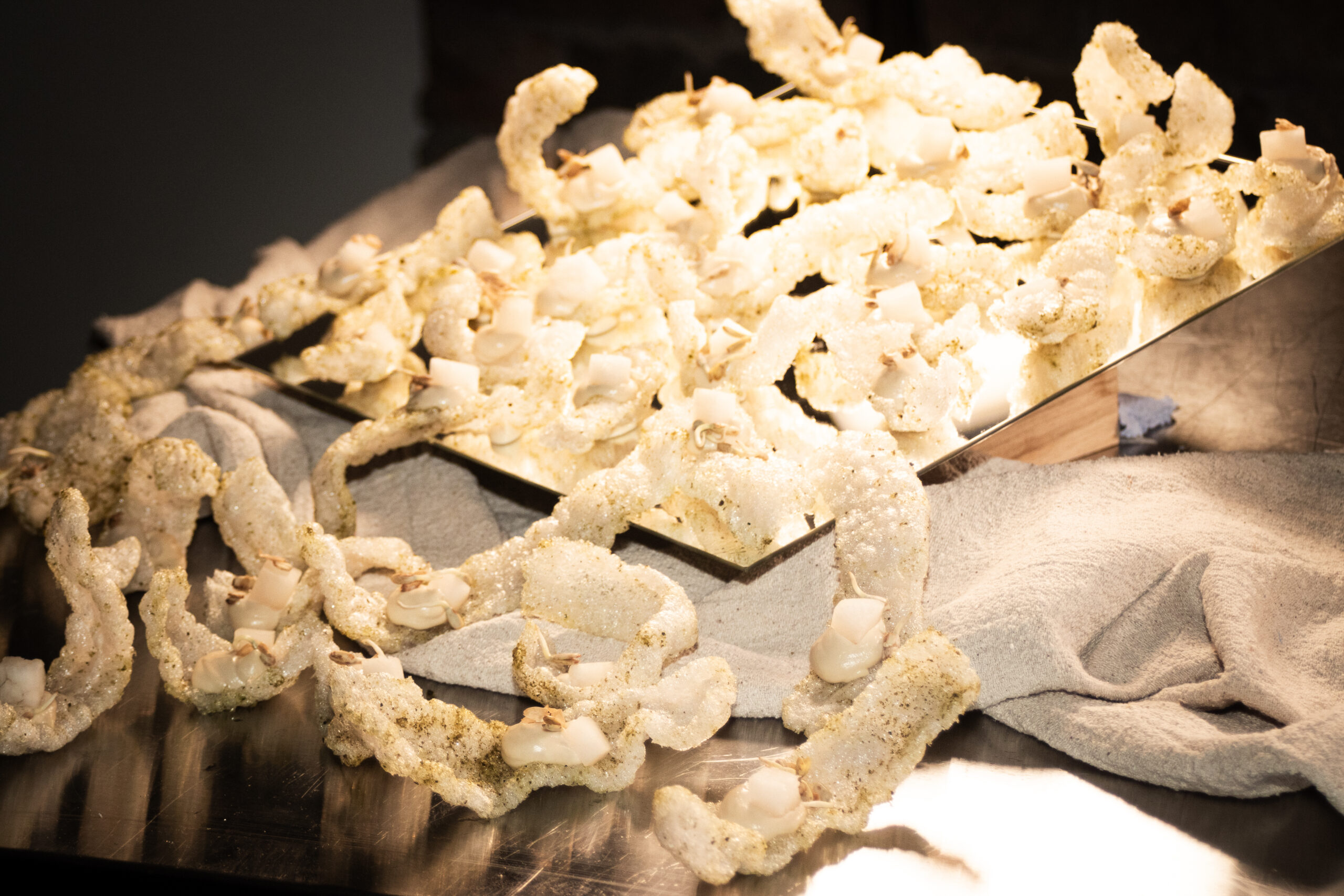
Barney Pau's food intervention, OBTUSE° at Galleria Objets
Cas Campbell’s stoneware sculptures appear as objects of ecological enquiry. Deceptively ornamental despite their bold hues of azure, chocolate, and maple, each vessel meditates on states of camouflage, from the mourning cloak moth to the queer body.
Nearby, Abigail Norris’s Utensils series extends this conversation between nature and artifice. In her bio polymer works, hairbrushes sprout yak hair and wheatgrass, while a pair of winklepicker shoes are bound together by a braid of vintage human hair: artefacts of uneasy symbiosis between wildness and respectability.
This interplay between adornment and survival continues in Irene Pouliassi’s mixed-media sculptures. Using found garments, human relics, and urban debris, she fashions objects that draw on the imagery of ancient warfare and contemporary street armour. Teeth, bones, and thread coalesce into sartorial trophies of modern conflict, poised somewhere between protection and vulnerability.

Performance by Waterbaby, OBTUSE° at Galleria Objets
Surrealism threads its way through the exhibition, blurring the boundaries between animal, human, and machine. Zeus Li’s Your Hands Full of Hours depicts a tree trunk from which plaster-cast human fingers protrude, life straining toward release. Desire takes a more mechanised form in Alfred Francis Pietroni’s digital paintings, where faceless bodies are entangled with pipes and cogs, their pleasure inseparable from industrial structures.These works sit alongside pieces by Juntao Gao, Jon Kipps, and Bo Sun, all of which grapple with adaptation and reuse as strategies for survival in the rubble of modernity.
Animals recur as figures of violence, guardianship, and surreal allegory, from Yutaro Inagaki’s two-headed Cerberus to Yuma Radne’s glittering phoenix. Lola Dupre’s Divine Swine offers a darker whimsy: an impossibly tall pig, its hooves poised like stilettos, rendered with an unsettling elegance that tempers excess with restraint.

Cheek to Teeth, by Yutaro Inagaki
Meitao Qu’s Île flottante provides a moment of levity and precision, reimagining Canary Wharf as a floating French dessert. The work is presented on an acrylic sashimi boat frosted with sugar canary paintings drawn from Chinese folklore, satirising the extravagance of megastructures and luxury excess through a global lens.
Anne Cheng’s concept of ornamentalism lingers over this exhibition, a reminder of ‘how to make discernible the peripheral, how to work the edges, how to enhance presence in the face of absence.’
Here, works hover between the traditional and the futuristic, the synthetic and the organic, the tender and the profane. In this charged in-between, ‘OBTUSE°’ transforms Galleria Objets into a mythopoetic landscape, one that resists resolution and instead invites us to dwell in imbalance.