Location London, New York
Published March 25, 2026
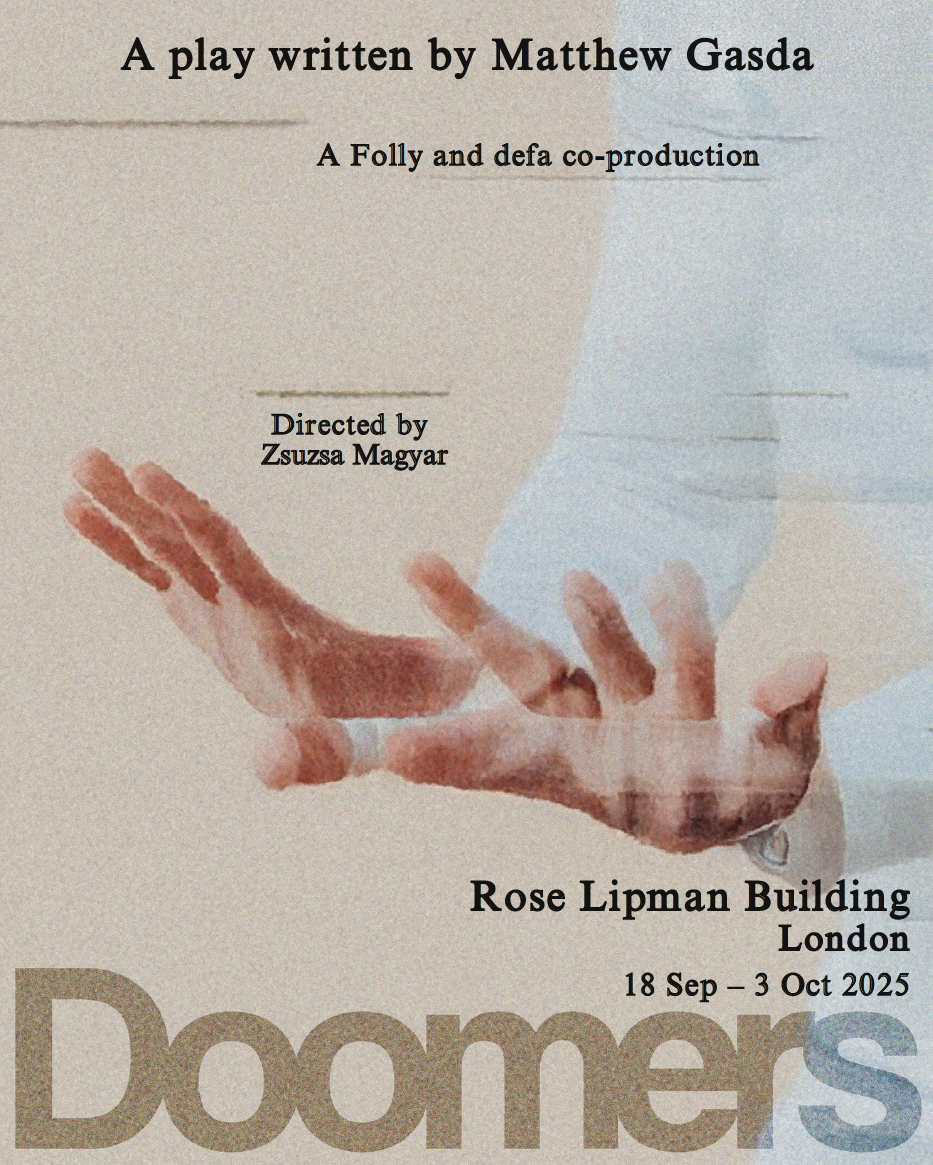
I first discovered Doomers through a friend who was in charge of costumes for the London production of the play. I saw the play twice, which I think gave me an opportunity to appreciate the narrative structure and look more closely at the nuanced interactions within larger dialogues. From the moment the actors made their way onto the stage to the last sentence uttered, I was engaged physically, mentally, and philosophically.
AI’s red flags have always existed in the periphery of my vision. Every ChatGPT prompt felt like it carried heavy consequences, although I might not have realised how heavy until I set them side by side with daunting OpenAI headlines. Doomers has come at a time when we desperately need to consider the ramifications of the systems that are presented to us so casually. We need to ask more questions and this play asks just the right ones.
For someone who is new to the world of AI, it a great first step towards educating oneself. To those, who have continuously contemplated the real dangers of companies like OpenAi it’s soothing reassurance. And for those who wanted to see beyond the company name and get to know the people making the decisions that affect millions, it’s real, although somewhat comical, insight.
Though Doomers encapsulates fictional discussions, the stakes the characters are presented with are based on real-life scenarios. The play is set hours after a Sam Altman-inspired character Seth is voted off from his position as CEO of a large AI company. What follows is two acts representing two sides of the organisation, Seth and his loyal team (act one), and the board of directors responsible for his exit (act two).
While humanising the previously faceless people behind world-altering decisions, the play also gives them plenty of flaws, some of which make for a great laugh. The play’s director Matthew Gasda has perfectly balanced existential and mechanical with a sprinkle of humorous to keep the audience on their toes.
From technical similes that will have you going down AI-related rabbit holes, to high-stakes conflicts that oscillate between overwhelmingly universal and curiously specific, with echoes of doomerism throughout, this play was one of my most interesting watches of 2025.
After my second visit, I knew I needed to talk to the people behind Doomers. The play’s importance in the current landscape needed to be expanded upon. I ran to meet Zsuzsa, the director of the London production and an actress in the New York one. She then put me in touch with Matthew, the play’s writer and director for the New York and San Francisco productions.
What follows is our conversation diving deep into the story behind Doomers and the consequences of AI use in the 21st century.
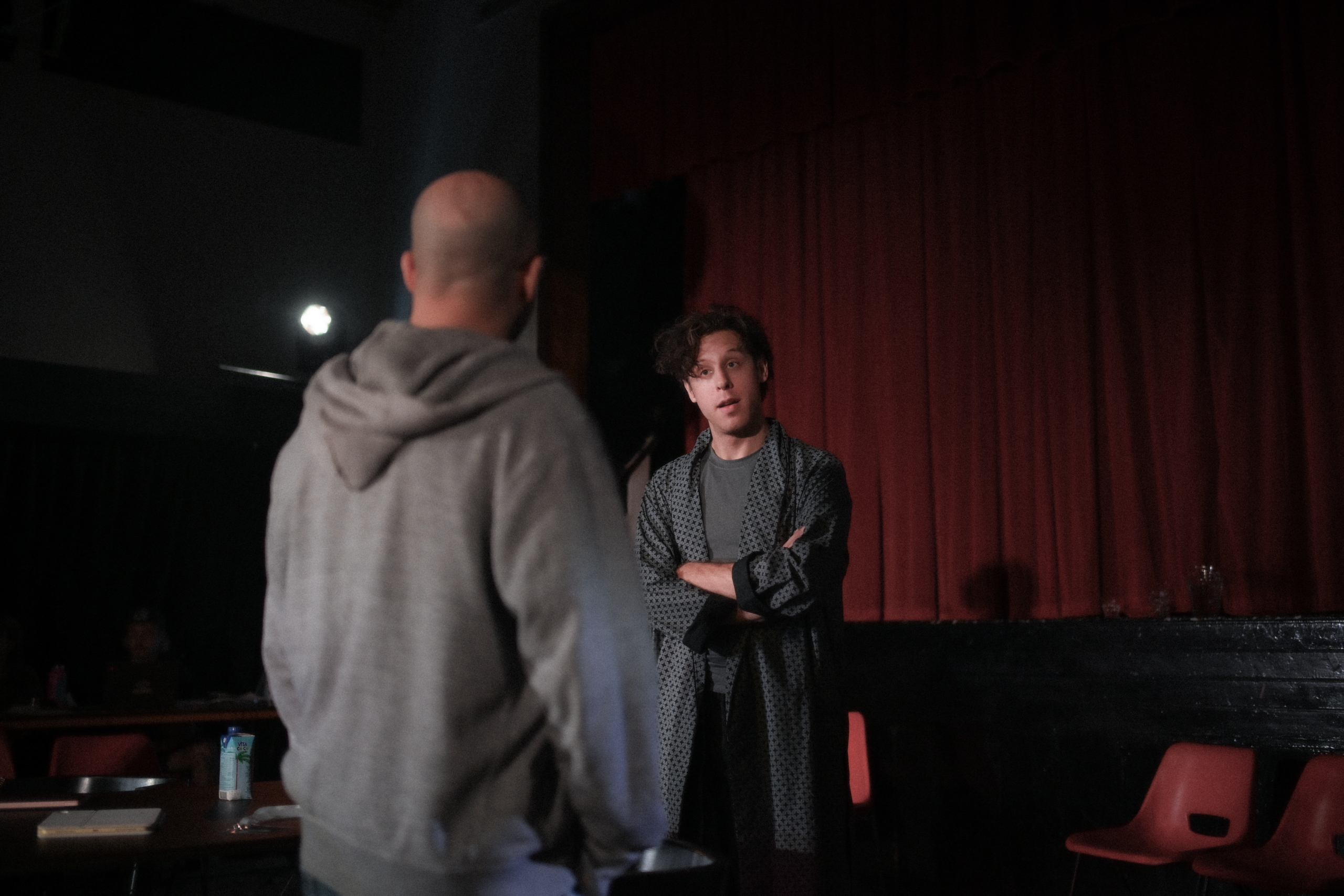
Doomers, London production
Transcript:
Asya: If you start by both of you just introducing yourselves and telling me a little bit about your roles in the play.
Matthew: I’m Matt. I wrote the play Doomers, and in New York, I directed it, but for the London production, I was just the playwright.
Zsuzsa: Hi, I’m Zsuzsa, and I directed the London version of Doomers and acted in the New York version as part of the original cast.
Asya: So Matthew, where did your key inspirations for the play come from? So what made you write it in the first place?
Matthew: The internet. I remember the weekend that Sam Altman was fired, it kind of took over, it took over the internet. There was a lot of speculation about what was happening, and it was quite mysterious, and there were all these major figures in the tech industry tweeting in a cryptic way, and I just, it struck me as a story or a play; it seemed like there was something.
I wanted to know what they were doing, I wanted to know what was happening, and that made me want to write about it, I guess.
Asya: There’s also such a delicate balance in a play like this between keeping the audience engaged but also retaining certain technical terms, and I think your play did that really well.
How did you achieve that balance between keeping it authentic but also keeping it so that people who are not necessarily in the technical world can understand it?
Matthew: Well, I guess in London you guys had a lexicon on the programme, which we thought about doing in New York, but then we never really got around to doing it. Some of it is just getting lucky and hoping that the terminology gets into the public sphere fast enough that the play makes sense.
I think London seems to be about two years behind New York in terms of mainstreaming AI culture. So I think AI culture and the play kind of hit London at the same time that AI culture and the play hit New York.
So some of it is you really just are hoping that by the time, when I was writing it, my hope was that by the time I finished this play and by the time we get it up, that some of these ideas have become mainstream enough that enough people in the audience can contextually clue in the other people.
I think a play is such a collective experience that you don’t need absolutely everybody to understand every single term, but you need enough of something to keep everyone in the audience engaged so that the energy in the room stays alive and stays moving.
And I think when people react in the crowd, it provides context for people who don’t know what’s going on. If 80% of people laugh, those 20% are kind of like, well, I guess I should laugh here.
I think there are many levels to it. There’s a big directing level to it, getting the actors to understand what they’re saying, so they can communicate it to the audience. Using nonverbal cues to give context clues basically as to what’s happening.
And then I think that some of the terms, people might not know what they are, specifically, but a term like P-Doom sounds bad. And so if a character is saying P-Doom is going up rather than down, you can kind of assume that that’s bad. Tail risk, you don’t know what tail risk is, but you still know what risk is.
So I think that in a way, I tried to pick some insider terms that were at the same time, not particularly difficult to contextualise or suss out the meaning of. And I left out maybe some things that were going to be much more nuanced. There’s a mention of game theory, but they don’t really get that deep into game theory. There’s a mention of tail risk and investing ideas, but they don’t get into that.
It’s gesturing in the direction of really big, complicated, quantitative things, but not going further.
In other words, people can kind of figure it out on the fly. They might have vaguely heard of some of these things, and it’s actually not that deep.
Zsuzsa: At least for the London version, and actually in New York, it was really important for the actors to understand what they were saying. And that does translate to an audience.
Like when you watch a play in Old English, or you’re watching Shakespeare, most people don’t have a direct translation in their head, but can get it because the actors have done that work.
Or even the overwhelm and confusion were a part of it. Having those foreign words was a part of this experience of this new technology alienating and also pushing people to be like, “Oh wow, okay, I don’t know this, and maybe I should.” So that was maybe, I don’t know, intentionally or if it just ended up being a, what’s it called, a result of that.
Asya: I think it definitely was quite educational for a lot of people. Even when I spoke to a couple of my friends, they were like, “Wow, now I need to go research this when I get home.”
Matthew: That’s great. I think that’s good enough. It’s a barrage of terms. Some of them are kind of silly, and the play is not entirely serious at all times, but it’s good enough that people, I think, want to dig in a little bit and start the conversation with themselves.
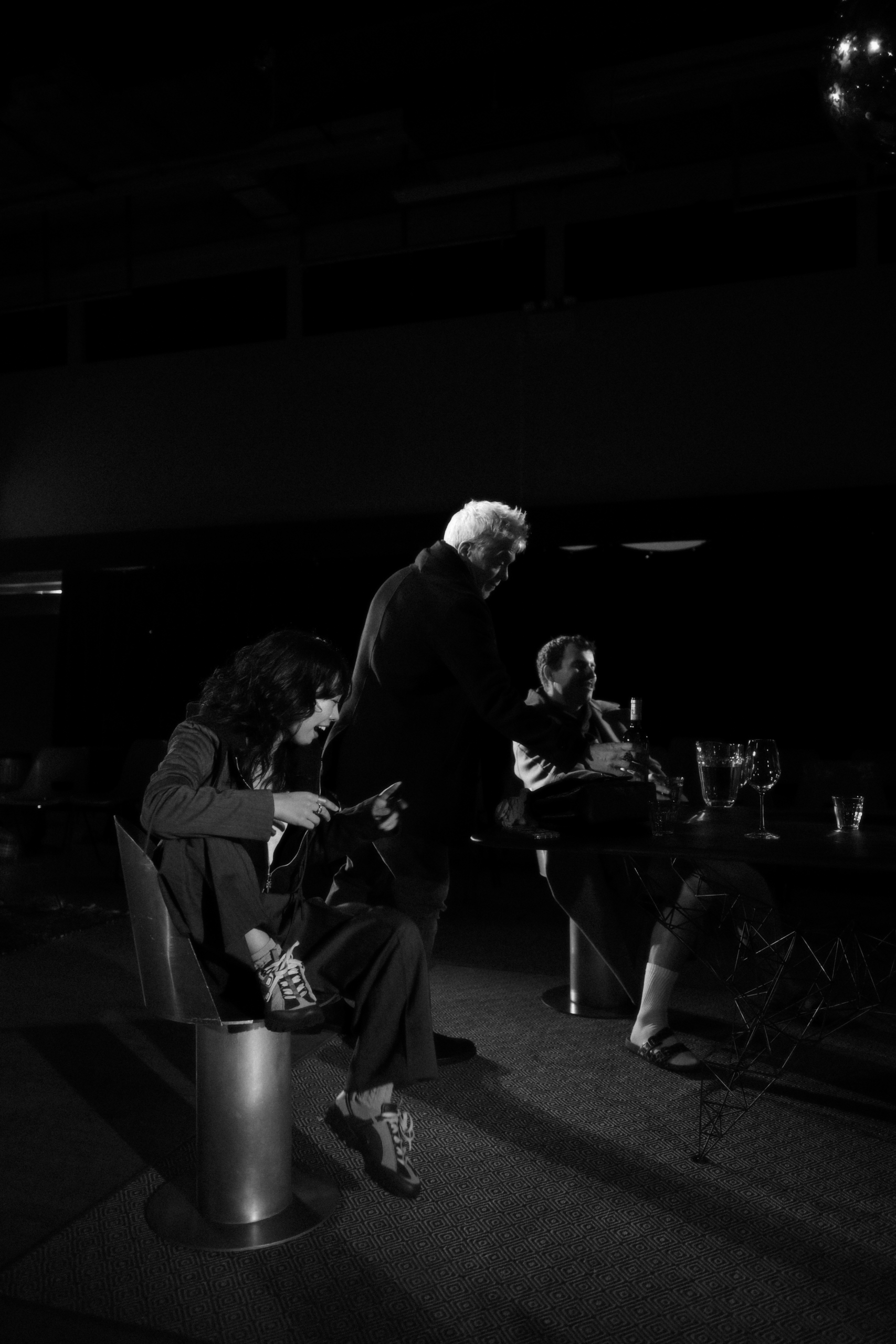
Doomers, London production
Asya: You did mention that it is a bit silly, and I just love the humorous aspects of the play because in the midst of all that stress and seriousness that you experience, you’re also like, oh wow, that was really funny.
How did you balance that, and was it important to you to add these kinds of more humorous aspects to the play?
Matthew: Yeah. I mean, I think that there’s no way to write about tech without being funny. There’s like the uncanny valley; there’s a super satirical version, which I don’t think we leaned entirely into satire.
These are funny people. They’re funny because they’re robotic, because they’re rational. And one of the essences of, I think, of humour is seeing robotic, or algorithmic, rational thinking that can’t adjust to reality, like Jeeves is one of the funniest characters in the history of literature. And that’s because he can’t adjust to, he’s like a robotic butler.
In a way, it’s a lot like Woodhouse. They’re trapped in a kind of behaviour and a kind of verbal pattern, like Bertie Wooster and Jeeves.
They are very smart, or they think they’re very smart. From our perspective, there are a lot of things that they’re missing, especially about themselves and their own desires and needs. So I think that, almost like the robotic essence of the tech guy who’s a hyper-rational tech person, they’re all kind of adopting the same rationalistic calculus. And I think we find that intuitively funny. Because it is intuitively funny.
Asya: I also thought that the way you broke down the play into two acts and having two different sides experience the fallout of the same event was really, really interesting.
How did you come up with that structure? And why did you make the decision to break it into two acts and have these two kinds of sides?
Matthew: I’m pretty stubborn. I think as a playwright, you have to have certain limits when you’re writing. Otherwise, you go crazy, and you never finish anything. So I think right from the beginning, I knew the structure was going to be, the structure suggested itself to me as two mirroring acts.
And I think I just decided I wasn’t going to fuck with that. I wasn’t going to change that from the beginning, because I think the play was so complicated to write. And I had to learn so much to write it that if I hadn’t done that, I would have inevitably never written the play.
There had to be some kind of way of limiting the scope so that I wasn’t writing a book or a novel about Silicon Valley or about every single person in Silicon Valley the night Sam Alton was fired. But rather, I was writing about something very concentrated and intense.
In other words, you just have to make arbitrary decisions. I’m teaching a playwriting workshop later today. And that’s kind of one of the things I teach, is you need limits, and you need something arbitrary to create a sense of drama and concentration, I think.
And I also wanted it to feel like, I’ve mentioned this in other interviews, I think there was something kind of very classical and Greek about the Sam Alton saga. And I think there still is.
And if you look at Greek drama, these plays are short; they’re very concentrated. There’s a ton of foreground; there’s a lot that happens before the plays begin. And then there’s also the suggestion that a lot happens afterwards, because in the Greek sense, they were like part of these longer cycles. So I kind of saw this as part of what could be a longer, tragic cycle about AI.
If Sam Altman is Oedipus, maybe there’s an Antigone, but I’m not going to write Antigone; that’s someone else’s job to write Antigone, the next play in this cycle about the fate of civilisation.
Asya: I think the play offers just this great insight into the people behind these big AI corporations, because you read it on the news, but you never really think about all of these little tools in this large machine of these AI companies. And it also kind of humanises them and exposes their flaws as people.
What went into the choice of picking these specific characters, these specific jobs, these specific people, and putting them on these specific sides?
Matthew: I think it has to do with just trying to provide a, again, a meaningful sample of points of view.
It’s amazingly artificial. I ultimately wasn’t trying to create a documentary reconstruction of real events, but I’m trying to create a fictional meaning, like a meaningfully fictional representation of how an entire community, which really believes itself to be at the centre of the history of the world, approached these grandiose questions about the future and human history, and the meaning of life.
And one of the motivations for the play was, okay, you have a group of people who really think they’re playing God, that’s kind of fascinating. So how can I meaningfully represent all the different points of view on that, relative to the points of view in this community? So that was essentially my goal. I’m sure I missed some things.
But yeah, again, it’s very technical, and you have to have a certain number of characters on stage to create a meaningful debate. You can’t have too many characters, because then the debate gets lost. And you have too many people speaking over each other. So five characters in each act is where I intuitively landed.
And it’s not because there were five people in real life in those rooms, there could have been 20. There could have been two, I don’t know. But that was what I found to be compelling.
Zsuzsa: And I guess uneven, in a way, always uneven and five.
Matthew: Yeah, exactly. That’s a great point. There’s always going to be three on two or four on one.
Asya: I love that those were these characters. And I feel like the number of people in the room was perfect, because you also have these little conversations happening at the same time, almost, or you can see the little interactions between people that have no words. And they just exist in the space while a bigger discussion is happening. And I just love that.
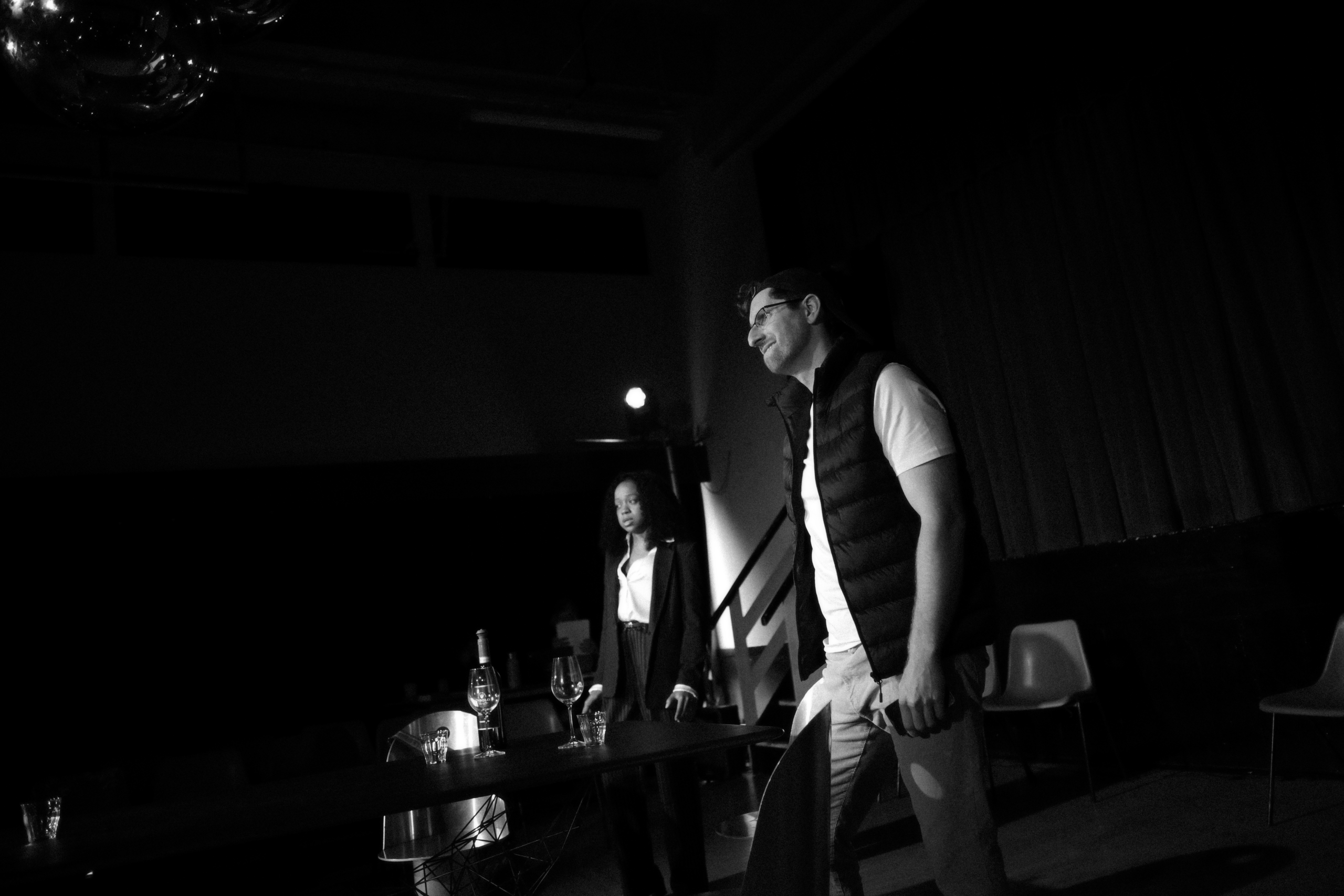
Doomers, London production
For Zsuzsa, what do you want to bring this play to London in the first place?
Zsuzsa: I thought the play was really special. And kind of on what Matthew was saying, London felt a little behind in the conversation. I don’t know if it’s two years; I’m not in the tech world. But it definitely felt like people were not quite where America was.
Every conversation we were having in every sector, I don’t know, finance, the arts, whatever, we were all talking about AI in New York. And I came back to London, and I realised that people were just not doing that. And I couldn’t quite believe it. So I guess I just saw it as an opportunity to start the conversation in my hometown. And I had the infrastructure and everything.
Asya: What were your expectations when you were bringing it to London to this new audience that also might not be as engaged in the discussion as the New York audience was?
Zsuzsa: I definitely was a little worried it would be alienating. The theatre crowd in London is perhaps a little bit more, I don’t know, establishment. And I felt like the arts in New York, people are really open to young people coming with new ideas. And so I thought, especially amongst an older audience, they might not receive this play with as much warmth as they ended up doing, actually.
And of course, I was worried it would feel a little too American. But I think all of the things I was worried about ended up just playing to its advantage. People liked the fact that it was alien and different and just entirely new.
Having been in the New York run and after hearing how it went in San Francisco, and how the audiences received it really differently from the way in which it was received in New York, I was curious to see how London would respond and if it would mirror New York, or mirror San Francisco or go in an entirely different direction, in taste and response in general to the direction of AI.
And it wasn’t really definitive. People really enjoyed the play. I think they enjoyed the fact that they didn’t feel the play was telling them to think in a specific way, which was interesting.
Because I think New York felt it was specifically Doomer and was more aligned with elevating Alina the ethicist’s point of view.
San Francisco saw it as a kind of homage to Sam Altman in Seth. I mean, Matthew, correct me if I’m wrong. That was generally the take. They were like, “Why is Alina standing in his way or people like Alina or the board in general?” And London kind of seemed to see it in a more overarching view of, oh, this is the landscape, and you can pick and choose your response.
The people were kind of describing it as the closest thing they’d seen to some sort of war room scenario. They really saw it as a projection of future conversations and as a what they felt was a fairly accurate portrayal of current ones.
Long story short, I didn’t have expectations for London. I mean, I really wanted it to do well and for it to be a fun experience. But I didn’t really know beyond that. I didn’t put too much pressure.
Asya: Was your experience with the audience different as someone who acted in a play in New York and someone who directed in London?
Zsuzsa: Oh, yeah, totally. I guess when I was acting, I could really lose myself, and I didn’t feel nervous when it was happening. I did my performance, and then I left.
Whereas I think when you’re directing, it really stays with you. The anxiety before, you’re watching it during, and afterwards, the stakes feel different, and the inability to disappear into another character. You are yourself with all of the repercussions of being yourself.
Yeah, it was different. It was more stressful, but it was also overall more rewarding, because you have more, at least I felt I had more ownership over the material, even though I wasn’t in it anymore.
Asya: I think you kind of mentioned it before, but for both Zsuzsa and Matthew, you talked about how the audiences might have been different in the US and UK.
But what do you think were certain similarities in the takeaway from the play in New York and London, and in San Francisco as well? What were certain things that all people definitely took away from it?
Matthew: I mean, I guess Zsuzsa didn’t see the San Francisco version. Only I can answer the full question, but I’m curious what Zsuzsa thinks about the difference between the response she got acting versus directing.
I think the major thing is that in every case, people were gratified to have some kind of view. People are interested in how elites think and are interested in this kind of absurd reality in which a few people are making decisions that potentially affect the entire world for a really long time.
I think at this point, even if AI is a massive failure, the impact that it will have on the stock market will change the world. If OpenAI blows up and is a joke, it’s already world historical. And these decisions still matter, even if they don’t matter in the way that the characters in the play imagine they will.
I think the one thing that is true of all the productions is that people find that fascinating. They find it fascinating to actually try to simulate what it’s like to have that kind of power.
Zsuzsa: I think the major contrast was with San Francisco, from what I understand. I think for London, it really did start people’s journey into investigating AI. A lot of people that I invited, a lot of people who went to the show, were like, ” Oh my God, I didn’t think about this. I hadn’t even begun.” So it was the beginning of their AI education. And I guess to a certain extent, the play was that for me as well.
But on Matthew’s point, what’s great about these characters is they’re really smart and funny. He picked a group of people who are entertaining and are verbose. I think British audiences found that to be engaging.
And I think we’re also quite well primed for that type of drama. We all went through the whole “Succession”. We want to see the rooms where things are changing, and we don’t mind if our characters are in suits.
Corporate life has become quite a popular satire that we all want to consume to an extent. And that’s no different in London than it is in the States.
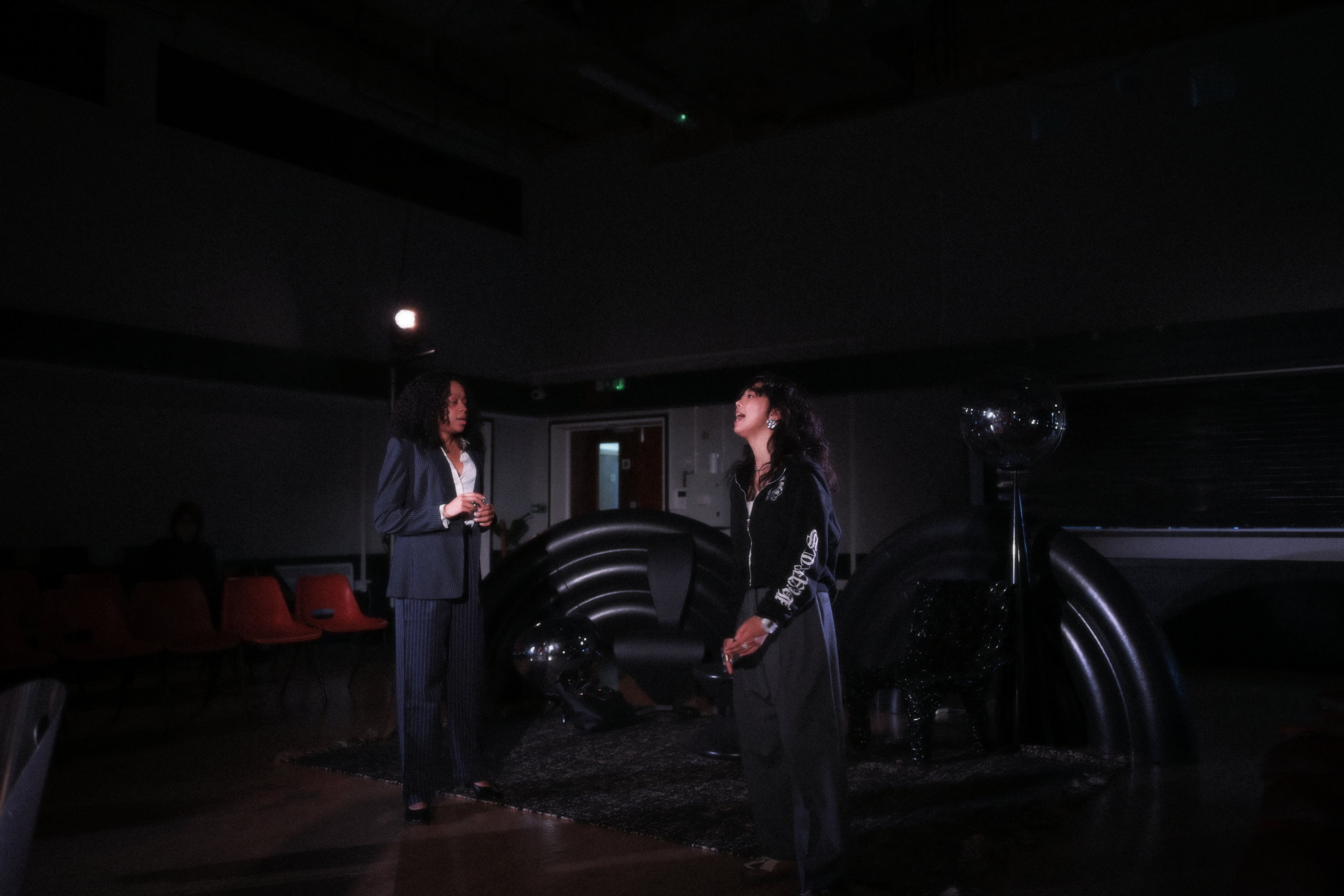
Doomers, London production
Asya: I think it’s so great because a play like that, I think, also removes a certain level of intimidation when it comes to big corporations. For so many years, these decision-makers have been intimidating to others.
They wouldn’t even know their names, but they would know that they’re just towering over them. But then with plays like this, you’re like, oh, they’re just people, and they’re being so silly. And it almost takes away this overwhelming fear and power that you have.
But I think also for a lot of people, especially in London, I think we kind of mentioned it before, but it’s the first time they’re actually expressing curiosity about what happens behind their ChatGPT, because everyone uses it. Everyone has their own account, and they ask it what to cook for breakfast or something, but they don’t really think about what’s behind it, or the dangers it has for human life, or the dangers of these people’s decisions.
What’s your opinion on the public’s general knowledge of people behind AI, the dangers of AI, and the whole mechanism of it all?
Zsuzsa: At least in Britain or London, I can’t really speak for Britain, and the particular circles in which I’m hanging out, the people who don’t work in tech explicitly are not that engaged.
But I guess now they are inevitably. I think with each week that goes by, people are more and more clued in. But you know, when we started the rehearsals, there were a bunch of actors who were like, ” Would I know if I was using AI?” And I was like, do you use ChatGPT? Some of them were like, “No, I have no idea what that is.” On that note, I might have quite a skewed view of how clued-in people are about AI in general.
I don’t know. Matthew, what do you think? I guess everyone you hang out with knows about it.
Matthew: I think it’s changed. Well, I mean, I think right now it seems like maybe AI has kind of hit a wall and is not necessarily as transformative as was promised. OpenAI is kind of really, really, like, they have no clear path to making a profit, right now.
But I think it’s more and more regular day traders buying Nvidia or buying Google. People are now interested in quantum computing. I think a lot of these companies, the ideas behind the companies are now a major part of popular culture, part of our economies.
Maybe people aren’t dooming and aren’t thinking in terms of doomerism, but they definitely are aware of Sam Altman, Nvidia, Claude, and certainly Sora. Social media is full of bots and AIs, and they’re just integrated into our world everywhere we go.
There are more apps that are AI-integrated. So much more writing is clearly written by AI. If you go on Substack or go on Twitter, you just see posts that are clearly AI-written. We take these for granted. We don’t even question it. But we know that the syntax of AI is really obvious now. It’s not this, it’s this. It’s become simultaneously ubiquitous and less dangerous. It’s less exotic, I think, than it was two years ago when I started writing the play or a year and a half ago when I started writing the play. It’s hard to believe that it was less than a year ago that the Doomers debuted at all.
I keep saying two years, but I realised Doomers debuted in January of this year. But it feels like two years, I guess, because so much has changed.
Asya: You mentioned that AI is becoming such a constant in our lives. And I think what your play does is ask a lot of important questions technically, but also philosophically. There are a lot of these discussions.
What do you think the current public attitude is towards asking these questions? And actually, since it’s such a big part of our life, stopping and thinking, what is this going to bring me in the future? What does this entail? What if this happens? What if that happens? Do you think these questions are being asked enough?
Matthew: No, probably not.
Zsuzsa: Yeah, we have probably been on this road for a while now. Relinquishing our privacy in the online realm. And I think people really haven’t been asking many questions. And it’s been happening so fast that I can understand, and it almost feels useless at the pace that it’s going. There are so few protections in place that it’s somewhat of an uphill battle.
I don’t know if you guys have been listening to the news about Neo, the humanoid robot, the latest AI thing. They’re like, you don’t have to talk to your phone, you can instead talk to this robot that can do your housekeeping and everything.
I think, absolutely, people are not asking the right or enough questions, and perhaps not fighting against AI entering certain spaces. However, it’s very difficult to do that. Companies and governments are not really incentivised to create these buffers between humans and AI.
Asya: Are there any specific questions that the play is trying to ask and motivates people to ask about the future of AI in the face of everything that is happening and the fast development of all of it?
Matthew: Yeah, I think I’ve sort of hinted at this already that I think the big question of the play is, should a handful of people who may not be as smart as they think they are, have so much control over this technology and the way it’s deployed into our civilisation?
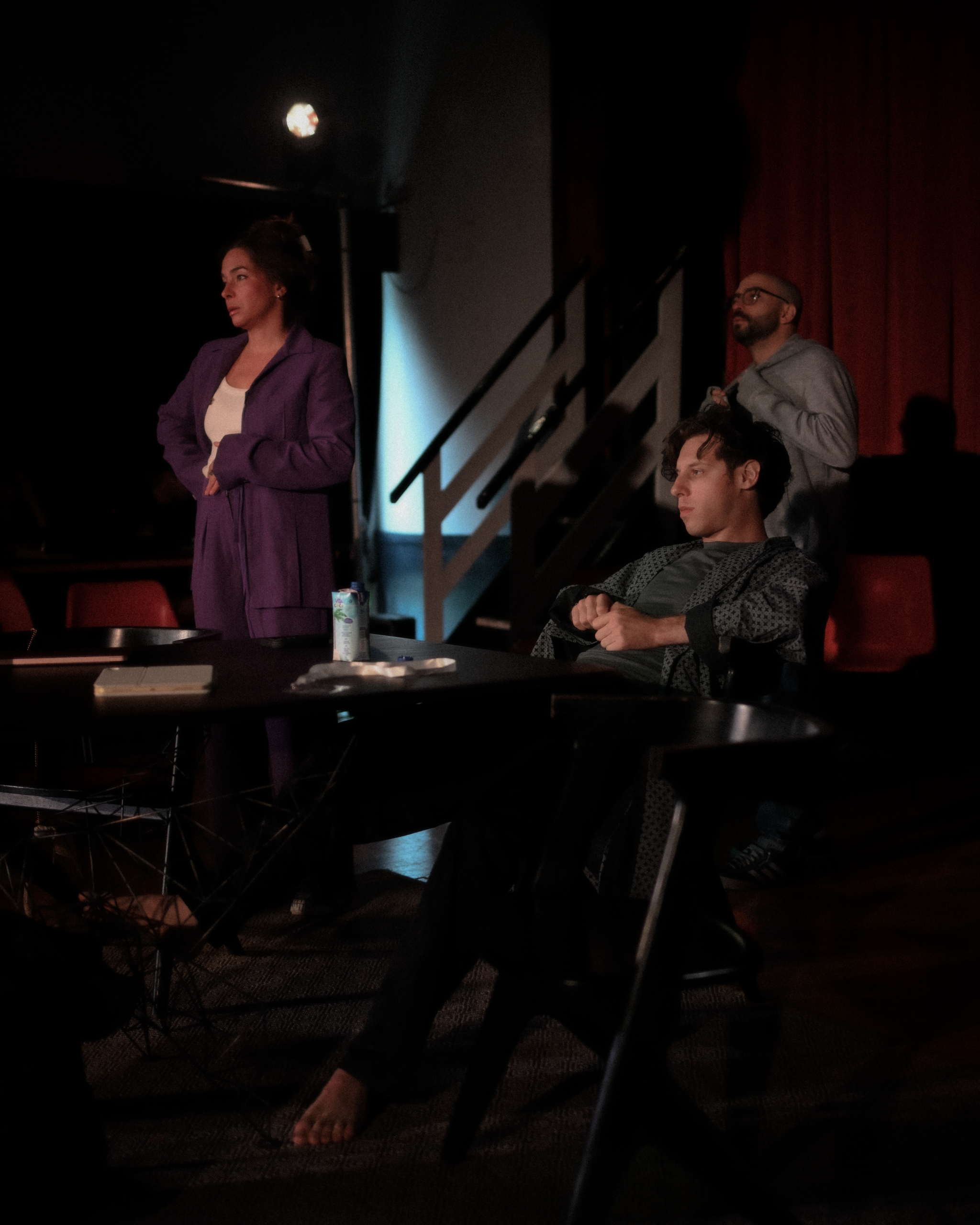
Doomers, London production
Asya: Speaking of that handful of people, if Sam Altman were to see the player, or do you know if he’s seen the play? What do you think his reaction would be?
Matthew: He knows about it, but he hasn’t seen it. It was like, “Lol, I can’t make it tonight,” or something. I don’t think he gives a shit. I don’t see why he would give a shit.
He has literally bigger things to worry about. I think the play doesn’t air any gossip or dirty laundry. And he actually comes off just as well as the other characters in the play, or better in some cases.
Zsuzsa: That’s so interesting. I don’t know if he would like Seth. I don’t know if he’d love the portrayal of Seth. I imagine he’d be flattered by the existence of the play. But Seth is kind of a bully.
Matthew: Yeah, I think he probably knows he’s a bully.
Zsuzsa: Sure. But then to see it on stage is another thing.
Asya: You spoke about the general idea and the general question you asked with the play.
Do you think that it resonated with people based on the things that you’ve received about the play? And do you think people started to understand a little more, and that the goal of asking why these people should even be in charge of this was achieved?
Matthew: I can’t really say what people got. I think at least it helped. I think the biggest contribution the play made to maybe general culture is just the right to write about it, the right to represent it, and the right to talk about it without being a tech person. I think that’s the play’s biggest contribution.
Saying we’re allowed to do this, a playwright can learn about this, actors can learn about this, and we can represent it. It doesn’t have to be done by experts in the tech industry. I think in a way it worked in democratising the ideas a little bit. That’s my hope, at least.
Asya: You said it’s been a year since it was released.
After going through this whole experience of writing the play and releasing the play, what are the things that you’ve learned? And what are some of the things that you’ve experienced through it? Maybe certain unexpected things that you didn’t know that writing and experiencing this play would bring you towards?
Matthew: I mean, just more people in the AI industry. It got me invited into rooms that I would never have been invited to. There are so few creative artists in Silicon Valley that it’s as unusual for me to be in that community as it is for that community to be coming to see a play in New York or in London.
I got, in some ways, a partial invitation to the tech community, at least a guest pass. I just heard a lot of people tell me that they’d never seen a play before. They don’t see plays. And that’s really funny and unusual.
So I think in a way, it showed me that there’s room. I mean, it changed my life in the sense that it showed me there’s room for tech plays from a tech perspective.
There are obviously a lot of tech plays, and there’s a lot of tech in culture, but they’re often written in a way that is distanced from the point of view of Silicon Valley itself. And I did try to get inside the minds of people who live and work there, or in tech colonies around the world, like New York or London, where there are growing tech industries.
I guess I saw that there’s room for further work in this vein. And that I think there should be more work in this vein, and more people should be trying to synthesise the two cultures, science and the humanities. Especially, I think, in theatre, where there’s a lot of immediate gain to be had from trying to represent these extremely important conversations.
Asya: Zsuzsa, what about you?
Zsuzsa: Kind of on Matthew’s point, I think the play kind of built bridges between the arts community and the tech community. And it was quite cool, I think, because in many ways, theatre feels like the antithesis of artificial intelligence.
It’s live, imperfect, very physical, and feels quite removed from any kind of technology. And maybe there’s hope for the theatre world, because of that, because it’s so human in that way. So, using the theatre as a way of discussing artificial intelligence, I found it to be very exciting and fitting. What was the other part of the question, if I answered that?
Asya: You did answer most of it, but what was your takeaway from that experience as an actor in one play and as a director in the other play?
Zsuzsa: I mean, I think I have become a full-blown doomer, a little bit. Which was probably my trajectory always, but it just sped up that process.
I think it was really inspiring for me to use theatre as a means to discuss very current, not problems, but rather events. As a vehicle for that. That’s something that I want to continue exploring.
I think it’s quite interesting because a lot of people look at theatre and think it’s quite inaccessible and expensive and just for the elites, and in many ways, theatre needs to adapt and become more accessible. But, at least, what this play did is democratise a lot of what is going on behind closed doors and what is going on in the tech world, the world of programmers and all those people. That was cool.
I think it offered a hand, saying, yeah, this isn’t so scary, and these are people, and they have their foibles, let’s talk about it. Just because you might not be techy, this is still a human debate.
Asya: Do you have any final messages for people who saw the play and it made them think about AI and appreciate its contribution? Any messages for the audience?
Matthew: Don’t normalise AI. I think that’s it. Don’t fall through a wormhole in time where suddenly using it is just like breathing. I think there are real consequences. It could have positive consequences, but it shouldn’t become part of our unconscious; it shouldn’t be taken for granted. We should continue to think critically about the way it’s changing everything.
Zsuzsu: Conscious AI usage.
Matthew: Preach.
Zsuzsa: And continue going to indie theatre because it’s fun, and there’s stuff going on.