Categories Film & TV, Life
Published July 4, 2026
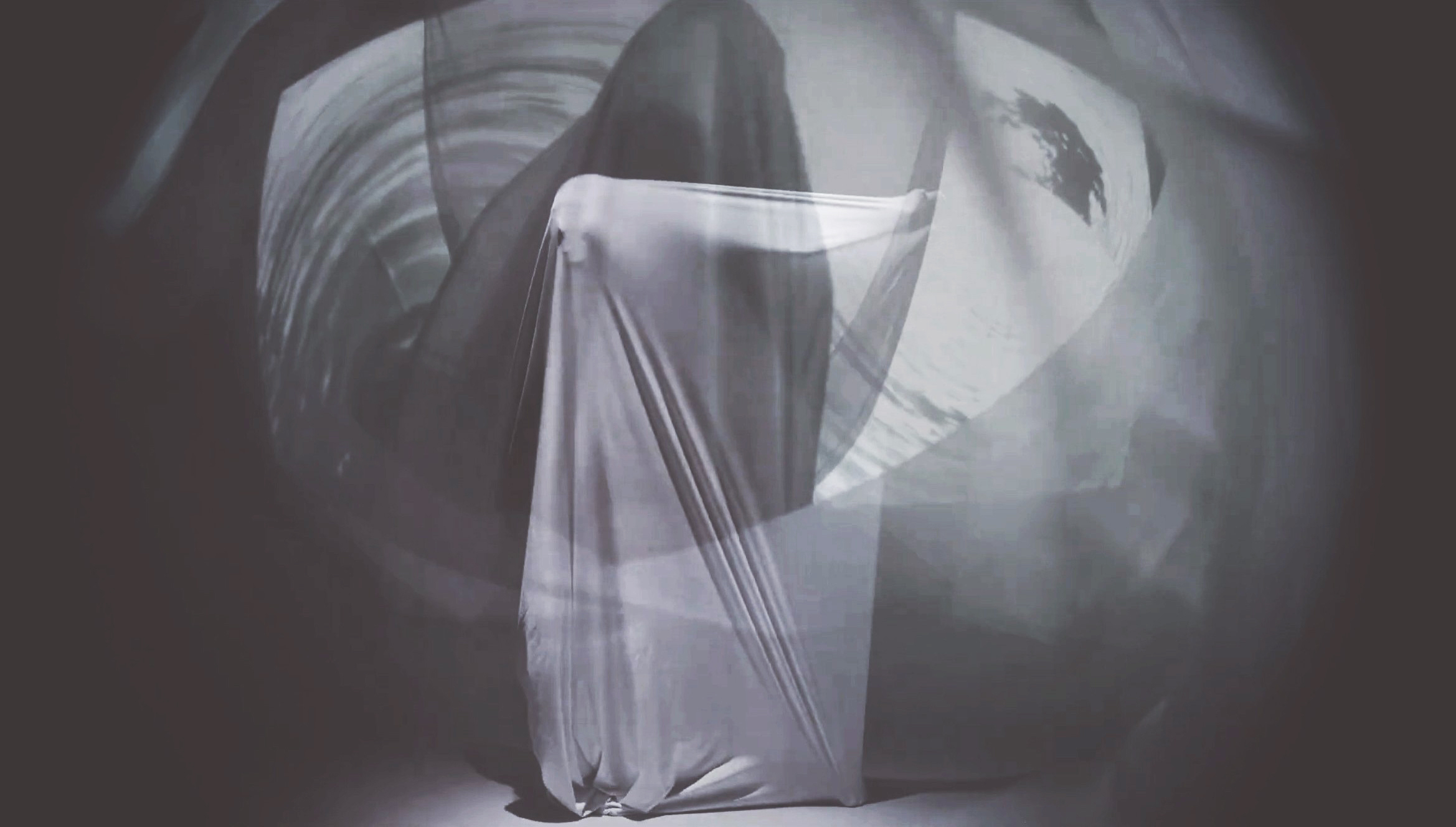
Still from "Desire, Engineered: Uncoded Bodies Beyond the Age of Machines", by Teodora Serbanescu
Story Flavour: lemon sorbet
Story Scent: the smell of fresh mountain air, untainted by human presence
Story Sound: any type of deep meditation music
We are overstimulated daily. Whether it’s creative projects, obscure visuals we catch ourselves lingering at, or moving pictures on our screens. Sometimes it takes a second to stand still, focus, and just take things in.
This time, it happened in a dark room of a small cinema. While the heat was raging outside, promising to burn anyone not able to seek immediate cover to a dehydrated crisp, I sat down, took a second to cool, of course, and found myself “In Other Minds”.
The air stood still as the films played, one by one, shedding occasional light on the faces of the observers, who, just like me, came ready to be surprised, informed, and even challenged.
The first film, “Co: Beliefs or Commonality of Beliefs”, took me away from the sensibility of everyday life and gently guided me towards memories of practical irrationality. Directed by Sami Malla and Junghyun “Zoey” Kim, the film explored superstitions as a shared sensory experience.
When time leaves the soul restless, logic often fails to provide a solution.
My thoughts turned inwards for a second, remembering the last time I gave power to my superstitious belief. It was just yesterday I knocked on wood to avoid a hex. I looked around me, seeing people in the audience space out for a second, looking back to their own moment of superstition. We all have them, but until then, I don’t think any of us really thought of the boundaries this language transcends.
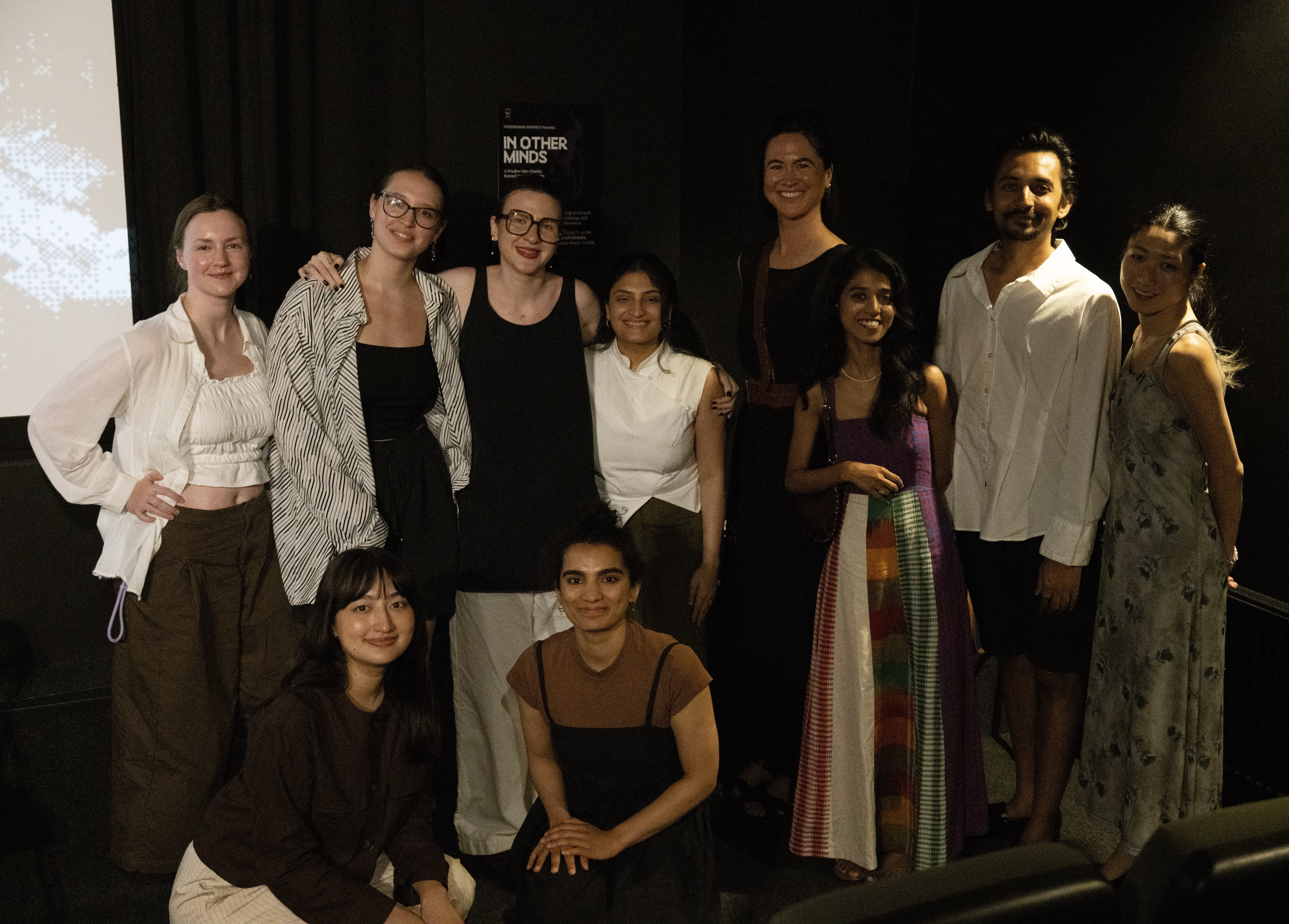
From left to right: Karolina Kanska, Daria Protsenko, Teodora Serbanescu, Anushka Khemka, Lynda Lorraine, Richa Shriwastava, Shawali Shayan, Yuko Arai and below: Sami Malla and Aarti Bhalekar, In Other Minds: A Window Into Cinema Beyond Human Knowing, photo by Adam Dorgham
These first five minutes, floating somewhere between cinema and lived experience, were the perfect introduction to “In Other Minds: A Window Into Cinema Beyond Human Knowing”. The event, put together by OTHERWHERE DISTRICT, a studio founded in 2026 by the event’s curator Teodora Serbanescu, mixed defining intentionality with complex, open-ended discussion.
Of course, each film left room for interpretation, as is the nature of visual art, but a categorised approach brought all the projects back to a common theme. The first film, for example, carried a subheading “A Window into Inherited Intelligence”, the knowledge we carry with us through generations of unspoken rules.
The second film, “How to Drape a Saree”, featured women discussing their experiences of getting dressed while maintaining their cultural identity. Created by Anushka Tendolkar, it continued the conversation of “Intelligence”, shifting it towards the “Material”. The experience itself is as informed by a physical act of dressing as it is by an act of observing the meaning the clothes carry across generations.
The thing about intelligence as a whole, though, is that even when placed in the context of material, it still remains slightly intangible.
The process of putting on a Saree might be physical, but as the film continues, we come to understand more and more how draping passes on knowledge and evokes pride. The sort of reclaiming of an age-old tradition in a contemporary environment, contextualised by stories of women spanning years, binds the material to the intellectual and the emotional.

"Desire, Engineered: Uncoded Bodies Beyond the Age of Machines" by Teodora Serbanescu, In Other Minds: A Window Into Cinema Beyond Human Knowing, photo by Adam Dorgham
Anushka Khemka’s and Aarti Bhalekar’s “Will We Disappear in the Cover of the Sky?” shifted the focus away from human experience altogether. We opened “A Window into Animal Intelligence”, and I suddenly realised: what will stay with me as much as the films themselves are the tonal shifts that prompted the mind to change perspectives while the sensation of previous conclusions still lingers. The vibe switches, the conversation remains, and the feelings, well, they stand both in line with the screening’s schedule and collapse on top of each other, making room for the mind to expand.
“Will We Disappear in the Cover of the Sky?” was visually incredible. Very different from the films that came before, it had no voice-over, only slow music and subtitles appeared on the screen as we watched familiar settings turn into constellations of light and energy. I later realised the film was narrated by a starling bird discussing its experience in a world changed by human presence.
Knowledge passed through the animal perspective. A thought immediately formed. What can we learn if we actually listen to the natural world around us, instead of just taking it as a given?
A step into “Landscape Intelligence” followed. “Our Gods are Angry” by Richa Shriwastava unfolded as a documentary exploring how the melting ice caps in the Himalayas affect the lives of people in the region.
Knowledge doesn’t just lead to informed experiences but to a level of concern.

From left to right: Sami Malla, Richa Shriwastava, Teodora Serbanescu, Aarti Bhalekar and Anushka Khemka, "The Future of Cinematic Language": moderated by Shahwali Shayan, In Other Minds: A Window Into Cinema Beyond Human Knowing, photo by Adam Dorgham
The Himalayan people recalled warm memories of snow, and a stillness took over the room. A reminder that even the most constant things in life, in nature, can disappear, taking the connections they helped build with them. The urgency of the subject matter, along with some incredible journalism throughout the film, created a world that transcended the images on the screen and consumed the viewers.
The last film completed the journey through other minds by bringing us closer to home, to ourselves, and to our own bodies. Teodora Serbanescu’s “Desire, Engineered: Uncoded Bodies Beyond the Age of Machines” gave way to “Kinaesthetic Intelligence”.
The absolute power of movement was at the heart of the film, exploring the knowledge our own bodies house. Movement, both automated and intentional, felt like a sensual mirror. The film carried an unspoken power; with each move, a cord was struck.
I appreciated the choice to end the screenings by exploring the place where the intelligence we collect is housed. Without a body to hold the mind, what is the mind? We inherit information, put it in action, pass it along, learn and interact. Our collective intelligence is supported by constant physical movement.
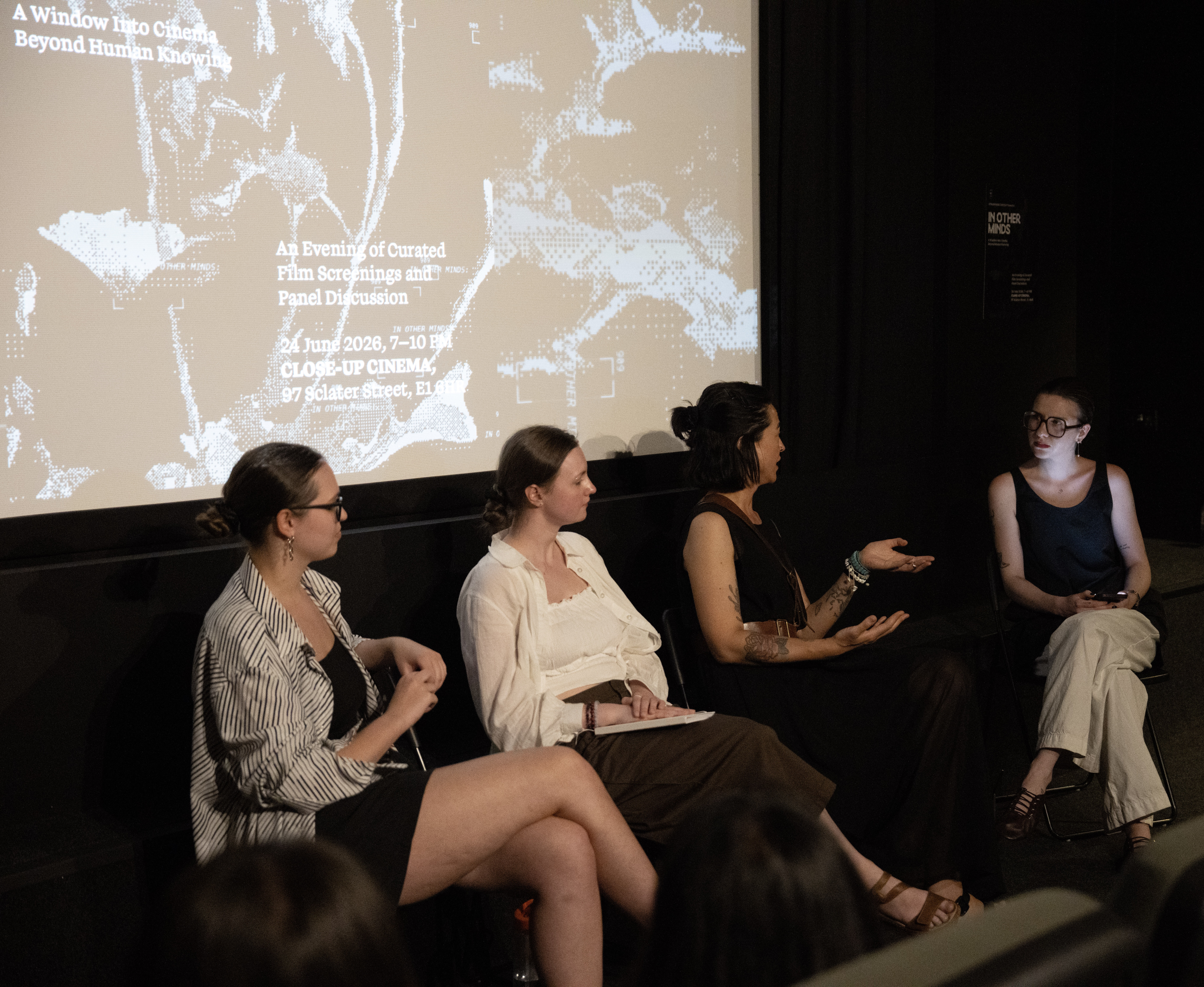
From left to right: Daria Protsenko, Karolina Kanksa, Lynda Lorraine and Teodora Serbanescu, “Collaborative Futures”: moderated by Teodora SerbanescuIn, In Other Minds: A Window Into Cinema Beyond Human Knowing, photo by Adam Dorgham
There was no single definition of what “Intelligence” demands. The curation introduced plurality. Each experience birthed a new way of sharing and consuming knowledge. And yet, they existed together in perfect harmony, complementing each other, while each telling an important story.
Two panel talks followed the screenings. The first, moderated by Shahwali Shayan, opened the floor for discussion of cinematic language. The central theme of intelligence took on different forms. It showed how versatile a single subject can be when introduced across multiple narratives, often vastly different.
That is what the screening and the following panel showed me: rather than hoarding knowledge and snobbishly raising our noses when it is presented in a format that differs from traditional sources, we can embrace plurality.
Another captivating thought raised by the panellists was the context in which an idea is almost forced to manifest itself in a visual projection.
What does it mean to translate an idea through film without sacrificing its origin to creative vision? The pressure an artist experiences when faced with transformation as the only solution for a continued discussion is a beautiful kind of urgency.

"Desire, Engineered: Uncoded Bodies Beyond the Age of Machines" by Teodora Serbanescu, In Other Minds: A Window Into Cinema Beyond Human Knowing, photo by Adam Dorgham
The conversation naturally transitioned into a look back at the audience. As concepts become projects, how do they continue to exist in the minds of others? What social benefits will they bring?
Moderated by Teodora Serbanescu herself, the second panel talk discussed “Collaborative Futures”, specifically in the context of creative practices as community builders.
Reflecting on the event, Teodora wrote: “Across both practices, a shared thread emerged: that knowledge is not produced in isolation, but formed collectively—through relationships between people, place, history, and practice.”
Sharing intelligence is the point. Buzzing in the air in the form of films, panels, new thoughts, lessons, and ideas that I am sure will birth more informed creativity, it lives on.
I walked back into the street, and as the sun’s light slowly poured on my face, my mind was filled with a new kind of knowledge. It stayed with me all the way home, and it stays with me now.
Special thanks to @teodora_serbanescu for the event’s curation.
For similar events, discussions and updates, check out @otherwheredistrict.