Category Art
Published August 14, 2026
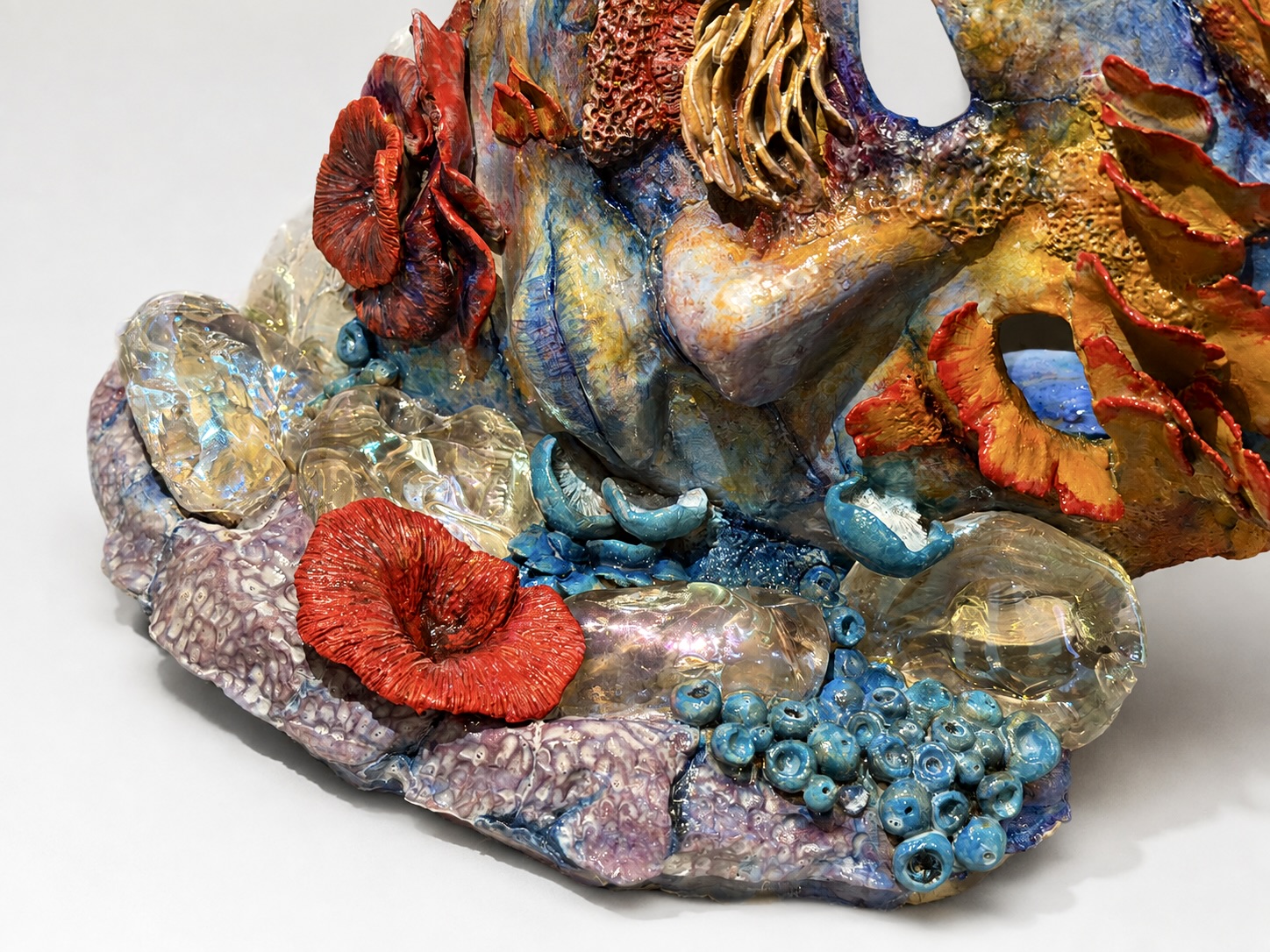
The Fertility of Ruin, by Theresia Helen Alamsyah
Story scent: Petrichor, Moist earth in the darker parts of the woods
Story taste: Sweet like the Forbidden fruit
Story sound: “Caribbean Blue” by Enya
London is home to art that has been with us since the beginning of time. Its royal palaces, gardens and galleries have taken a particular interest in sculptures, not for the way they look, but for the story they tell—of the kings who reigned, queens who made history and subjects who lived to see it all. But the contemporary galleries have a different story to tell. A story that offers a different narrative for different people. This is my narrative.
Right in the middle of the busiest parts of London, Espacio Gallery opens its doors to artists who had such a story. The many colours in their canvases emote many moods and their many interpretations. Some bring a smile, some make our eyes go wide and some simply keep us puzzled. This is one such. There’s a certain energy emanating from it. Is it the sunlight tracing its textures from the window in its vicinity? Or is it the burst of colours in its body that fades into something clear and iridescent?
We can only imagine; until we cross paths with the artist.
Theresia Helen Alamsyah, the multidisciplinary designer and sculptor behind the work, has left a piece of herself in this, quite literally. It is an autobiographical self-portrait, moulded from her very own face—the clay left to air-dry and crack (or rather, “allowed” to crack). She recalls working on her very first sculptural piece, where the clay accidentally cracked but “allowed” her to learn and work with its imperfections. The episode truly captured “The Fragility of Beauty”—its name.
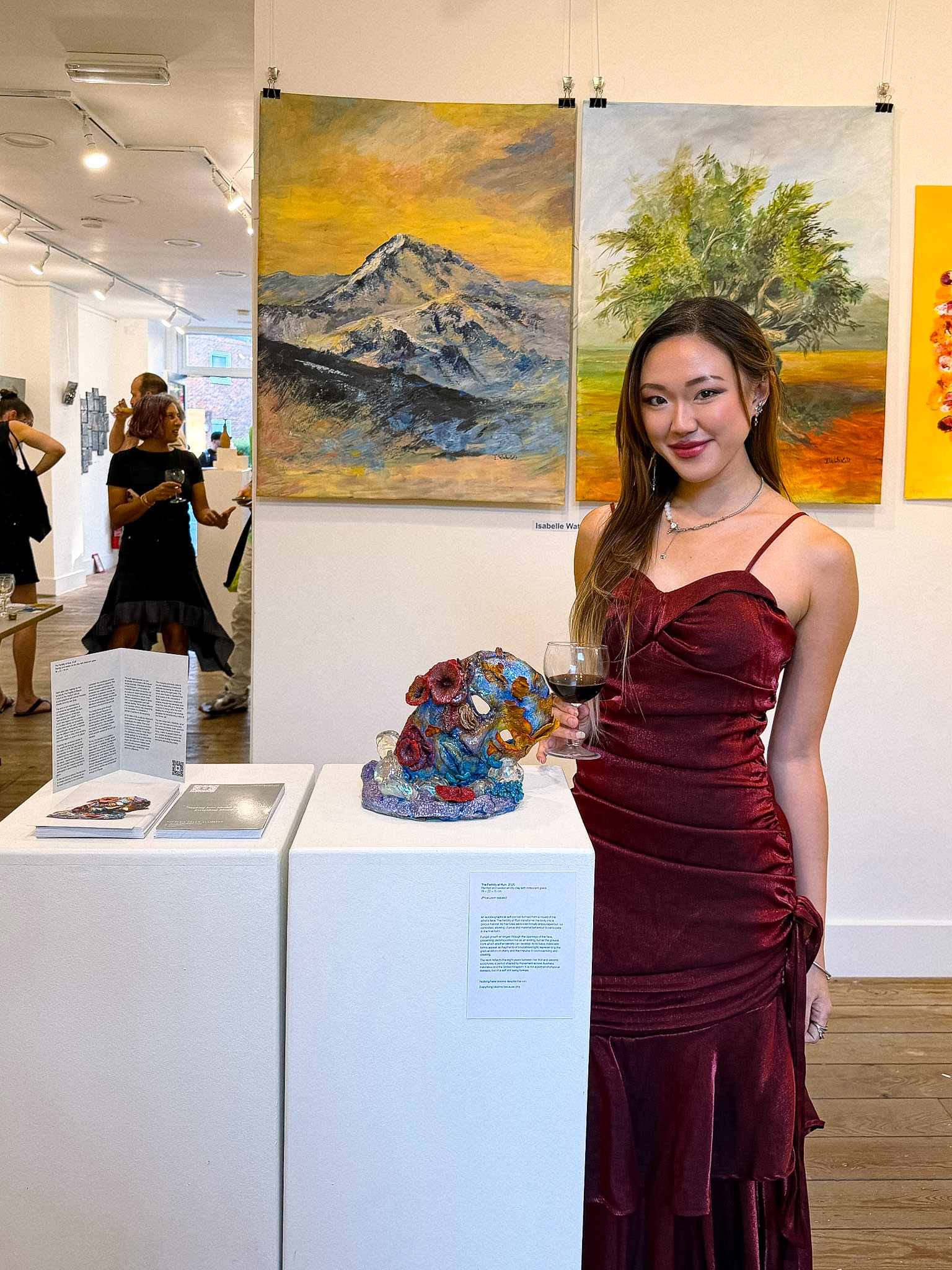
Theresia Helen Alamsyah next to her work "The Fertility of Ruin"
Finding the way back to the medium after 8 years, she has learned to let material behaviour decide the form. The cracks didn’t become the end of life of the material, but became a habitat for growth. Signs of a second life emerge as mycelial matters are seen mushrooming over the piece, in both texture and form. They find a way to thrive in this habitat to remind us that nothing is really left to ruin.
The artist calls it “The Fertility of Ruin”, but I see it as a reflection of everyday life—a promise that there’s always room for growth. It becomes more than a reflection of her own journey across continents, cultures, and experiences, relating to every onlooker in a place as diverse as London. Because we are all either ourselves or acquainted with someone who has travelled, explored and found a new life without letting go of the past. For we are all finding ways to grow over what was left to crack, crumble and ruin.
In a rather spiritual connotation, the artist mentions that the palette was inspired by her Chinese name 小月 (Xiǎoyuè) meaning the “little moon”. The unpredictable flow of the colours and the prismatic fragments sprawling at the base perhaps metaphorise the change we observe in the lunar cycles.
The deep character of her autobiographical portraiture reminds me of Frida Kahlo’s self-portraits, but the abstraction of her face says otherwise. She has chosen to let her identity be self-defined and susceptible to change. Those downturned eyes and the tilted face sinking into the fallen fragments of crystallised matter feel like they are looking right through us—our journey through change and growth—with wonder and speculation.
Should we snap out of it?
We couldn’t.
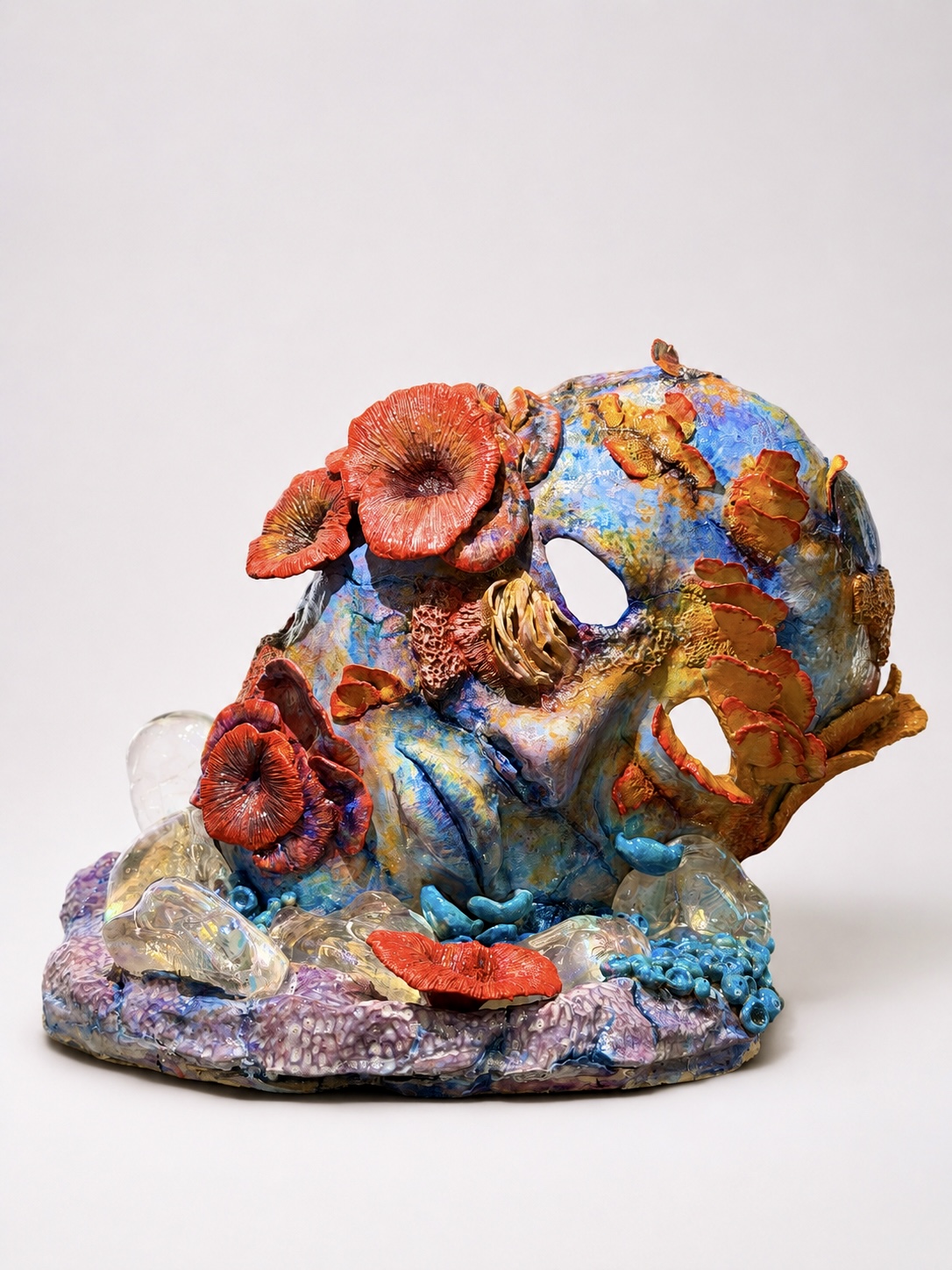
The Fertility of Ruin, by Theresia Helen Alamsyah
Because when we look at it a little longer, we can see the sculpture change its guise. As time passes and the sun moves about the room, the iridescent glass shines and scintillates, as if it were changing its colour. One moment, the brilliant blues stand out to us with their dominance, but at another, the oranges catch our eye with the way they change gradient with every texture—something coarse, something blooming and something completely untamed. And at yet another moment, the earthy yellow seems to ground the entire piece with its nonchalant spread across the deeper folds of the face sculpted here. Was it the structure of the face, or was it truly the cracks of the material that led the conscience of the artist to colour it this way?
Because I believe that consciously or sub-consciously, we are all have a certain way of doing things. The artist may have noticed the cracks first and the contours of face later; perhaps because the face is something she has been familiarised with, while the cracks, stemming from the behaviour of the material, is something new. Or it could have completely been the other way round. Her order of noticing things may have encouraged her to colour them a certain way.
But so does our order of noticing things. The way we perceive these colours is shaped by what, when and how we notice—our patterns. For me, all I could notice was that a part of the face was sinking while the other half was blossoming, branching out and freed into the air—peeling away its different layers. One part was giving in, while one was letting go. It looked like a perfect oxymoron—symbolising ruin and growth at the same time.
That was the kind of interpretation of rebirth that no books could elucidate. Art indeed has its way of making us understand the world around us.
I found mine with: Fragments of Presence, an exhibition organised by Capital Culture House
At: Espacio Gallery, London
From: 05-11 August 2026