Category Film & TV
Published October 31, 2026
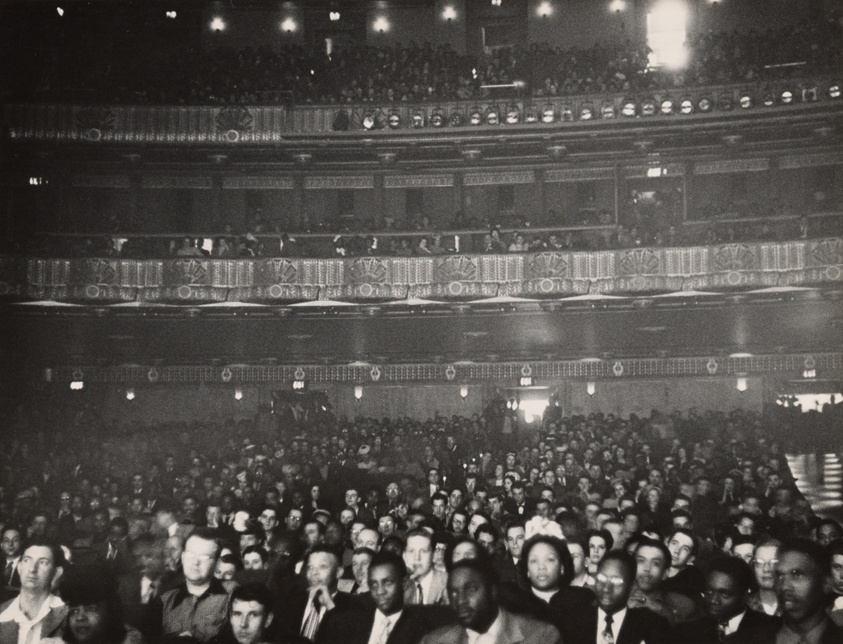
Audience in Theatre, by Gordon Coster
Story scent: old CRT screen smell
Story flavour: large movie theatre Coca-Cola (or your theatre drink choice)
Story sound: clapping at the very end of a movie
When asked about how much of today’s Argentina we can find in Family Fears Another Night of Terror, winner of Best Direction in the Noves Visions Section at the Sitges Film Festival, Lara Sade, Assistant Director of the film, answered: “Unfortunately, there is quite a lot of it, the influence of the media, along with evil, all mixed together, generating terror within families and at various levels.”
Argentina is currently facing a period of intense economic instability and political polarization, where media outlets and social platforms actively manufacture a baseline state of fear. But this is not new: from the state-controlled silence of the 1970s dictatorship and the trash-TV sensationalism of the 90s to today’s algorithmic dread, Argentine media has been engineering collective distrust for a long time now. “There is a present Argentina and a past Argentina; there is something cyclical about searching for resources and ideas to produce the film,” added Juan Protto (Executive Producer) and Ignacio Croce (Production Assistant).
These answers, by themselves, speak about the meta condition of the movie, self-referencing the connection between what we see on screen and how it reflects on the audience. Family Fears Another Night of Terror is an Argentinian movie from 2026 directed by Cristian Ponce, who also directed History of the Occult (2020), the highest-rated horror movie on Letterboxd in the year 2020. It tells the story of a family living in a house- a TV set that haunts and exposes its members as performers for us to stare at.
The house, as they say in the movie, “is not a house.” It has no walls, just a pitch-black background that the characters might not be aware of, but we, as an audience, can see. This scenography instantly reminded me of Lars von Trier’s Dogville and its portrayal of a village torn down to its simplest form, drawing the streets and rooms inside the houses with white tape over a black floor. And as also noted by some people at the post-screening Q&A at the Festival, it also reminded them of The Truman Show. The idea of deconstructing stages to their fundamental form is not new, but traces back to Bertolt Brecht’s epic theatre, who believed in the minimalism of these stages along with the distancing between fiction and audience.
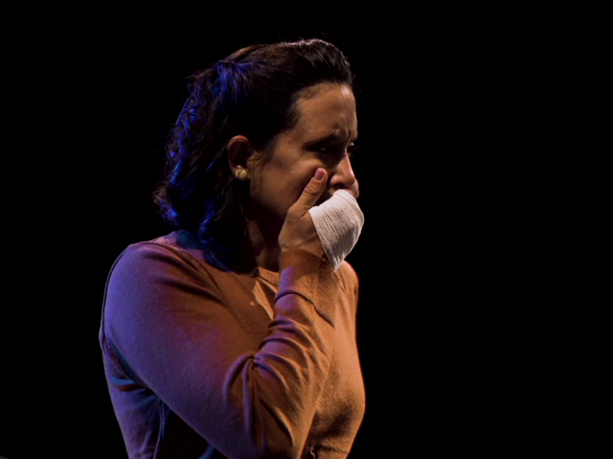
Family Fears Another Night of Terror
By constantly breaking the fourth wall and stripping away the illusion of a traditional realistic setting, they force viewers to step back from pure immersion, reminding them that they are not just watching a domestic tragedy, but actively participating in a calculated spectacle. If existence is merely a grotesque performance, who is hiding behind the camera?
To intensify the metafictional aspects of the movie, the director chooses to shape it as analogue horror, shot to resemble an old soap opera. Even the film’s trailer presents itself as a TV spot for Canal 6, carrying the disturbing motto “the channel that watches you”. This dynamic carries over directly into the film: some of the characters sometimes act as if they were in a melodrama, just to instantly break that impression with an unsettling image, movement, or sentence.
These decisions guide the audience through a very weird watching experience that won’t let them ignore that they are sitting in a theatre, but that at the same time becomes a world that’s surprisingly easy to accept. The moment the credits started rolling, we as an audience (I’m sure I was not the only one who felt this), felt as if we woke from a dream, one very realistic, that imitated life very closely, but a dream after all.
The characters looked directly into the camera? Fine. They discovered these cameras behind the mirrors of the house and started covering them? Fine. They were looking at us! Please, keep reminding me of the evil world we live in, of how the media chooses to frame our lives and shape and influence them. Life can truly become a horror movie.
These Truman Show-esque moments of the film are, for me, undoubtedly the scariest ones, maybe more than the ones depicting the satanic contact through metal music between the teenage son of the family and the Devil, or the ones with the very paranoid dad who thinks the neighbours have replaced him with a doppelgänger in this very messed up TV set.
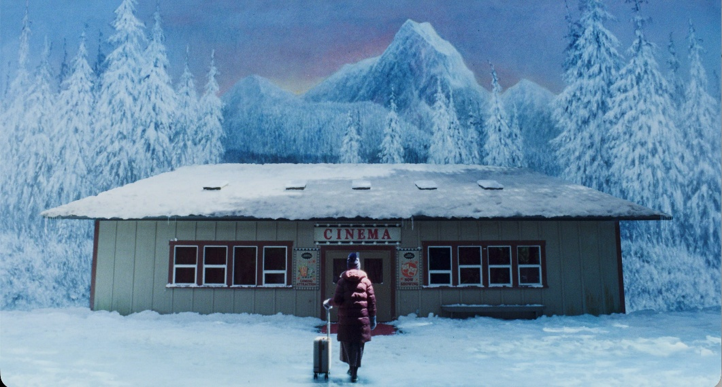
Teenage Sex and Death at Camp Miasma (Mubi)
And this idea of the fake set, although framed a bit differently, also appears in Teenage Sex and Death at Camp Miasma, where at some points the characters seem to be walking through painted backgrounds that reminded me of 1950s Hollywood movies. Jane Schoenbrun is very intentional with their choices, as this dreamlike depiction of a summer camp, set in the subconscious rather than a real place, evokes a collective idea of what our past, memories, and desires look like, wrapped in a cinematic glow resulting from all the media we have consumed.
I could have watched this movie at home before Sitges Film Festival, but after watching I Saw the TV Glow, I knew this second movie by Schoenbrun would be a really enjoyable experience in a movie theatre. And I was right. Sharing the experience of watching a movie with strangers is always cool, but it’s even cooler when the movie speaks about movies, playing tricks to remind you that you are watching a film with very clear intentions.
In this case, the meta elements are more subtle than in Family Fears Another Night of Terror, where the reminder of this reality-inside-reality is rather constant. In Teenage Sex and Death at Camp Miasma, Schoenbrun uses these elements as a reflection of how media builds us and shapes our understanding of the world, our dark sides, and our kinks.
For instance, instead of stopping at a deconstruction of horror clichés (like the hyper-sexualized teenagers, the see-through T-shirt of the final girl in her final moments, and the rigid stock characters of the sweet old slashers), the narrative pushes into more provocative territory. They turn the camera back on us, probing the blurred line between viewer and screen.
By linking the killer’s presence to the very act of spectatorship, Schoenbrun examines how decades of consuming violent, highly eroticized tropes have subtly conditioned our own psyche, transforming the dark thrills of the genre into part of our psychological DNA, and for us horror addicts, that really leaves questions waiting to be asked and answered.
In both cases, after Ponce’s and Schoenbrun’s movies, I was left orbiting the idea of an eye existing behind the camera (which obviously does, the director’s), but I was rather thinking of the eye behind the camera within the movie. It might be my (our) own. At this point, trying to untangle fiction from reality is a lost cause; the two have bled into each other so completely that the boundary no longer exists. So, who am I speaking to when, the same way they do in Family Fears Another Night of Terror, I say, “This is not a text”?
You are staring at a screen reading this right now, in the exact same posture I held in those dark theatres. The illusion of passive spectatorship has been broken; the media, the movies, and Canal 6 are no longer just content we consume, but the very eyes staring back at us.