Category Art
Published July 29, 2026
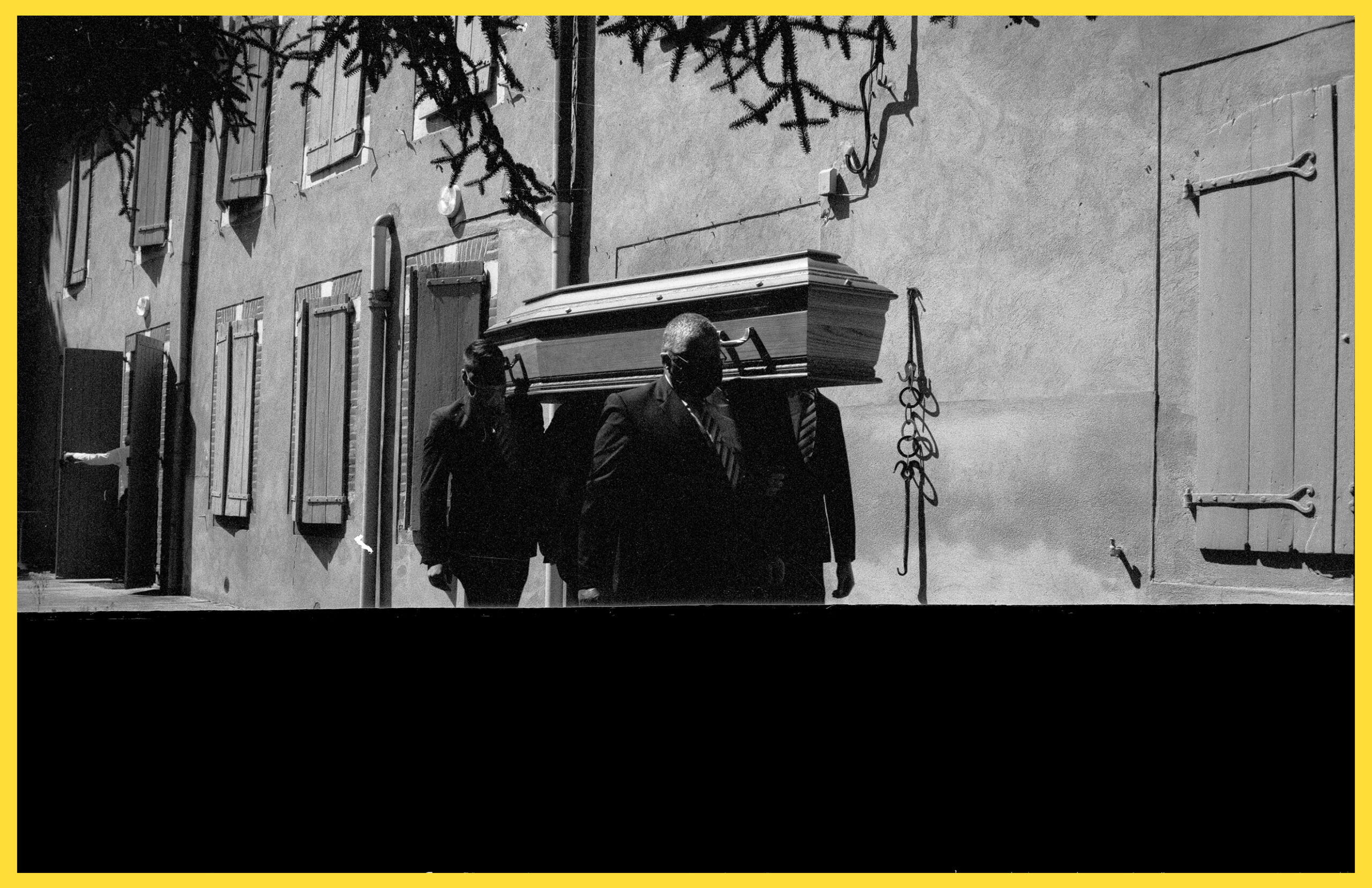
Des funérailles françaises, Photograph & Montage, 06.09.21, Tarn, France, by Arno Ivaldi
Story Flavour: Overripe fruit and Coca-Cola
Story Scent: The metallic smell of a carpeted airport corridor
Story Sound: “Last Night I Dreamt That Somebody Loved Me” by The Smiths
‘I forwarded you the final details of what we were looking for,’ narrates the visual artist, Arno Ivaldi, at the beginning of his work “fait accompli, you felt intimately stalked for I was looking for you, and so I…” His words—spoken in English and subtitled in French—caress a dark screen, which cuts mid-sentence to a photograph of a white window framed by red curtains. ‘It’s in an email, to which you never replied,’ he continues.
Outside the window, it is dark and splashed with rain. On a closer look, though, I notice it isn’t rain at all: the plants trembling outside have only created an impression of a storm rippling across the glass pane. This misdirection, this melancholic—and often playful—contortion of reality, is characteristic of Ivaldi’s work. His images are haunted by visions of intimacy, longing so sweet and seething it physically hurts, limerence with the self as much as with a past or present object of desire.
Arno Ivaldi works across photography, film, writing, and performance art to create the umbrella—or, as he might call it, suitcase—project A Pocket of Desire, the broader cycle of which the slideshow “fait accompli” is a part. ‘I think the buzzword is “visual artist” but just “artist” is enough for me,’ he says when I ask him how he defines his practice. After spending more time with his works, I’m inclined to say he is also a composer of sorts: more than his profound accomplishments as a photographer, Ivaldi knows how to put different mediums together and make them sing.
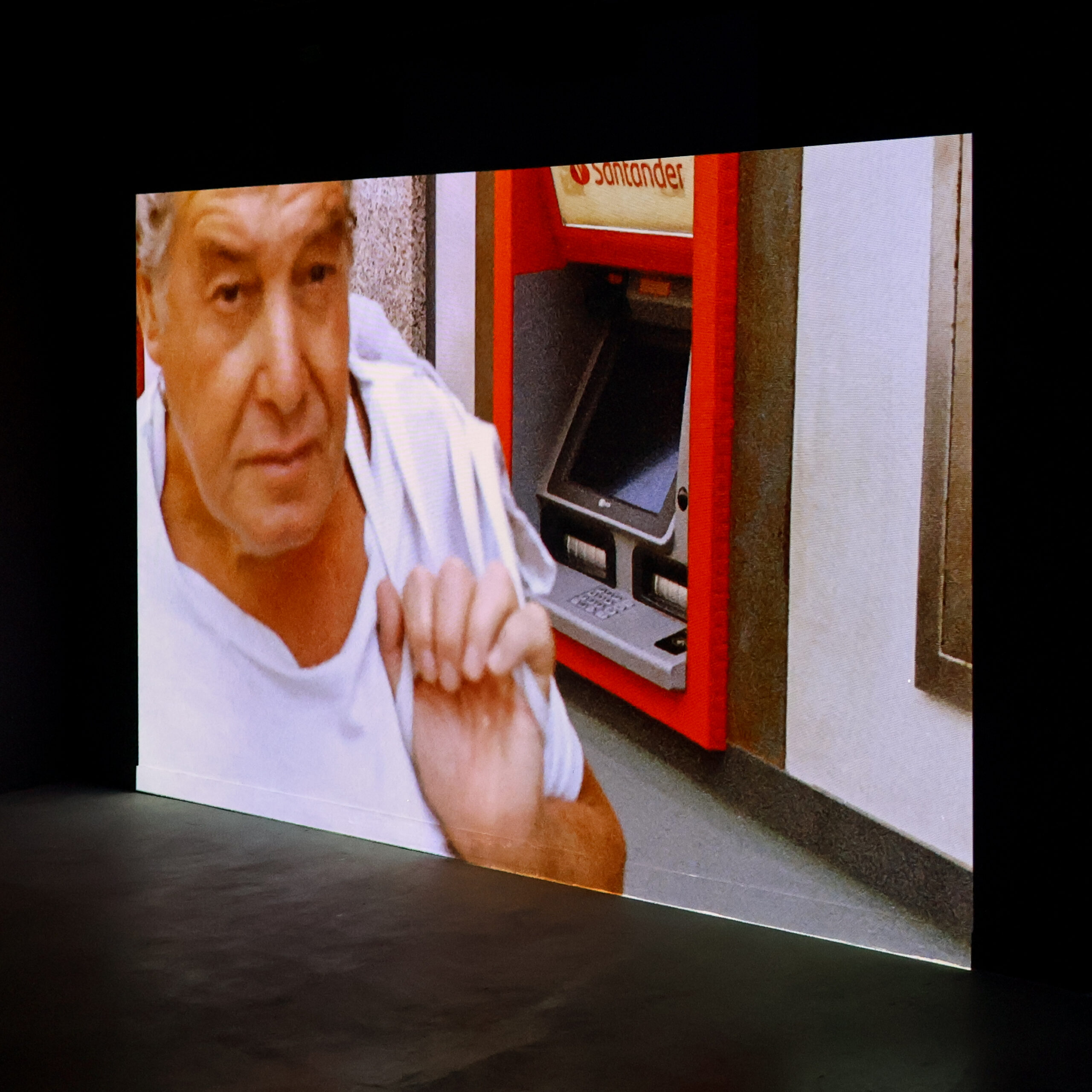
View n°1 of Immersive video installation from the group show Rêve Party, 360°projection mapping, with Détour Expo Paris, 2025
There is a haunting quality to his autofiction in “fait accompli”, with its rhythmic thrum of images and scenes that pair with and pace over one another. The music, specifically commissioned from the sound artist Ulises Souto, is aching, incantatory. At the beginning, it reminds me of a Park Chan-Wook film score, like something composed by Clint Mansell. Cinema is a wellspring for Ivaldi’s art: as much as he cites Nan Goldin’s slideshows, he returns frequently to Chris Marker’s docu-fictions and film essays as sources of inspiration. Currently, he is working on a text called After the Cinema, about the feeling of emerging from the velvety darkness of the movies. ‘When you push open those emergency exit doors and find yourself outside on the street after your brain has been in a fictional state for two hours,’ he says, ‘you have this very particular sensation inside your body, and that’s what I’m trying to describe.’
Throughout “fait accompli”, Ivaldi’s images move with the shifts in the music: they tremble, they judder; they strum; they roar. Street photography, in his hands, becomes less a genre than an instrument to excavate emotions, most of them the artist’s own. Near the beginning, a grainy seascape is collaged by a photograph of a woman in red walking her dog. Soon after there is a series of city people walking on cobblestones, sitting on park benches, eating solitary lunches, each image timed perfectly to Souto’s score. Each person’s visage is obscured, by the leaves of a plant, a billowing scarf, the light of the sun, and I wonder at first if Ivaldi is perhaps hesitant to photograph faces, until I watch on and see unapologetic shots of a man with a furrowed brow in a corner shop, holding a gloved hand up as if to say, stop filming me. There is a child being carried by her father, staring almost at the camera over his shoulder; in another, a young man in a suit helps his girlfriend fasten something to the back of her evening dress, and she looks straight into Ivaldi’s lens.
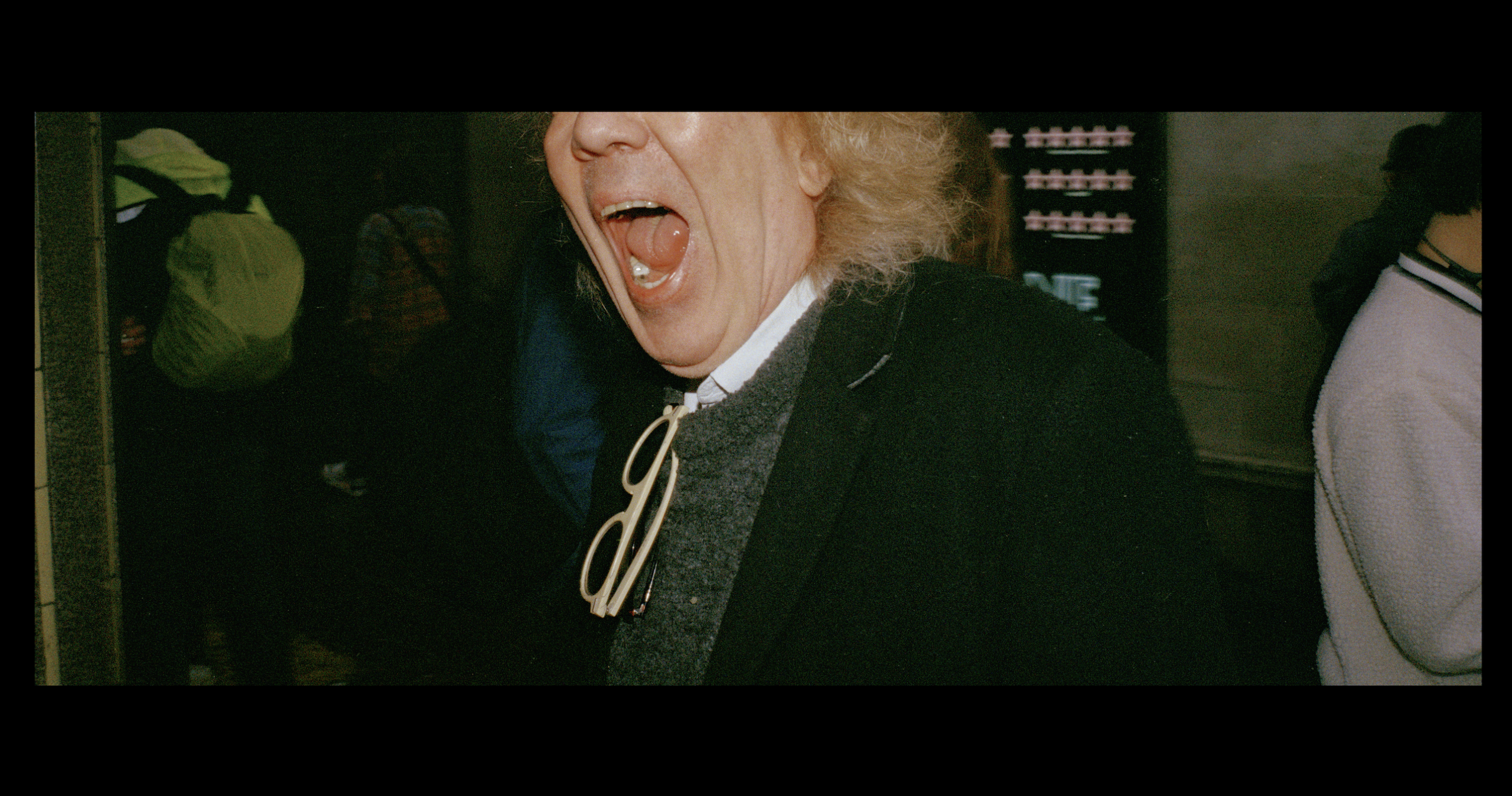
No scream, photograph & Montage, btw. the 29.10.23 & 31.10.23
When I ask him about the tension behind his gaze, he cites an oft-quoted maxim: it’s not street photography, it’s the photography of life. ‘I don’t really like the phrase,’ he admits, ‘but I do think that’s what I’m doing. It’s why I want to capture certain faces I might never see again, or maybe to understand myself through their expressions, to see what was going on for me at that time that made me notice.’
There is a conviction that anything sufficiently internalised belongs, ethically as much as legally, to whoever has carried it around enough to make it their own. ‘I think it comes down to my relationship with film photography, where, compared to digital, it’s a relationship with failure. You’re never sure you’ll get the shot perfectly. Even if you know your camera, your film stock, your settings perfectly, there’s always this risk of failing, of not getting it. You know exactly how to take the photo but you know maybe they moved a little too early, and you’ll miss that one expression, that little smile, that wrinkle you wanted.’
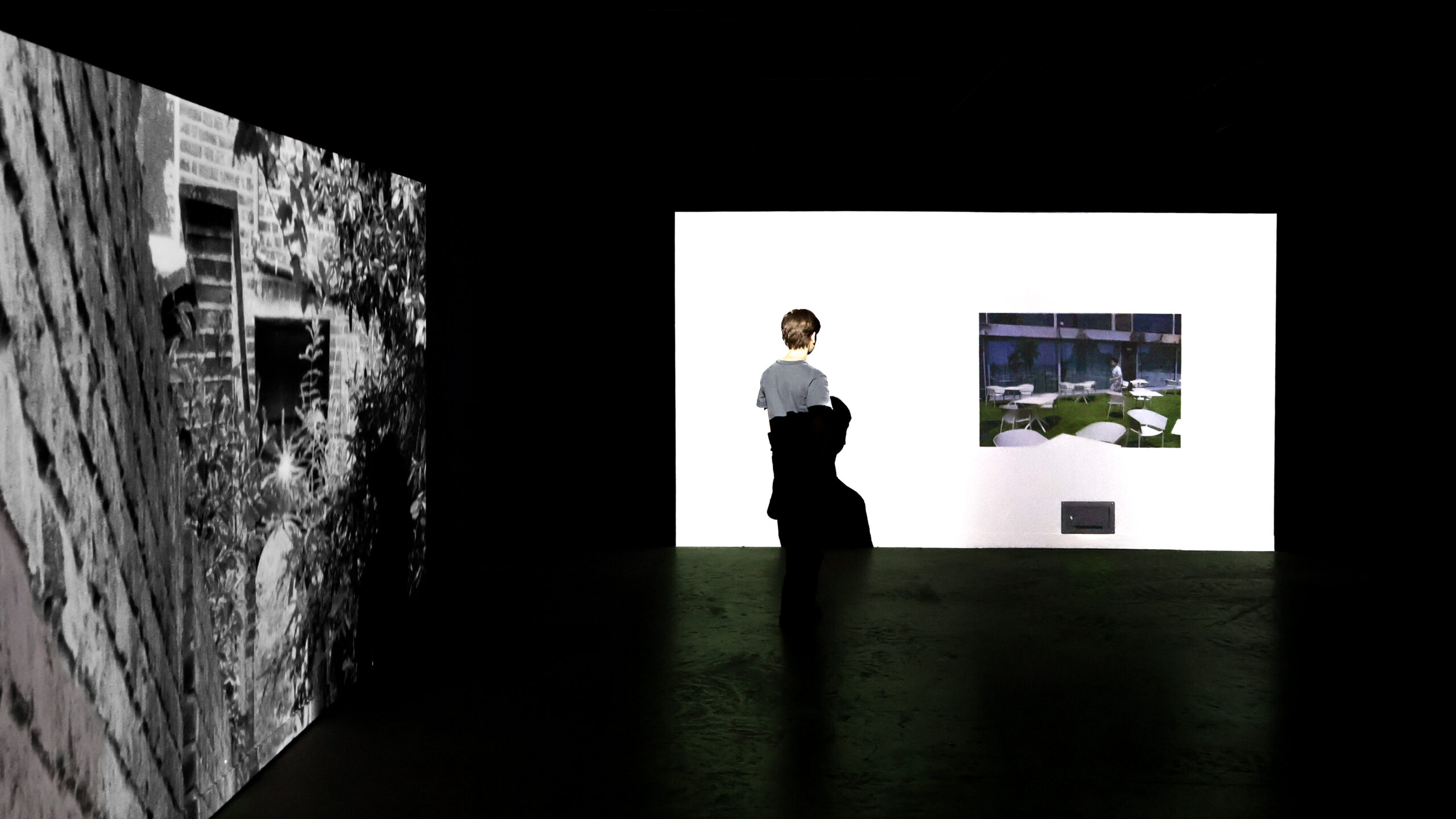
View n°3 of Immersive video installation from the group show Rêve Party, 360°projection mapping, with Détour Expo Paris, 2025
It for Ivaldi seems to be a humanistic search for the right question. What is this agonising compulsion to document, “fait accompli” seems to ask. Why do we keep track, note down, click the shutter, let it go, bathe the images, arrange them to music, play the film to a room of people, decide to talk or write about it all?
Perhaps the thing I am most compelled by in Ivaldi’s work is how he doesn’t attempt to wrangle these questions for answers. He enjoys the asking, permitting his audience to sit with the complexity of things that preclude closure. In its full title, “fait accompli, you felt intimately stalked for I was looking for you, and so I…” encapsulates the perambulatory, often unfinished nature of any dalliance, whether with another or with a previous version of one’s self. In French, a fait accompli refers to a done deal, ‘a thing accomplished and presumably irreversible’. Yet, in this ongoing, formally diverse work, one gets the sense that Ivaldi’s title is playing with the possibilities of language.
Throughout the slideshow, his poetic narration flits between French and English—a choice which might seem impromptu at first, were it not for the meticulous switch between subtitles, too. Always, he returns to memory and its tools. ‘In both French and English, when you talk about something you remember, you can never say exactly what happened. Your mind is not pitch-perfect; it’s not going to give you all the details. You always embellish, or avoid, certain things. Just like how what you get after translation is not the same.’ He smiles. ‘It’s just life as well, no? It’s fact and fiction.’
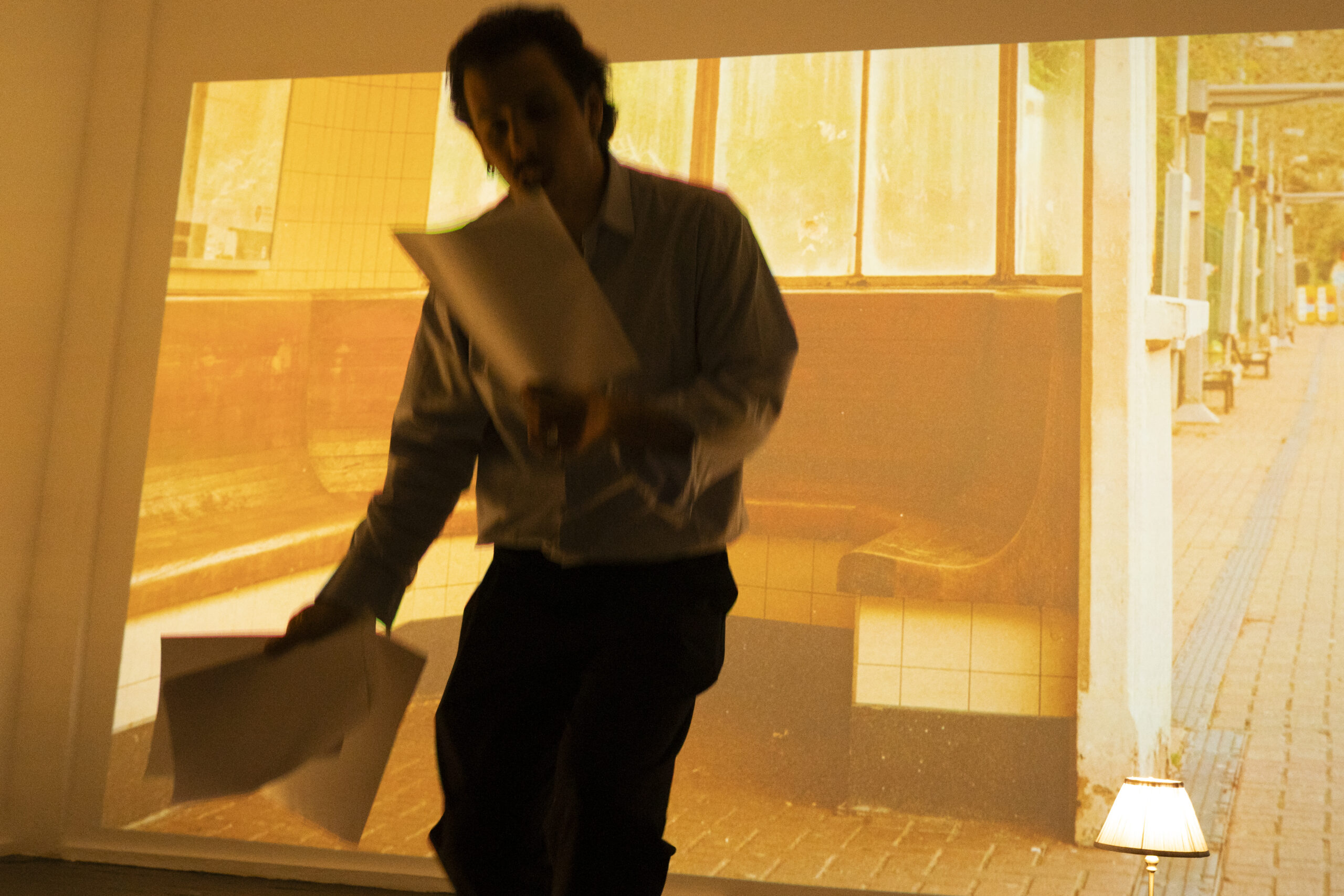
Documentation n°1 by Lila Rui Lan on a night of performance ‘Temporay Art’, Somers Gallery, 2025, London
As a body of work, A Pocket of Desire draws from his personal image archives and a penchant for recording unexpected intimacies, on receipts and in guest checks from his time working at restaurants. The project is comprised of its central slideshow; a fragmentary collection of creative writing, Bridge Door Gate Window, that invokes—both literally and emotionally—Gaston Bachelard’s The Psychoanalysis of Fire; a series of still images, Can You Tell Me How to Do It?, and a performance piece, A Confidential Report of What We Are Looking For. It speaks to how composition itself is an elusive art to master, and is, in brief, an ongoing document of Ivaldi’s interior world.
‘I found a kind of methodology of returning to places, or to experiences of my own life,’ he says, ‘repeating them through photography, and then layering them through writing, fragmenting one experience of life onto another.’ There is a sense in this aching project of each medium lapping over the other—if not explicitly, then in ways that still leave a mark. Can You Tell Me How to Do It? contains extended or abridged versions of texts first explored in Bridge Door Gate Window and vice versa; A Confidential Report of What We Are Looking For reprises the essayistic quality of “fait accompli” in dramatic real time, with in-the-moment variations. ‘If, suddenly, I switch to French in the performance, it’s because I feel uncomfortable, and know it is less likely my audience will understand me,’ Ivaldi confides. ‘And perhaps they receive it as something romantic, with all those ideas we have about the French language, when most of the time it’s actually things I want to hide from them.’
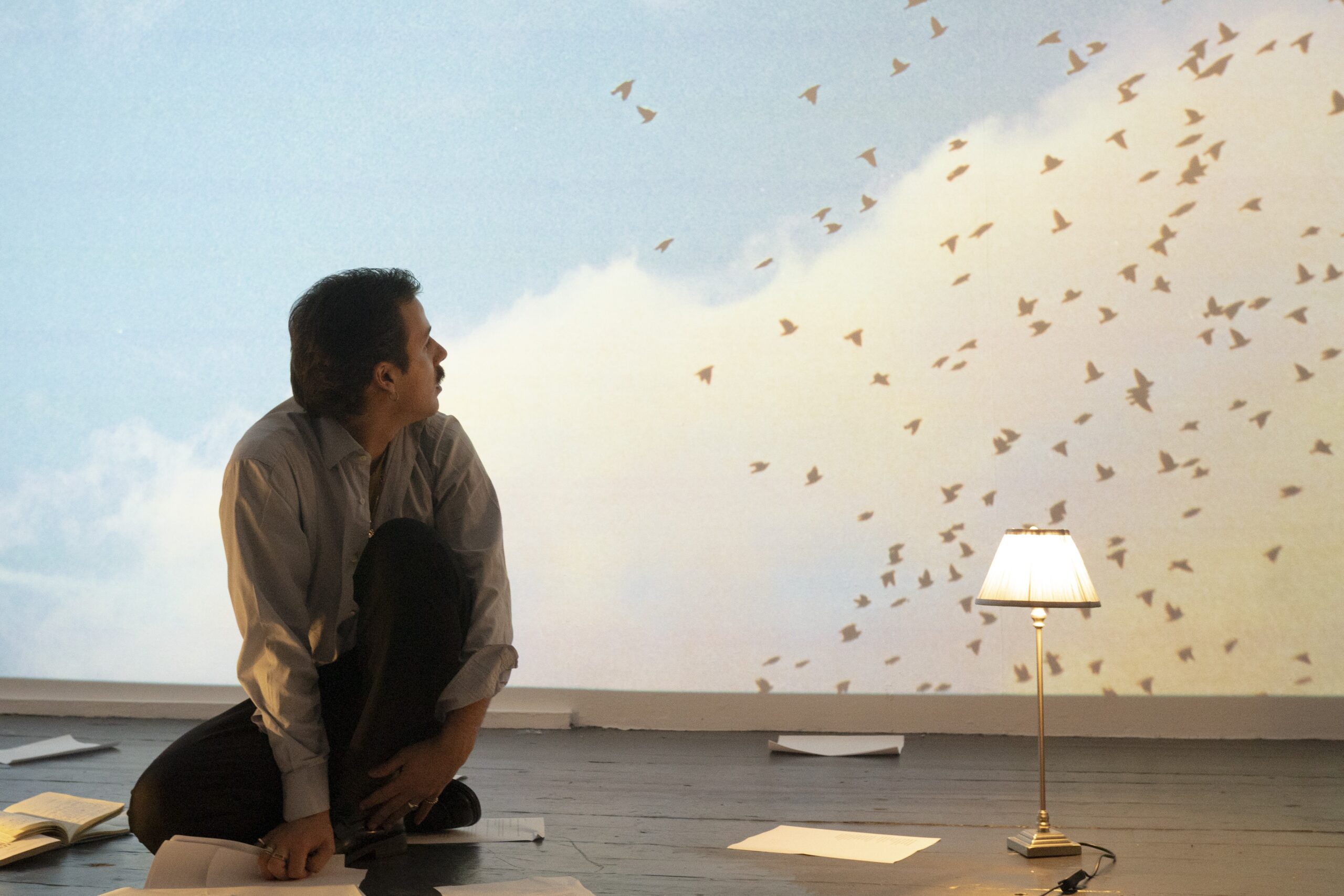
Documentation n°3 by Lila Rui Lan on a night of performance ‘Temporay Art’, Somers Gallery, 2025, London
Throughout A Pocket of Desire, he traces with luminous precision the relationships between the descent into self-knowledge and the acceptance of what cannot be known, between the pleasures of desire and the hollowness of finally eating one’s cake, between the losses of speaking in an other tongue and the way those mistranslations can offer opportunities for manipulation. I say he “traces” because if there’s one thing Ivaldi’s art is not, it is heavy-handed. In “fait accompli”, his images whisper across each slide, glimmering faintly in time before they disappear again, perhaps to reappear in a new way, to different music.
For Ivaldi, attaining your object of longing is not the same as keeping it. A Pocket of Desire dances on that tightrope with the sinewy grace of a seasoned lover: I want, I hesitate; I grasp, I catch; I have, I lose; I fail, I get to begin all over again, wipe the slideshow clean and poison the blank page with myself. ‘The truth is, I only need one thing,’ Ivaldi narrates in the first few seconds of “fait accompli”. Behind his words is a faraway city photographed against an otherwise blank screen. ‘But what is it?’