Category Art
Published August 1, 2026
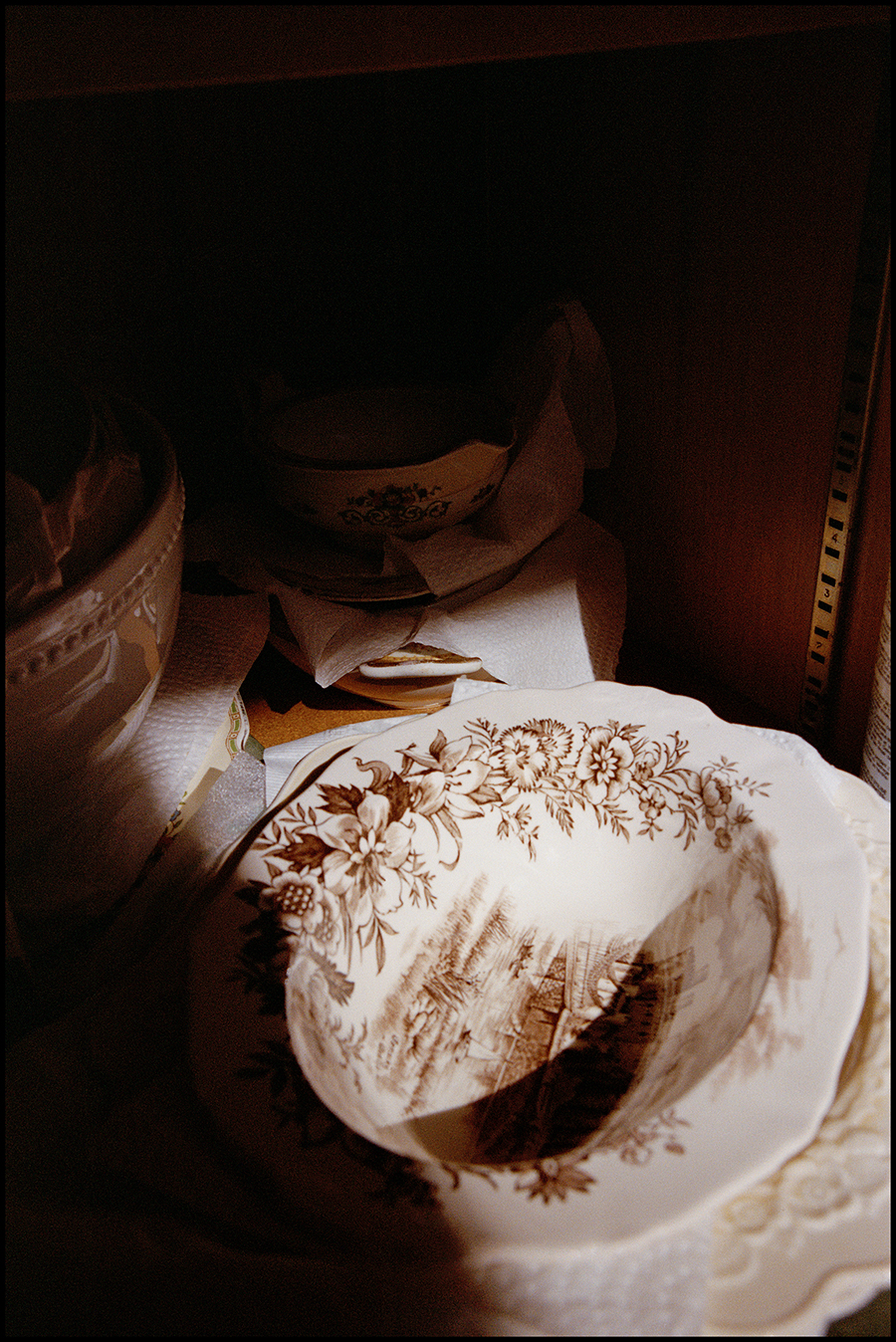
Plates, Who Drinks Your Tears, by Allison Gretchko
Story Flavour: Licks of summer honey, Tabasco in my beer, watered-down black coffee
Story Scent: Rosemary oil, bonfire smoke, morning dew
Story Sound: The wind blowing through the tree leaves in a dense forest
You can tell just by looking at her photographs that Allison Gretchko likes her work to build slowly, accruing new layers of meaning through the passage of time like geological artefacts, inviting us to be a part of it.
As you walk into her studio, ten self-portraits of a woman hang from a cylindrical centre of paper towels, the way a 120-format roll of film unspools from its canister or a tapestry unfurls from its loom. Each is a black-and-white photograph reprinted in orange and red tones on sheets of an indispensable but disposable household canvas.
The woman wears a dark sweater and light jeans, at times standing and at times sitting on a circular stool in the middle of the room, often seen clutching a long shutter release cable. She looks down in one image, straight at the camera in another; in yet another, her face is covered by her hair, and then blurred in motion. In the majority of the photographs, we do not get to see her face at all, the image beginning only from below her neck and hugging the trunk of her sporadically exposed torso. In the final image, the circular stool has disappeared from the frame entirely.
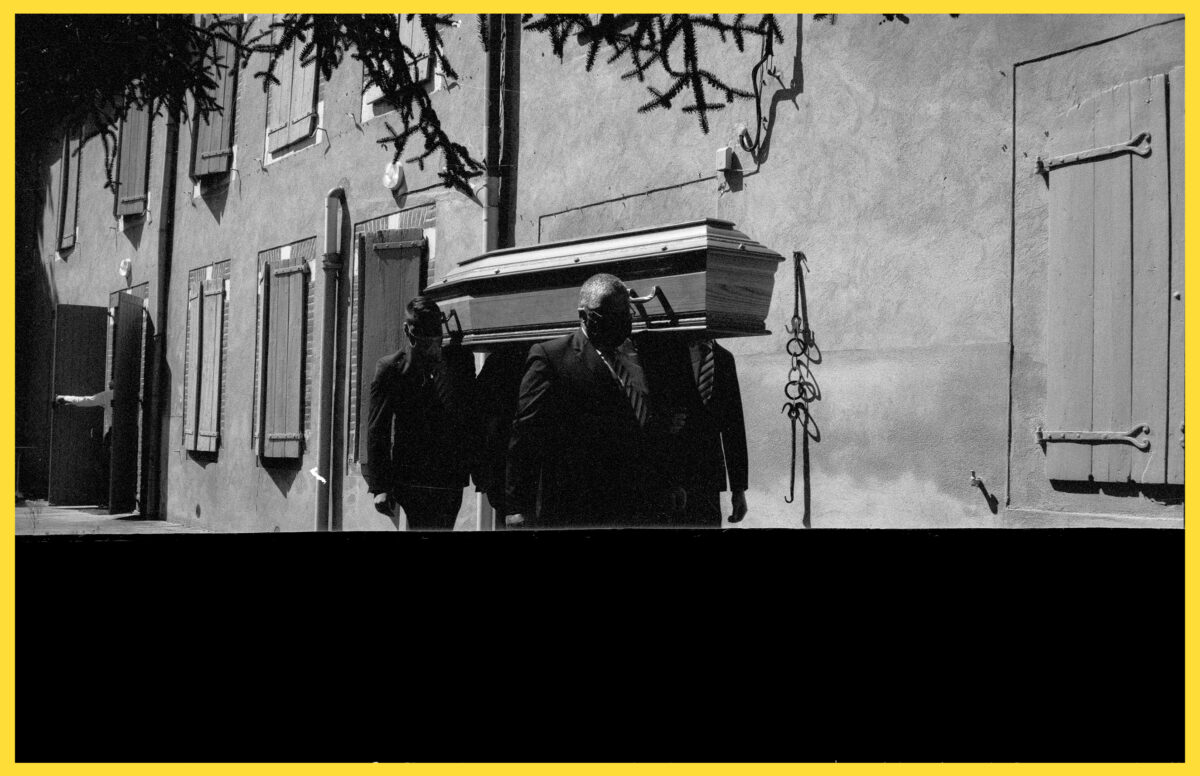
If a gallery-goer tugs the roll of paper towels down as if getting ready to rip one off for use, one new image appears at a time on each fresh sheet—a tactical experience of viewing the visceral movements of the woman’s body frame by frame, the way you’d look at a flipbook if you tore its pages loose and hung them end to end. The sheets are not trapped behind glass. They are not meticulously archived nor hung next to a pair of white gloves, but exposed to the perils of time, of weather, of visitors’ fingers tearing and scratching.
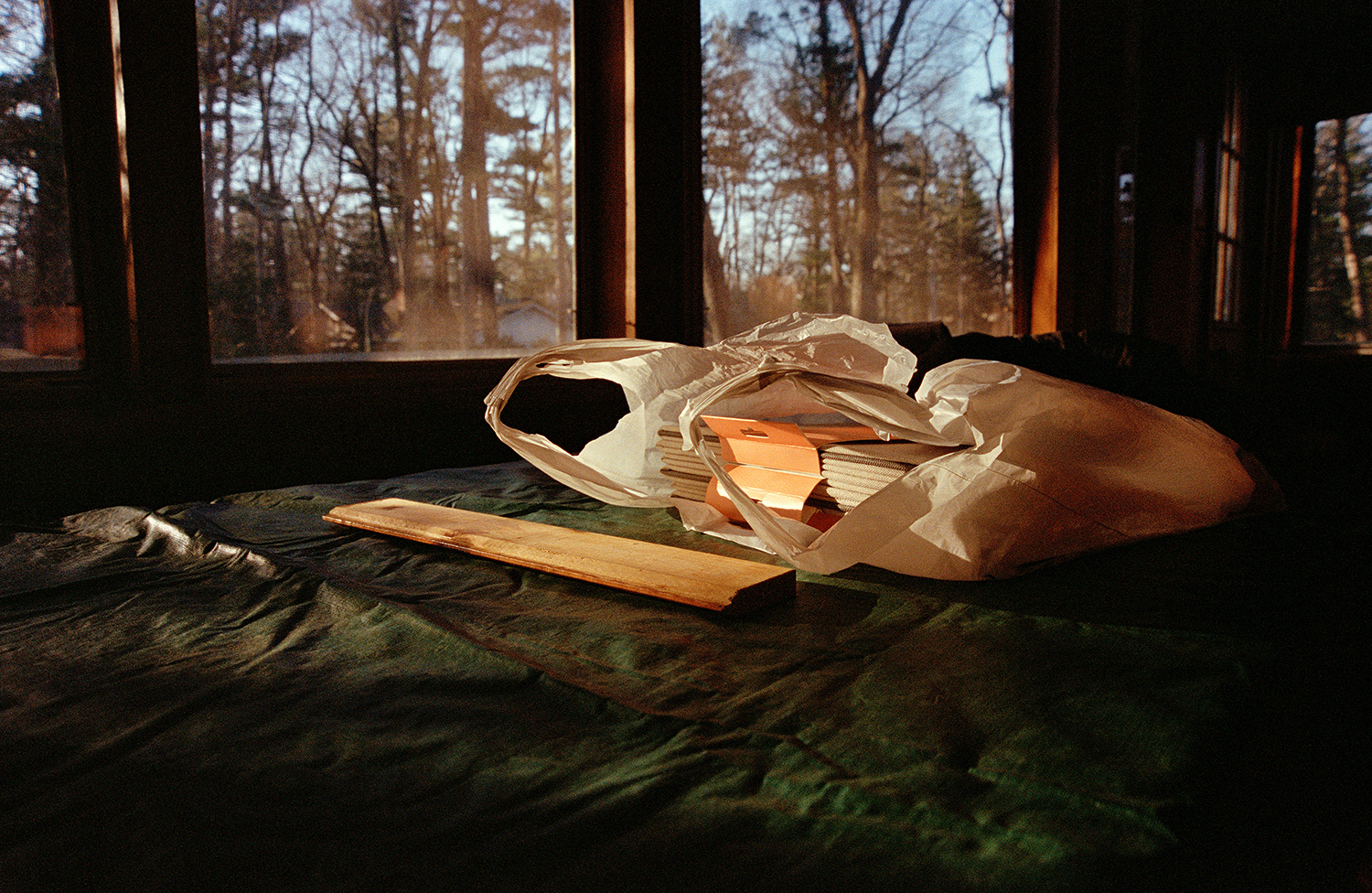
Bag, Who Drinks Your Tears, by Allison Gretchko
This is the fine art photographer Allison Gretchko’s most recent gesture, although “gesture” undersells what is, perhaps, closer to a wager. The work, which comprises one contact sheet of self-portraits, was made in 2023, in what she describes—without elaboration—as one of the worst periods of her life. It did not become public until the very end of 2025, once she’d gained a certain separation of time to look at it again. ‘That’s where art has its moments,’ she tells me. ‘It wasn’t until years later that I looked back and saw how the context of these images had changed, how I’d changed, and how the piece had a larger voice of its own.’
In the spirit of its exhibitions this year and public debut, Gretchko’s Self Portrait relishes its own ephemerality. By sanguinely accepting the inherent risk of wear and tear in the material variations of her prints—on bubble wrap and bath-mats as well as paper towels—she flirts with the notion of what is deliberately discarded and what deteriorates naturally over time, resisting preservation. Her only “permanent” artefact of this series exists in the single, physical black-and-white contact sheet, itself an unabashed reflection of the importance the artist gives to the urtext of her process. Like framing the napkin sketches that provided the blueprint to a masterful painting, or choosing to publish the bullet-pointed scrawls that were integral to a novel’s skeleton, Gretchko has profound respect for the archival material that others might disregard in today’s digital filing.
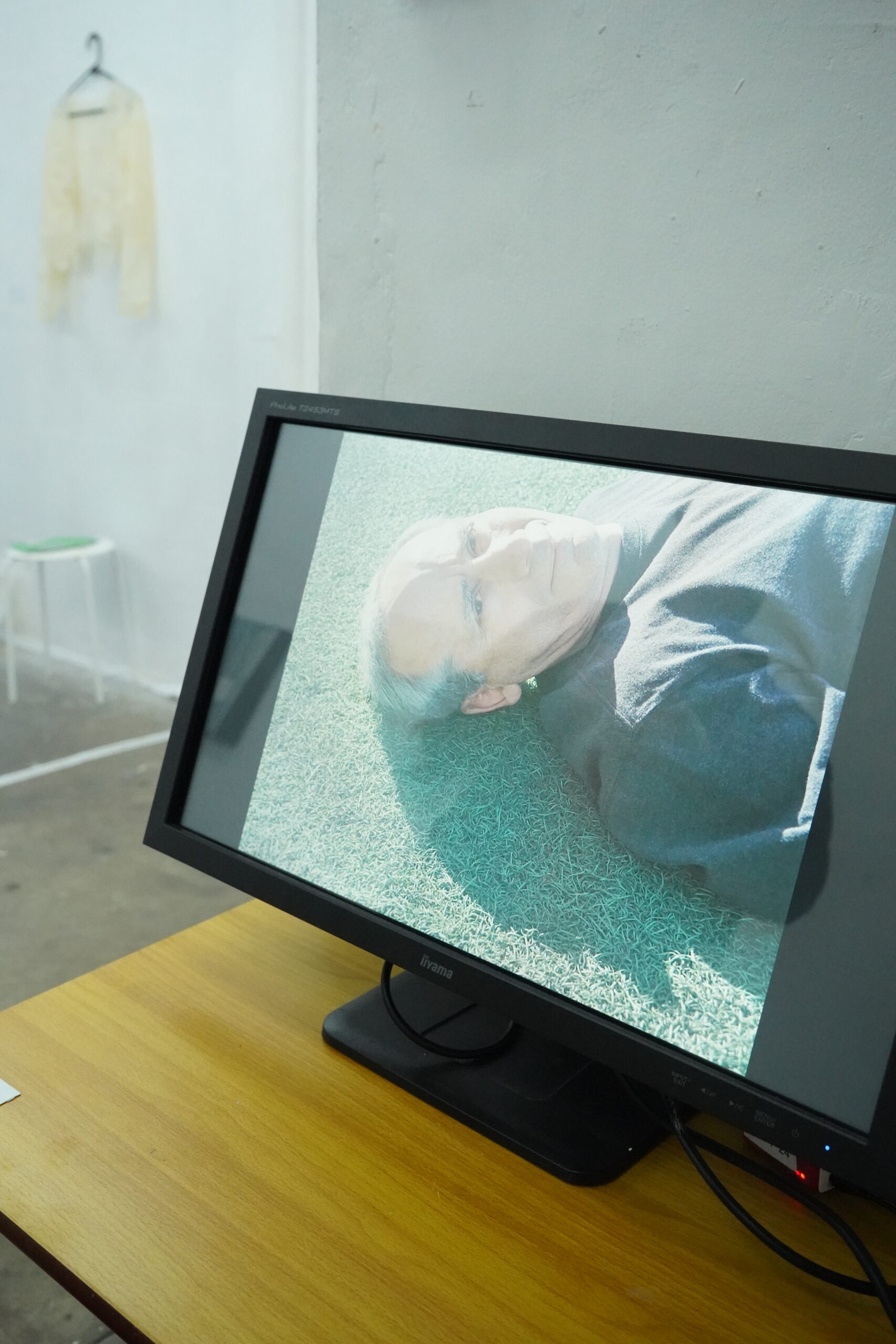
Am I Defined By The House I Was Born In, Filet Gallery, by Allison Gretchko
This explains why she prefers to work almost exclusively in analogue, mostly 35 millimetre and medium-format film developed, processed, printed, and eventually scanned too by her own hand—despite the time and physicality this requires. ‘For the first five years of my practice I worked strictly in black and white in the darkroom at my high school, and did everything by hand because that’s all I knew,’ she tells me. In her early training as a photographer, she didn’t use a digital camera, had no knowledge of Photoshop, and did not even scan her negatives. ‘Even back then, I was aware how uncommon that was as an introduction to photography these days. That kind of teaching isn’t accessible to most people now due to cost and facilities, so I’m very grateful for it. I used to work very traditionally, window-matting all my own images. That’s really what shaped my eye. It instilled in me the importance of photography as a craft, and the use of movement in the process as a type of methodology.’
After an early introduction to photography at age fifteen—when she began the ongoing project Am I Defined By The House I Grew Up In of documenting her parents—and later her job as a commercial photographer for the better part of a decade, Gretchko transitioned back to fine art photography some five years ago. She obtained an MA in Photography (2023) and MFA in Arts & Humanities (2024) from the Royal College of Art to reconnect to her personal creative vision, and has since gone on to exhibit regularly both within the UK and abroad. Her practice is governed by movement, from psychogeographic wandering with her camera to find sources of inspiration to handling her images in the darkroom. When you look at her images, you would never imagine that she spent years away from this type of making: her photography feels like second nature.
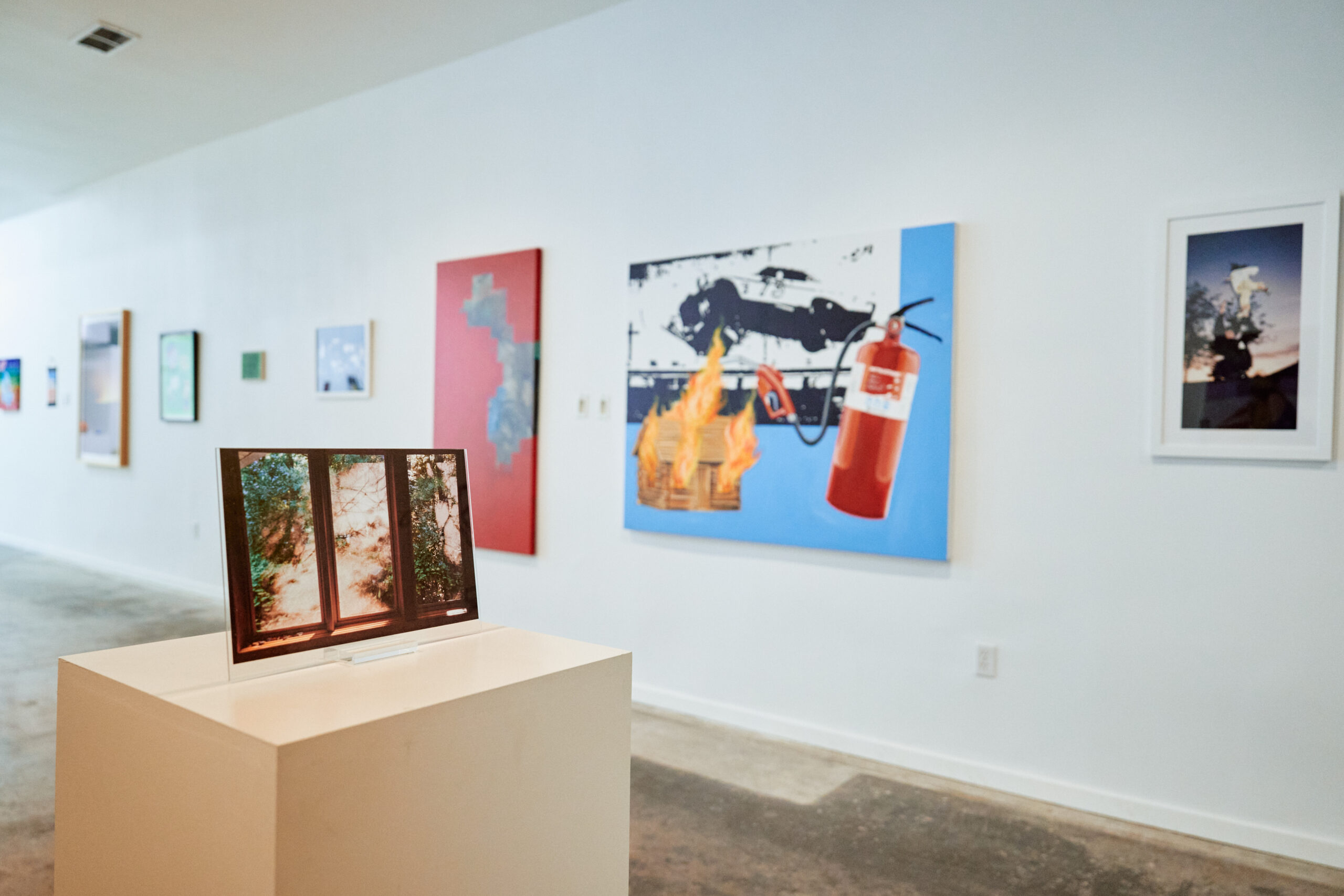
Screen, Who Drinks Your Tears, by Allison Gretchko
If there’s a single sentence that unlocks her work, it is this one, offered almost in passing: for Gretchko, light is ‘the embodiment of what wants to be seen, what wants to be excavated and brought to the surface.’ She does not construct her images, but looks for what the circumstances offer up: for the way hair naturally falls across a face or a sweater rides up the ribs depending on one’s posture; for the slouching curve of a wicker chair, as if still poised for an arm to rest upon it. Light in these images is a graceful instrument: it decides, moment to moment, what the world is willing to disclose.
Her most substantial photography series, Who Drinks Your Tears?, orbits a house: a generational family home in rural Ontario that she began photographing years before she had any reason to suspect it wouldn’t last. It has since been demolished, or is in the process of disappearing; she hasn’t been back to confirm which. There is something apt and characteristic of her work in that reluctance, in her desire not to prod too hard for a fact that hasn’t organically revealed itself.
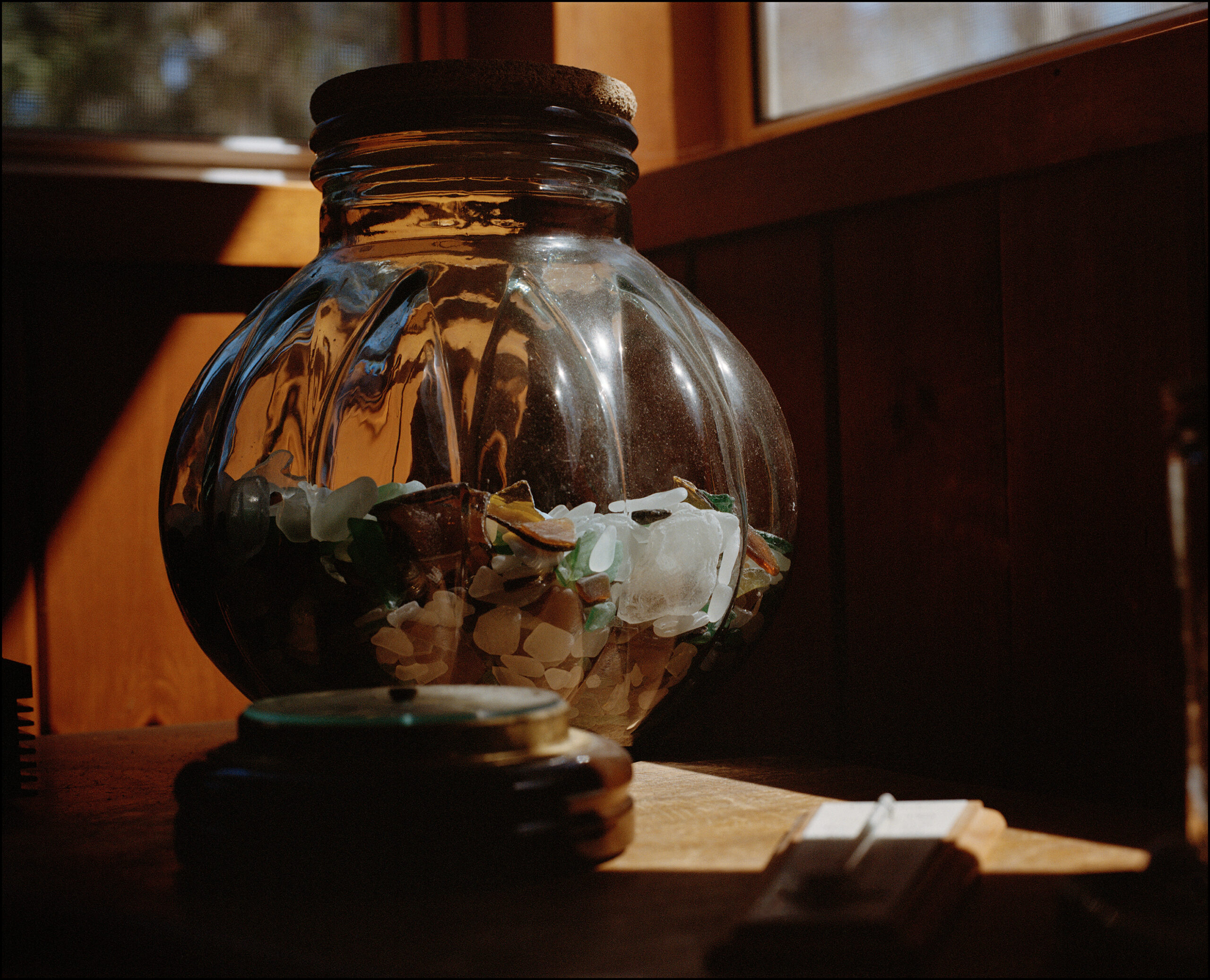
Seaglass, Who Drinks Your Tears, by Allison Gretchko
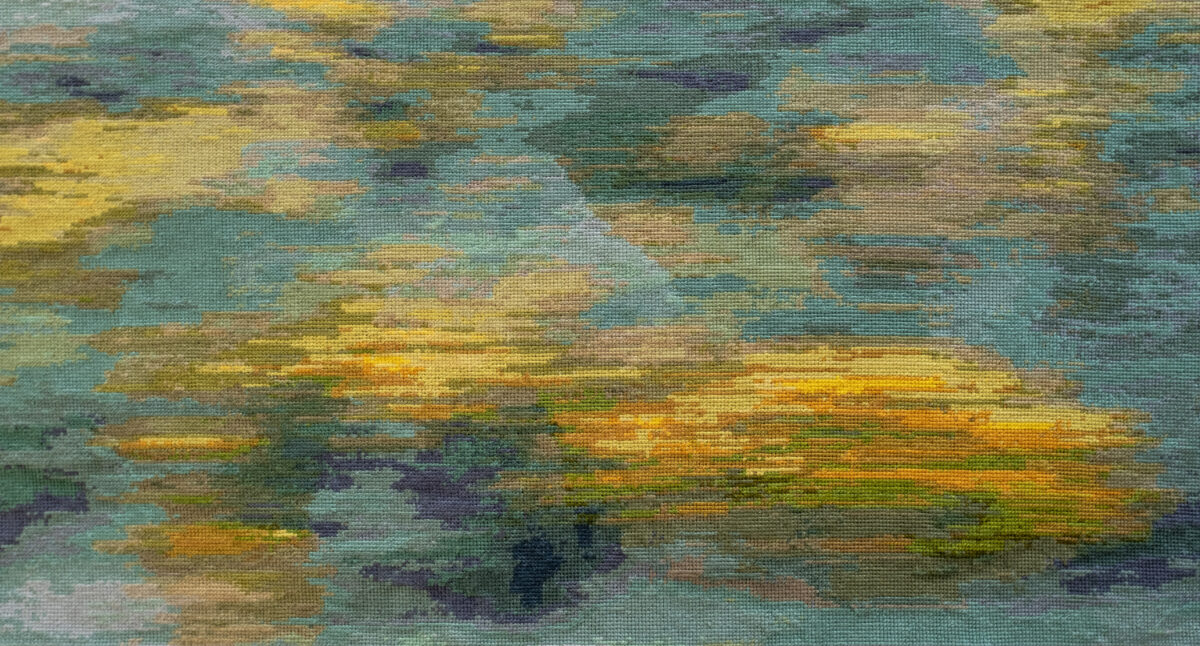
Unbeknownst to her, Who Drinks Your Tears? was always an archive. ‘The house, as it appears in these images, doesn’t exist anymore,’ she says, still adjusting to the tense. In one of her photographs from this series, a jar of sea glass sits on a sill in one frame, its shards worn smooth by the ravages of the natural world. Windows recur, again and again, captured in a way that makes the private world public: the viewer looks out through milky glass—whether it is an unwashed pane or a dawn mist, the artist lets us decide—and in doing so becomes complicit in a kind of trespass. There’s a voyeuristic quality to these photographs, as well as a pathos: as Gretchko’s audience glances out through her photograph’s window frame, somebody else’s private view is reflected back to us.
The “tears” here belong to a domestic economy of care and consumption, a phrase that could serve as an epigraph for her whole artistic project*.* Is a home, and the memories sedimented in its walls, a site of tenderness, or of alienation from the unknowable lives of its prior inhabitants? What do we inherit, physically or psychologically, from our kin—what do we give, and take back? And does looking into the past consume or console?
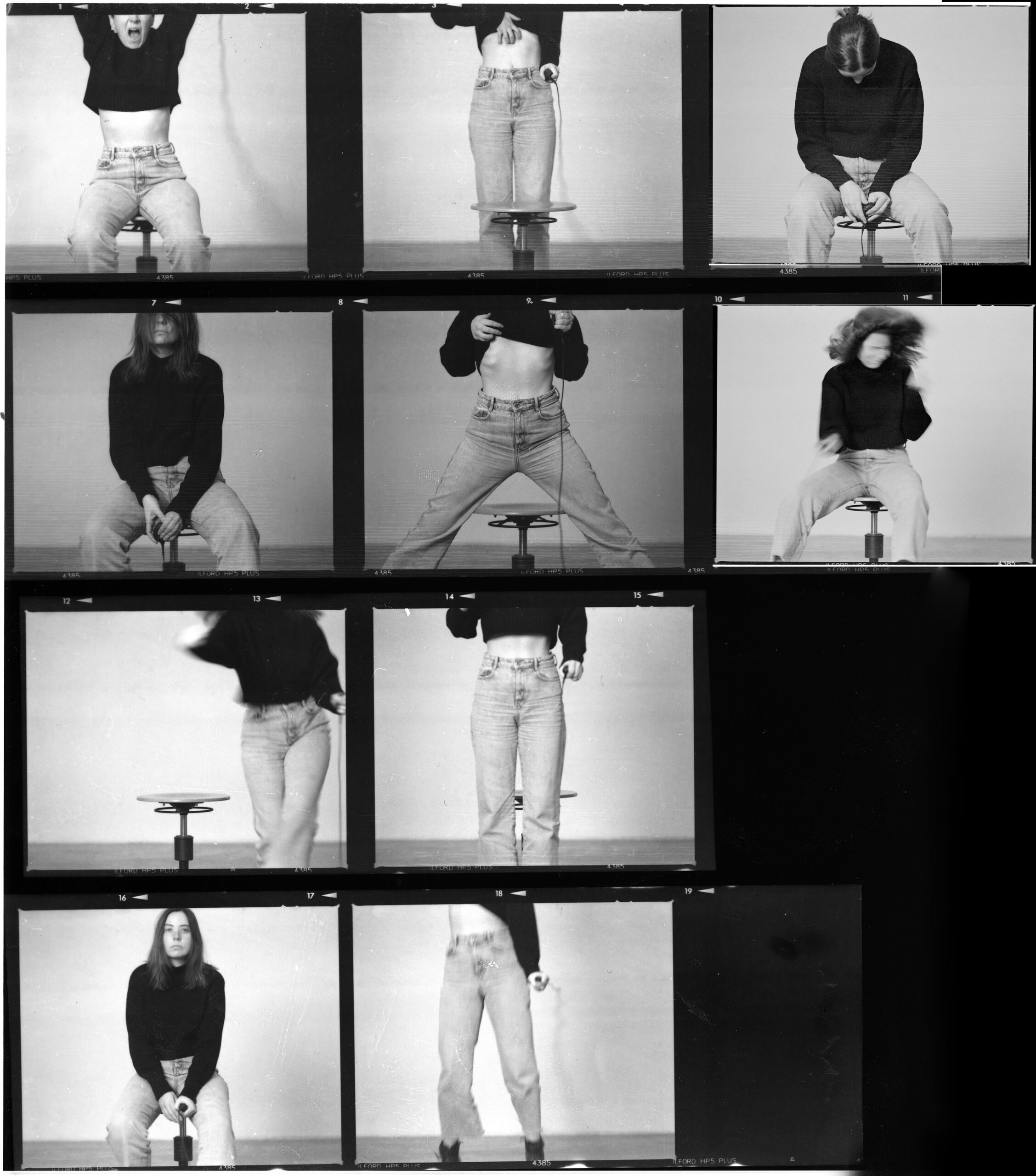
Self Portrait (Contact Sheet), by Allison Gretchko
Gretchko refuses to answer conclusively, and this open-endedness is her point. ‘It’s not about me colouring a place with my own domestic memories,’ she says of the accompanying—and as yet unpublished—fragments of verse she’s been writing alongside these images. ‘I want to create a world someone can insert their own past into, their own stories, their own make-believe.’
Across Gretchko’s personal and keenly domestic body of work, affect clings to sites and objects. Her collections Who Drinks Your Tears? and Am I Defined By The House I Grew Up In offer a condensed but ongoing slideshow that unlatches our complex relationships to memory. They break through the microcosm of her images to ask not just how the artist or the subjects of her photographic enquiries remember, but how her audience recollect and recall their own experiences. It is this fragility of understanding that keeps them returning.
A photograph, from Gretchko’s lens, is not so much a fixed record as a held breath, a cathartic interlude between descent and relief. Her oeuvre conveys a deep sense of patience, of the tenacity and resilience to let things take their time—whether it’s waiting for film to develop or for a heightened emotional state to settle; for a house to reveal its inhabitants’ secrets or withhold them to the grave. With almost menacing subtlety, even her most apparently serene images house a guttural roar of deep emotion, whether in the realm of care, consumption, or intimacy with oneself and with the backbreaking weight of one’s inheritance. They are worth the wait.