Category Art
Published November 19, 2026

Sound as Ephemeral Decay, by Sanchit Bembi
Story scent: faint smell of the custom vermouth scent still lingering on the exhibition pamphlet
Story flavour: Vermut Blanc
Story sound: “Call It Fate, Call It Karma” by The Strokes
They say art is in the eyes of the beholder, but that night under the roof of Copeland Gallery, art was also in the beholder’s hands, ears, and physical sensations. From the first step I took into the concrete open space, I knew this would be a very different kind of exhibition. Every work, down to the last panel and sound, is extremely technical and extremely immersive.
Sanchit Bembi’s new exhibition “Delusion” has a built-in duality that I found fascinating. On the one hand, the installations are a reflection of the artist’s deeply personal experience, yet the work constantly changes based on the person perceiving and interacting with it.
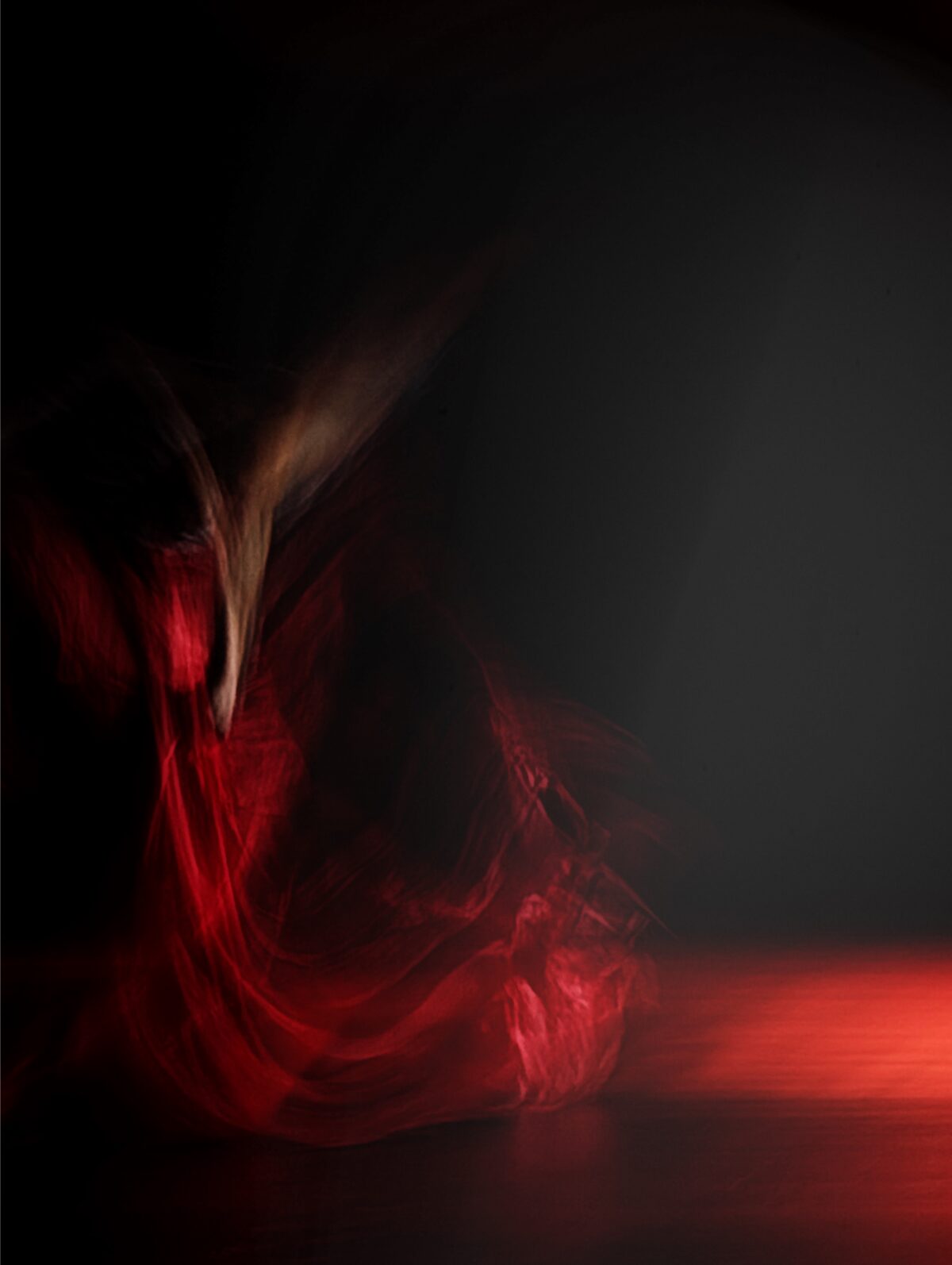
Against the backdrop of white walls, the colours broke through the emotional walls we often put up when faced with newness. Fitting for the artist’s experience with synaesthesia and visual snow syndrome, red dominated the exhibition, translating the shades that permeate his vision in loud and crowded spaces.
As I entered, a large text on the wall shared an introduction: different iterations of Bembi translating the physical sensations he experiences daily for the audience. A quote from an 1848 Edgar Allan Poe poem, “Eureka”, also graced the wall.
Were the succession of stars endless,
then the background of the sky would present us an uniform luminosity…
the distance of the invisible background so immense
that no ray from it has yet been able to reach us at all.
In the text, one sentence stood out to me: What is called a delusion is often only perception without a witness. On that warm Thursday evening, the artist was calling upon us as witnesses to his delusion, coincidentally making it a reality and pushing us into our own version of “delusion”, building up the relationship we will come to have with his work, based on singular experiences of perception that will forever be only accurately replicated by our own memories of them.
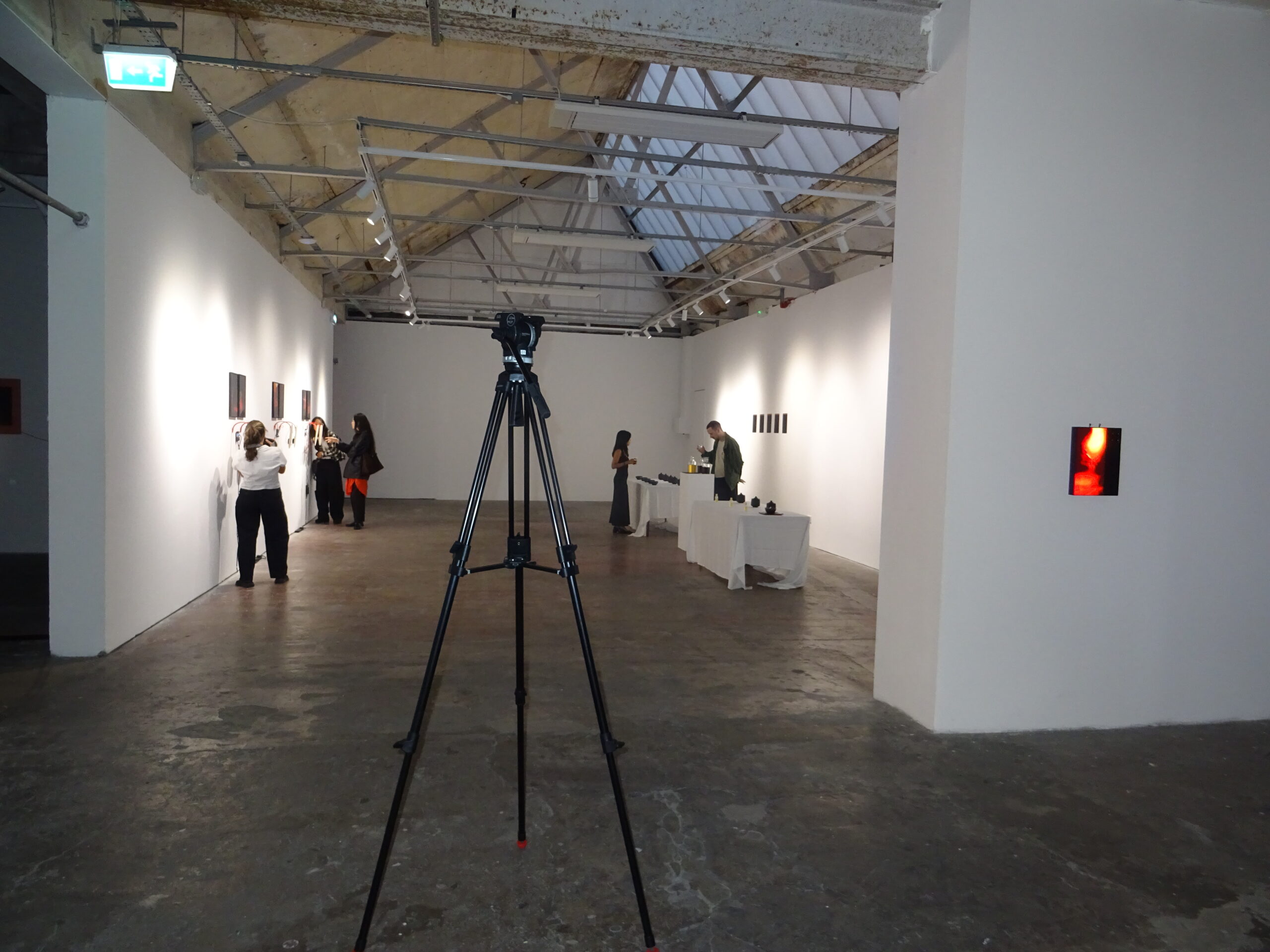
“Delusion”, exhibition by Sanchit Bembi, Copeland Gallery
Sanchit’s delusion, as he explained to me, is his synaesthesia filling in the gaps left by the distance of the stars in the night sky, the light reaching him before it does us. His own gift of foresight.
My delusion was thinking I could understand all the technicalities behind the exhibition. Sanchit did a great job explaining them to me, but for some more nuanced aspects of the software and tech, I was still thinking sorcery.
That being said, I also loved seeing the tools of his installations exposed for the public to witness. Wires connecting the objects crawling through the walls, a projector resting on a small shelf. It felt native to the exhibition, and of course I am sure that was intentional. But so many times, when we see more technological aspects of an artwork, they are hidden.
Some artists justify such mysteries with fear of taking the person out of the fantasy of their work, but for me, it always had the opposite effect. If I don’t see the process, all the complexities of it, how can I contemplate its life, its full existence in a space? How can I truly understand what someone is telling me when the language they are speaking remains hidden?
Even if I looked at the program and struggled to understand the specifics of deconstructing a bottle of vermouth or the complexities of Patternflow as an artistic tool, I felt the meticulous effort the artist put into setting these systems up and connected deeper.
Beyond showcasing his immense artistic and technological talent, this exhibition felt like an interesting way for Bembi to take control of his synaesthesia. He shared it with others to help them understand, but he also turned it into an installation where forms and visuals could be changed manually and configured by the artist himself.
The exhibition does not take long before throwing you right into the first visual experience of the night.
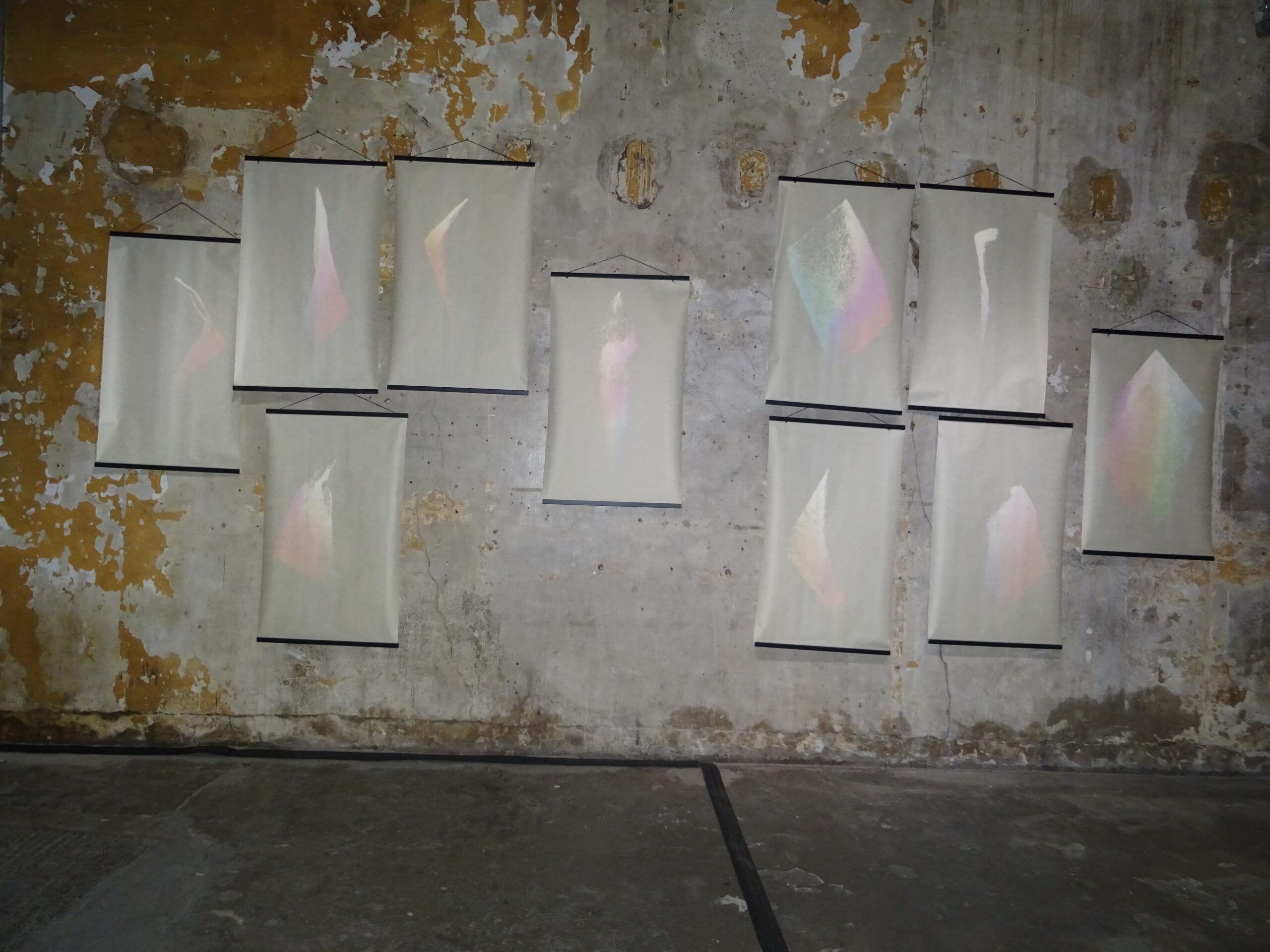
Room 1, “Delusion”, exhibition by Sanchit Bembi, Copeland Gallery
Room 1
Turning towards the left wall by the entrance, I came face to face with ten sheets of hand-cut washi paper, with projections drawn from the artist’s work and diffused into a 3D colour space.
Two of them had the colour warping, drifting and glitching through time-lapses. They felt intense and sporadic, like moments I wanted to catch, but before I could make them out, they’d slip away, never telling me what I wanted to know. These projections were closer to the way the artist actually perceives.
The other eight were more still, slowly moving and changing; they were drawn from synaesthesia and visual snow syndrome, something ever-present in its persistence. I looked up to them, hoping they would share with me the moments that I missed, but they were too different; they had their own stories to tell. They were too constant to share quick words; they just existed, slowly blending with my own vision the longer I looked at them.
The first room immediately shares the tone of the exhibition. The artist mixes art and tech to deepen our understanding of his condition and literally submerge all of the guests’ senses in his work.
As I walked from room to room, there was not a single point when I wasn’t completely engaged, in deep alignment with the spirit of the room. My thoughts, my moves, my senses were only guided by the sensations I experienced. Even when my mind would wander, lost in the red glitches or the faint scent of oranges, a new detail- a wire, a movement, or a sheet hanging from the ceiling would bring me back into Bembi’s realm of “Delusion”.
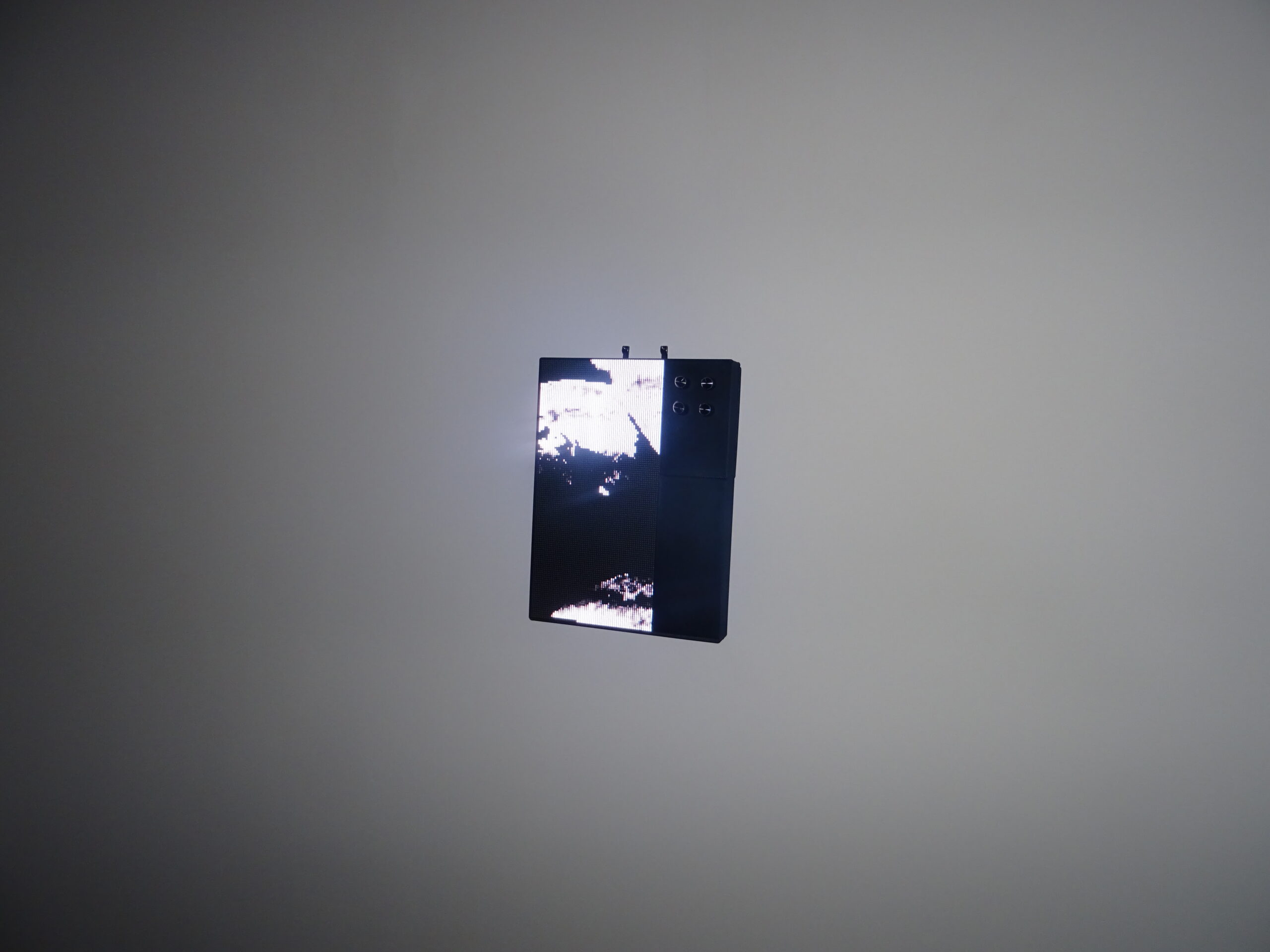
Room 2, “Delusion”, exhibition by Sanchit Bembi, Copeland Gallery
Room 2
I stepped deeper into the large space of Copeland Gallery and found myself in the second room, where two small screens hung on the wall. From afar, they looked like pixelated black boxes with moving figures that steadily changed shape, but after the distinct impressions room one’s flickering sights left me with, I knew better than to gawk from a distance.
As I came closer, it began to make sense.
What I saw in front of me was small LED panels with four knobs on the side. Inside the panels, Bembi’s photographs were rebuilt as light; a moving source would pass through them, forcing the image to change shape, decompose and recompose. The more I played around with the knobs, the more I pushed the images to explore or stretch; the more their metamorphic capabilities became apparent.
No change is permanent, though, as the artist assured me. After some time, as if trained to read the room and wait for exactly the right moment, the image drifted back into its original form.
The program Sanchit handed me at the start of my visit described each room’s thoughts and technicalities. Under Room 2, it said these pieces are finished only when you take hold of them, further playing into the idea of individual perception of his work.
Apart from being just plain exciting and satisfying my recurring intrusive thought of “touch it” every time I come close to an installation, it gave me an odd feeling of control, a power to choose how deep I go into manipulating the pixels in front of me.
Of course, I went as deep as I could, but I saw others approach it more carefully, touching the knobs softly and even trying to reverse the changes they had made. Did they treat the work more preciously by giving it slow and steady caresses, or did I by pushing it to its full potential?
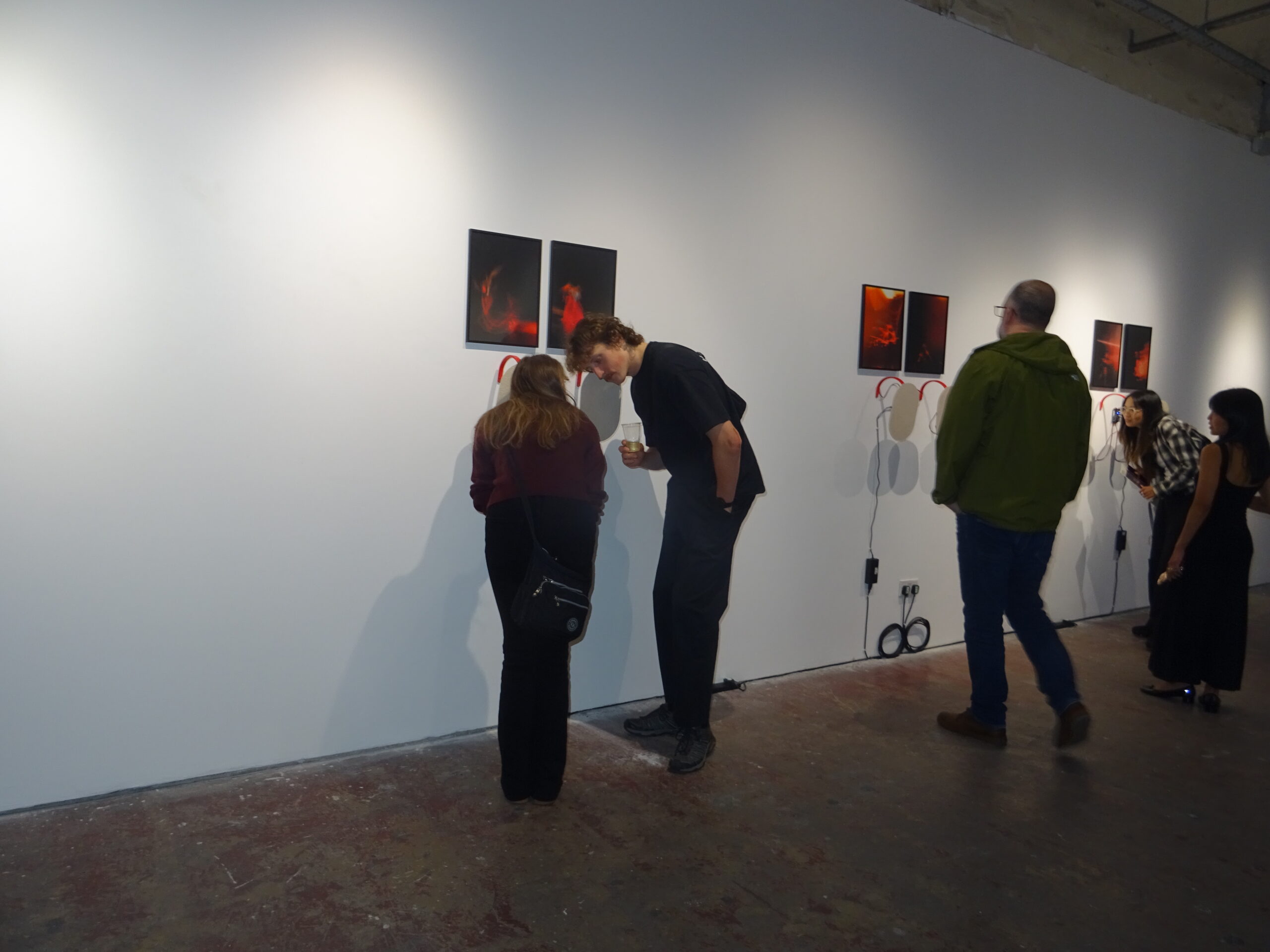
Room 3, “Delusion”, exhibition by Sanchit Bembi, Copeland Gallery
Room 3
The largest room in the gallery, Room 3, had a lot to offer. I first looked to the left, where the artist’s photographs hung on the walls with large stone speakers underneath them.
The photos included frames of a single moment layered on top of each other using Bembi’s signature technique of digital fermentation. These moments were now extended to conquer new senses.
Filled with scent and distant sounds, the room felt like walking down a street where bars and cafes stretch out, all playing completely different music and emitting vastly different smells. You almost get to live in all these different worlds at once, but only as a distant observer, as a shadow. Here, you get to come closer and disappear in a moving moment.
I watched people come by and stand for a long time, listening, looking, exploring. I had to wait quietly behind many backs to get my moment alone with the work, but once I did, I understood why so many lingered; I had to come closer.
Instead of following the frankly outdated and a little boring tradition of placing text description boxes beneath artworks, the artist chose a song and a scent to accompany each piece. The sound grew louder the closer you got to the large speakers, which also carried notes of a scent that expanded the moment. You caught whiffs of it now and then, never expecting when they would hit, and it propelled the photographs into movement.
When I got to the last image, Sanchit mentioned it was taken at The Strokes concerts, and he chose the scent of oranges to accompany it because, like the band’s music, this scent makes him happy. It might have been a slight bit of conditioning, but I could see sharp guitar strings turn into the soft juice of a fresh orange in front of my eyes, its smell overtaking my consciousness.
Room 3, “Delusion”, exhibition by Sanchit Bembi, Copeland Gallery
Some of the installations at the exhibition were built upon Bembi’s previous work. Some of the photographs were taken directly from his past series “Ephemeral Decay” and “Eldritch Bodies”. It felt like a gradual evolution of the work itself, the photo series growing into something larger, something all-consuming.
Instead of bombarding the audience with countless disconnected visions, the artist focused on the length to which he could take his work, while still retaining his visual language. In that, I see a greater respect for his own craft.
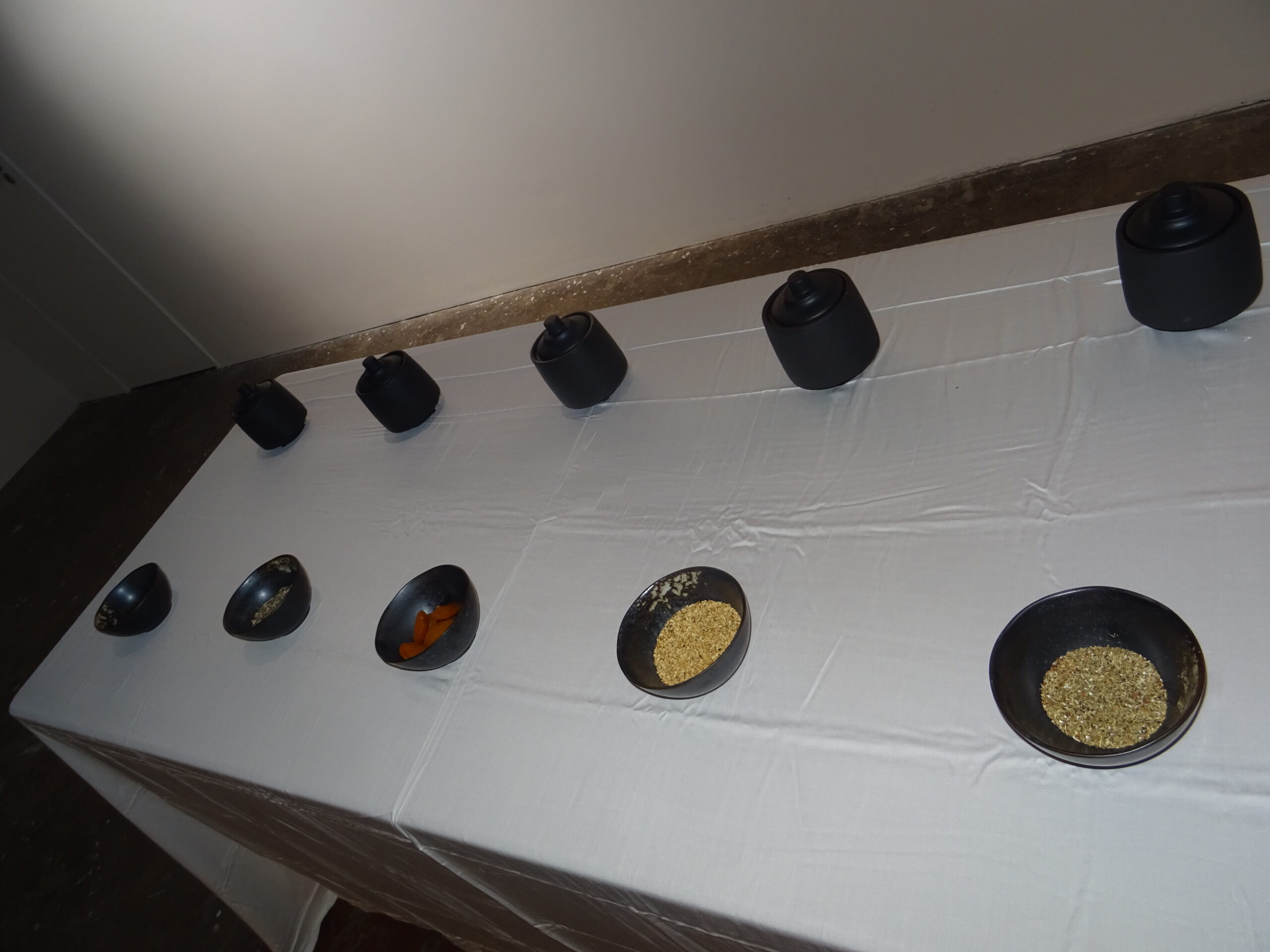
I turned right to two long tables, with a small podium between them, proudly displaying three large glass vials filled with liquid I didn’t yet recognise. Sanchit told me he had been making his own vermouth at home. He wanted to serve it that night, but the gallery was slightly sceptical about serving liquor he made in his kitchen. Fair enough, in retrospect, but I would have loved to try it. With serving the drink out of the question, he did something so much cooler instead.
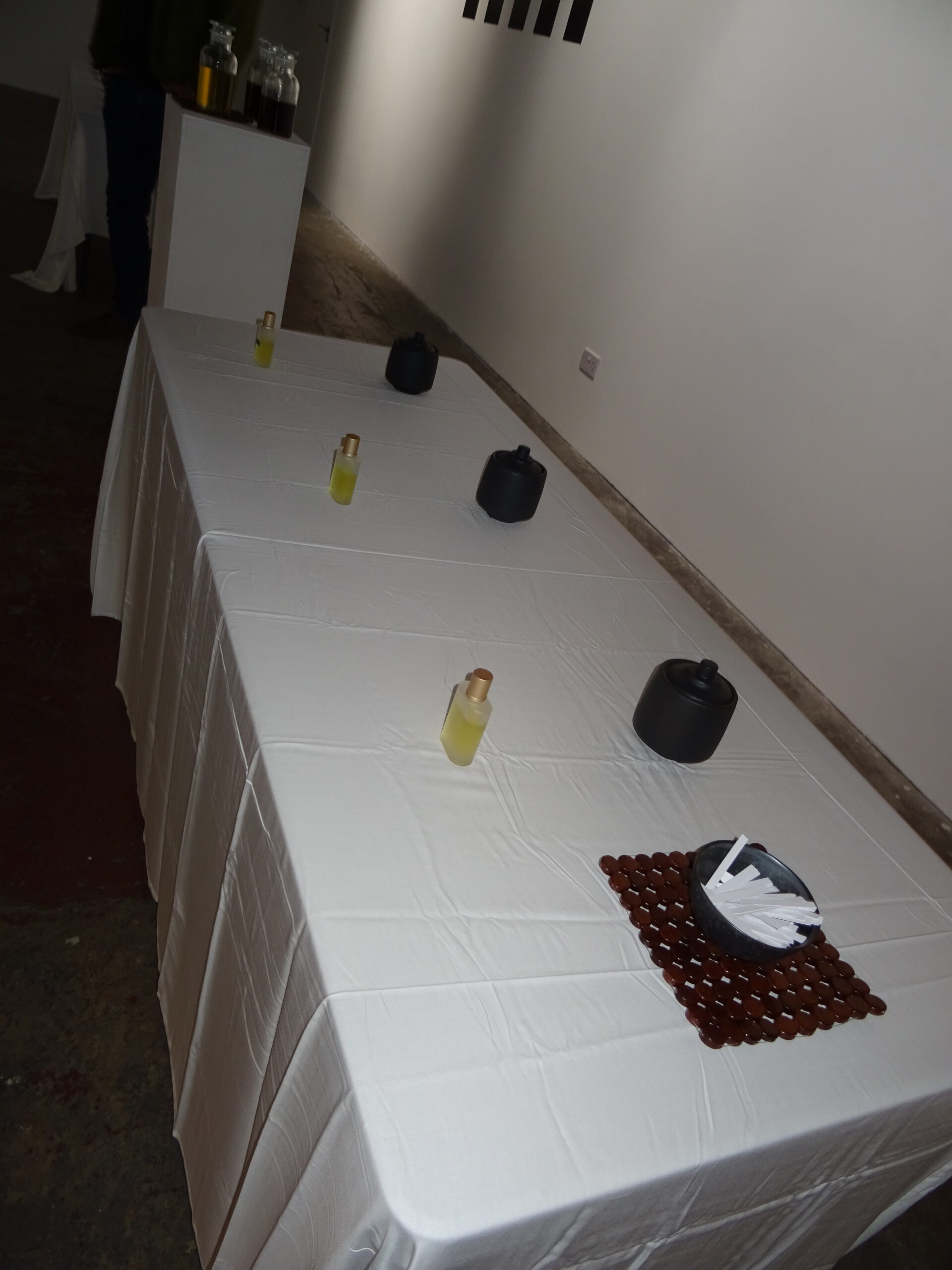
Room 3, “Delusion”, exhibition by Sanchit Bembi, Copeland Gallery
On the first table, he placed five oxidised ceramic bowls holding the raw botanicals. The same five plants appeared again as digital negatives on copper plates hung behind the table. These were the key ingredients of the drink, deconstructed down to their original form.
I’m going to take us out of the fantasy of this exhibition for a minute to share a personal note. That’s just so fucking cool! Okay, let’s go back.
The play on the timeline of scent was a perfect match for an exhibition that warps perception repeatedly. Often, we rely on taste to understand the notes and ingredients in the products we consume. We have a sip of wine and then sit tirelessly trying to guess the subtle flavours hiding under its surface. We have a piece of meat and try to discern what spices were used in the marinade.
Here, everything is laid bare. Our minds are faced with the pure formula and pushed to contemplate how this composition can bring the sweet notes of this enticing liquor to life.
I quickly realised the podium is displaying the final product. The ready vermouth. Tempting the visitors with its deep colours, completely out of reach.
At the next table, Bembi took his experimentation further. There he placed three perfumes; each was his personal interpretation of the botanical grammar of vermouth. Each gave faint whispers of the liquor’s aroma and built up to create a unique scent.
Once again, so fucking cool! I wished I could get one for myself so bad.
The scents included some familiar notes like Cedarwood, Cardamom, and Chamomile. And intrigued with some unexpected layers, like Champagne, Neroli, Baked Apple, and Vetiver.
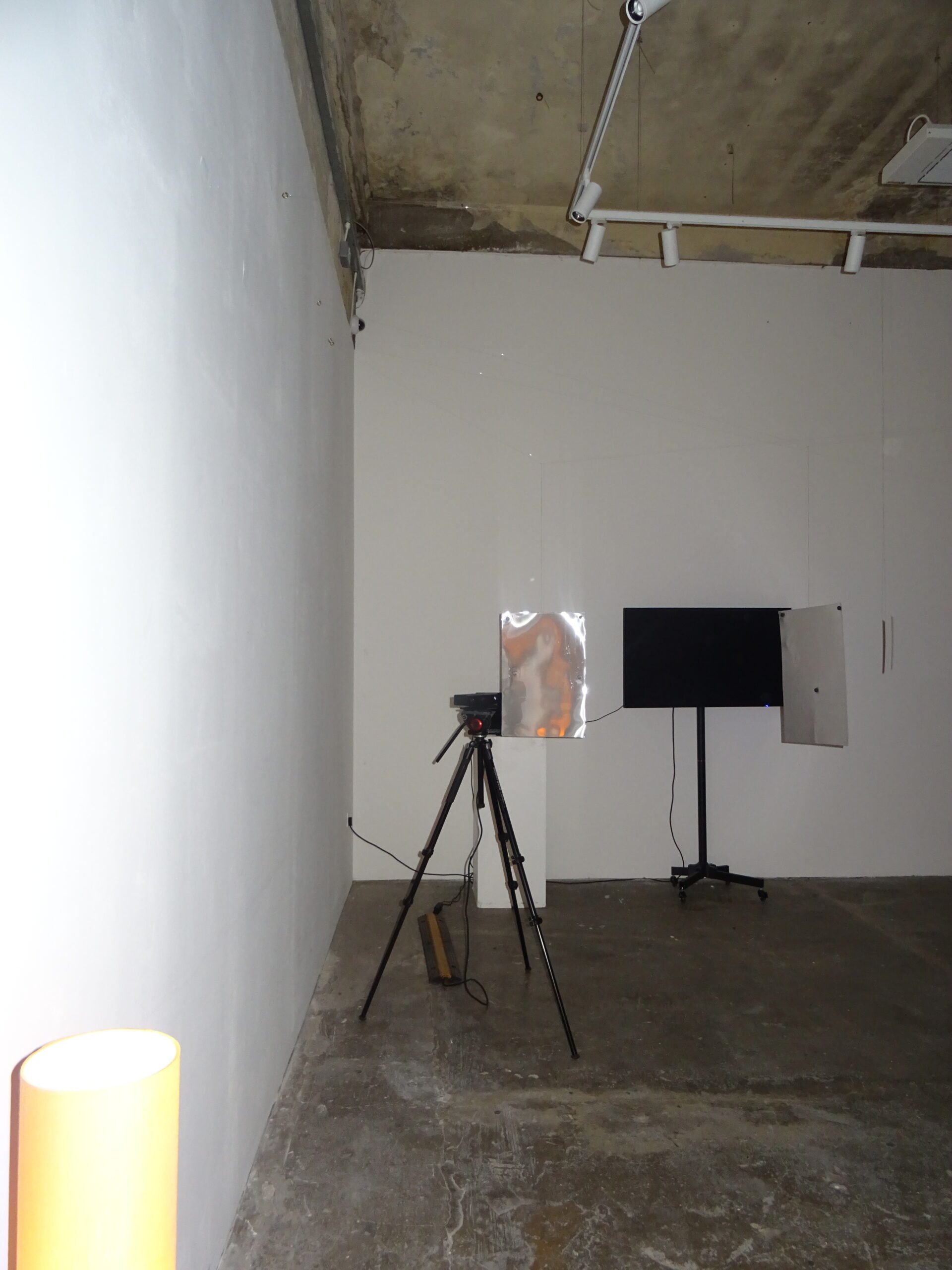
Room 4, “Delusion”, exhibition by Sanchit Bembi, Copeland Gallery
Room 4
The penultimate room of the exhibition showed me a familiar installation. I have read and written about this particular project of Bembi’s before, but seeing it with my own eyes was a very different experience. I think at this point, we have already established that, although Bembi’s work can be greatly observed and discussed from a distance, there are certain aspects you just have to get personal with.
This piece was an audio-reactive installation previously exhibited during his lecture at Tate Modern’s “Exceptional Spaces: The Cosmic Vision of Aleksandra Kasuba” event. Two lenticular sheets hung on opposite sides of the room, passing a message that changes based on the viewer’s perspective.
I watched Bembi’s creation bend and ripple as I moved around the room. Every step revealed a new discovery, a new perspective, yet if I stepped back, it changed again. Witnessing connections that can never be repeated, an experience so individual it’s almost lonely.
I have looked at the images and videos of the installation numerous times since, and I still can not grasp the full depth of this structured interaction. In moments like these, it is tempting to surrender to the persuasion of delusion.
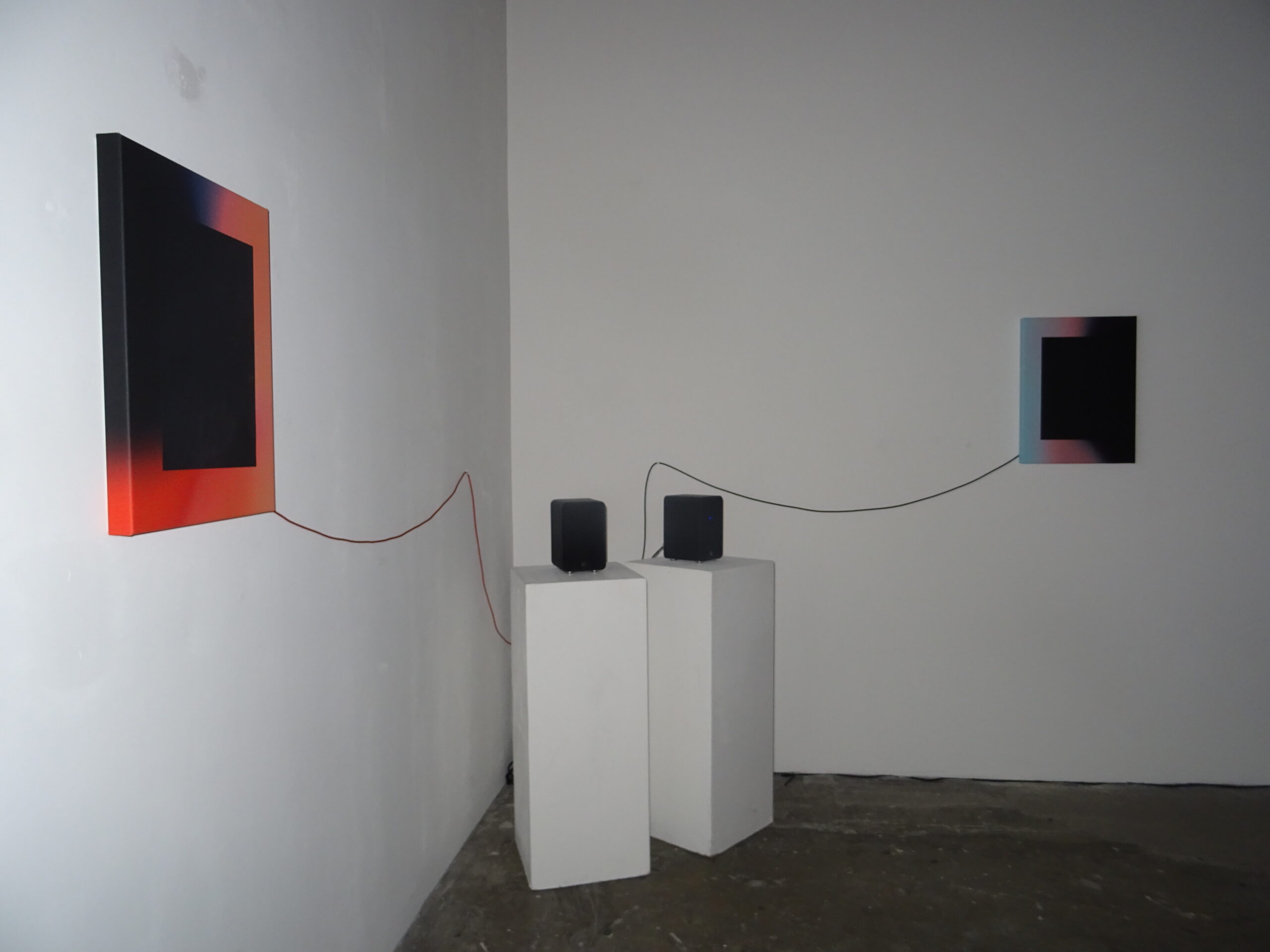
Room 5, “Delusion”, exhibition by Sanchit Bembi, Copeland Gallery
Room 5
I reached the final room. The first thing that caught my eye was the large static visuals on the wall, coming from a projector propped on a small shelf. But my weird compulsion to investigate any room from left to right drew my gaze to two canvases hanging calmly, as two red wires crawled from beneath them.
I moved closer and saw the wires go directly into two large speakers in the corner of the room. A guy next to me told me quietly, “You know you can touch them”. Yes! I was hoping I could.
As I ran my fingers over the canvas’s soft black surface, a faint sound came from the side. For a second, I thought this exhibition had lived up to its name in the most literal of ways, and I am now submerged in delusion. Touch has become sound, sound has become scent, all the senses have mixed together, and I am now a willing prisoner of this sensory concoction.
A later conversation with Sanchit revealed that both canvases and speakers are developed with software that turns each touch into sound. In the final room, the artist wanted to create an inverse of his synaesthesia. Sound, for him, usually triggers sight, so here, he wanted us to experience what happens when touch triggers sound. I was relieved I wasn’t going crazy, or maybe a little disappointed.
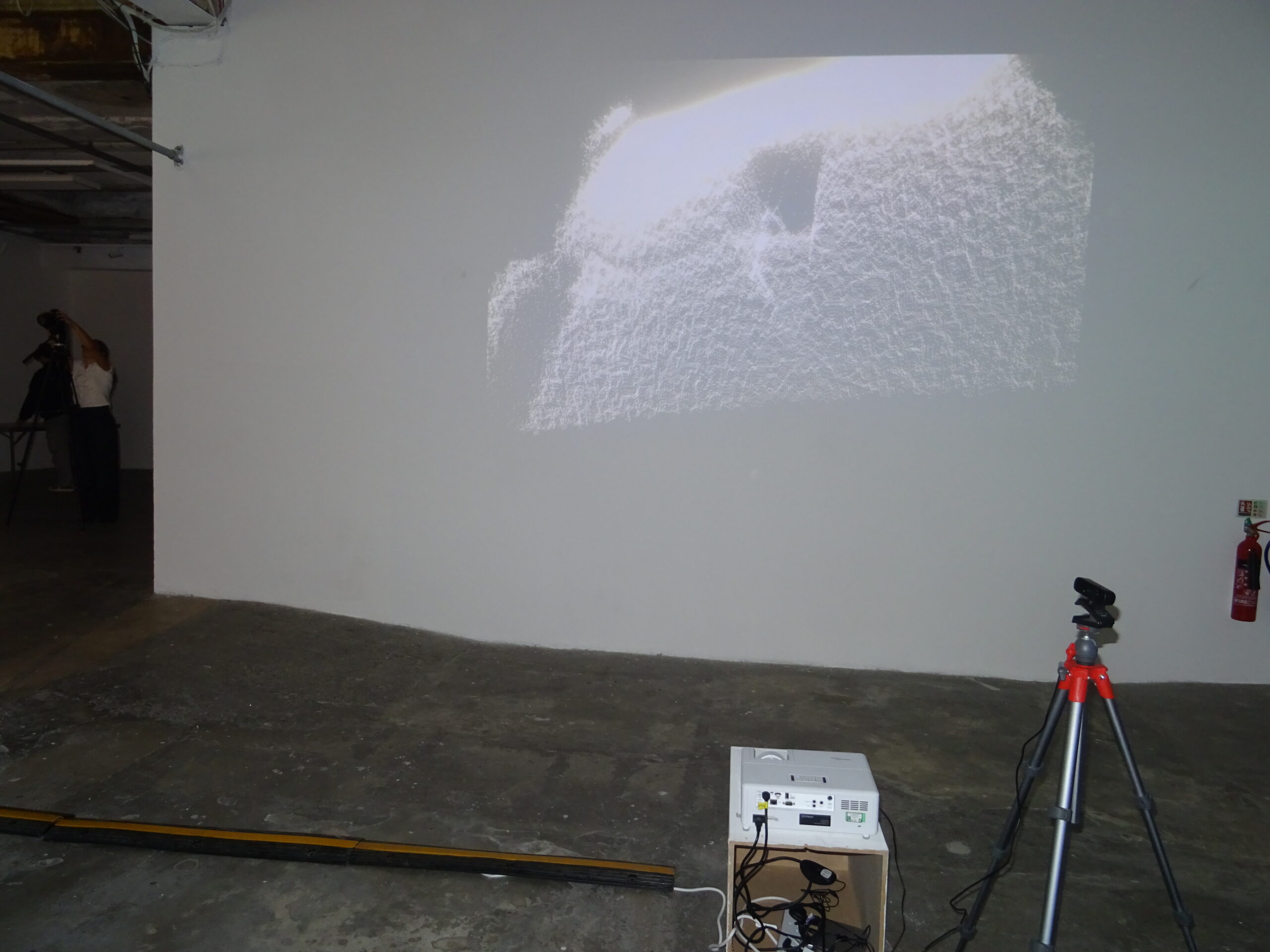
Room 5, “Delusion”, exhibition by Sanchit Bembi, Copeland Gallery
I reached the final installation of Room 5, Bembi’s early work. A video is projected on the wall next to a sound-reactive sensor, changing visuals as the surrounding noise grows louder. Perhaps the most literal interpretation of his condition, yet in his words, it did not fully convey the complexities of the visual distortions he experiences.
It was interesting to see Sanchit’s earlier work, and viewing it at the very end added a special touch for me. In many ways, this exhibition subverted and inverted senses, systems and perceptions, so why not invert time as well?
Looking at the artist’s past work, you can revisit the exhibition almost like a time machine, moving from future to past. Or go back to Rooms 4 and 3 and see the progression in a linear timeline. No matter which direction you choose, this is definitely an exhibition you have to experience multiple times.
When I got home, I opened the program again; the scent that filled the room was still lingering on its coarse pages.