Category Art
Published November 14, 2026
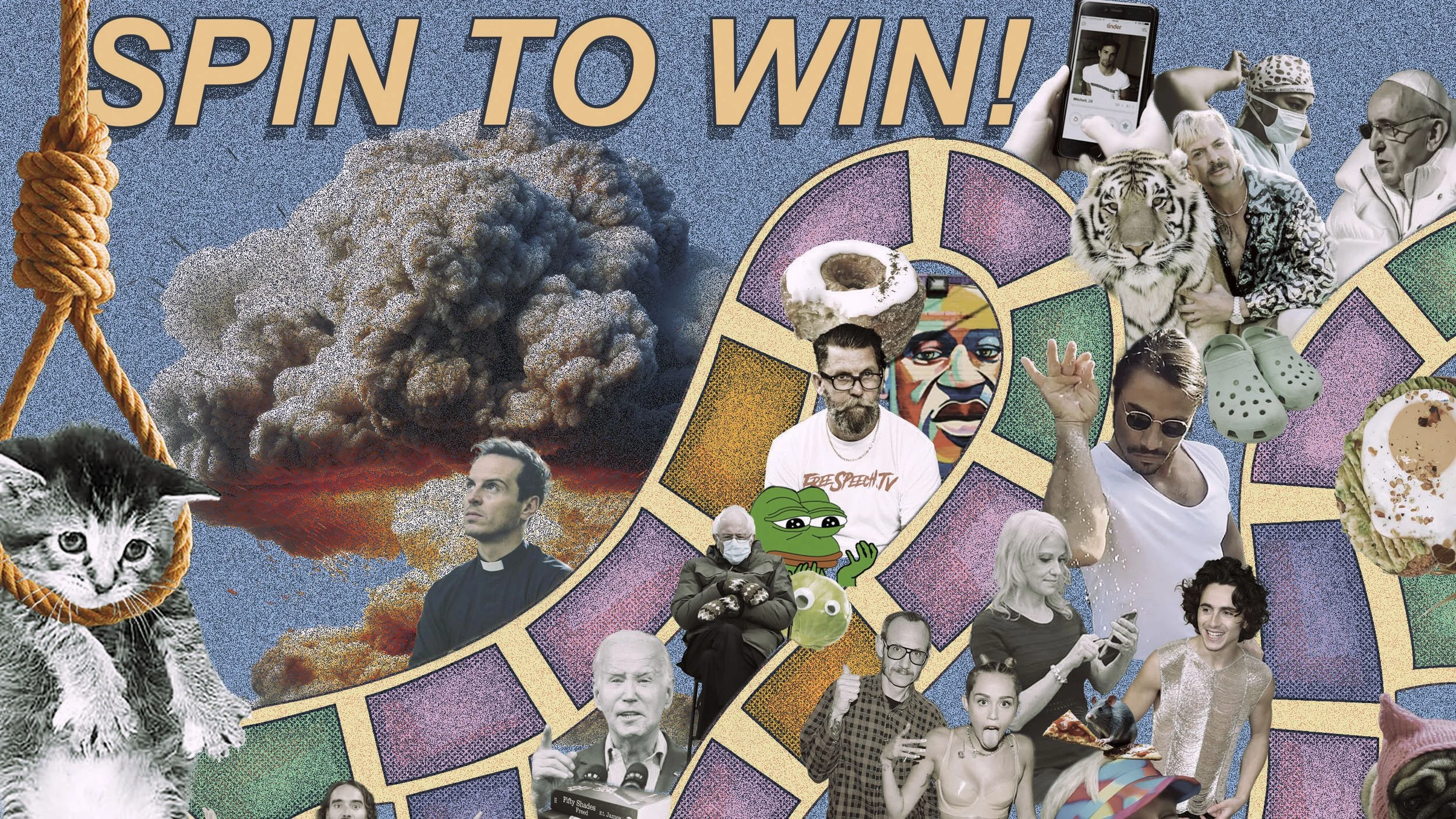
Perpetual Kittenhood, Boardgame, by Kaitlin O’Connor
Story Flavour: the aftertaste of a banned artificial sweetener, forgetting to brush your teeth after a night out and Vodka Red Bull.
Story Scent: Paris Hilton’s “Heiress” perfume, stale Diet Coke and unwashed synthetic fabric.
Story Sound: a dial-up modem, an ex-boyfriend’s experimental House music and late-night TV static.
Consider the Ozempic Cheato, a snack manufactured and branded so you can eat something unhealthy while looking like you don’t care. Kaitlin O’Connor’s imagined product—one of many in her multidisciplinary project Nobody’s Dead, Yet, alongside the BLM Malbec, the Q-Anon wine, and the Pussy Riot rosé, to name just a few—lampoons the weight-loss drug, the effortless cool girl, and the snack brand all at once. Riffing on the word “cheat”—‘because I’m so clever!’ she tells me with a laugh—she pokes fun at the unsettling reality that nonchalance is now a product.
The conceit of the Cheato runs through much of O’Connor’s sprawling creative practice, one spanning illustration, performance, product design and, improbably, a board game. As a millennial, she is no stranger to the perils and hilarity of commercialisation, having been raised as both the product and the sales target of global consumerism. ‘Everything I saw on TV was trying to sell me something,’ she says of growing up in the eighties.
Kaitlin O’Connor has trekked a richly unconventional path to becoming an artist. She trained as a contortionist at the San Francisco School of Chinese Circus Arts from the age of fifteen, and later studied costume design, attained a scholarship to the School of Visual Arts, completed an MA at the London College of Communication, worked at Desigual and Nylon Magazine, and secured representation from an acting agency. Currently, she works from the Koppel Studios, and has showcased her multidisciplinary pieces at equally varied venues, from the Indra Gallery to the Mexican Embassy, with a recent solo show, ‘Soft Sell’, at the hARTslane Gallery in November.
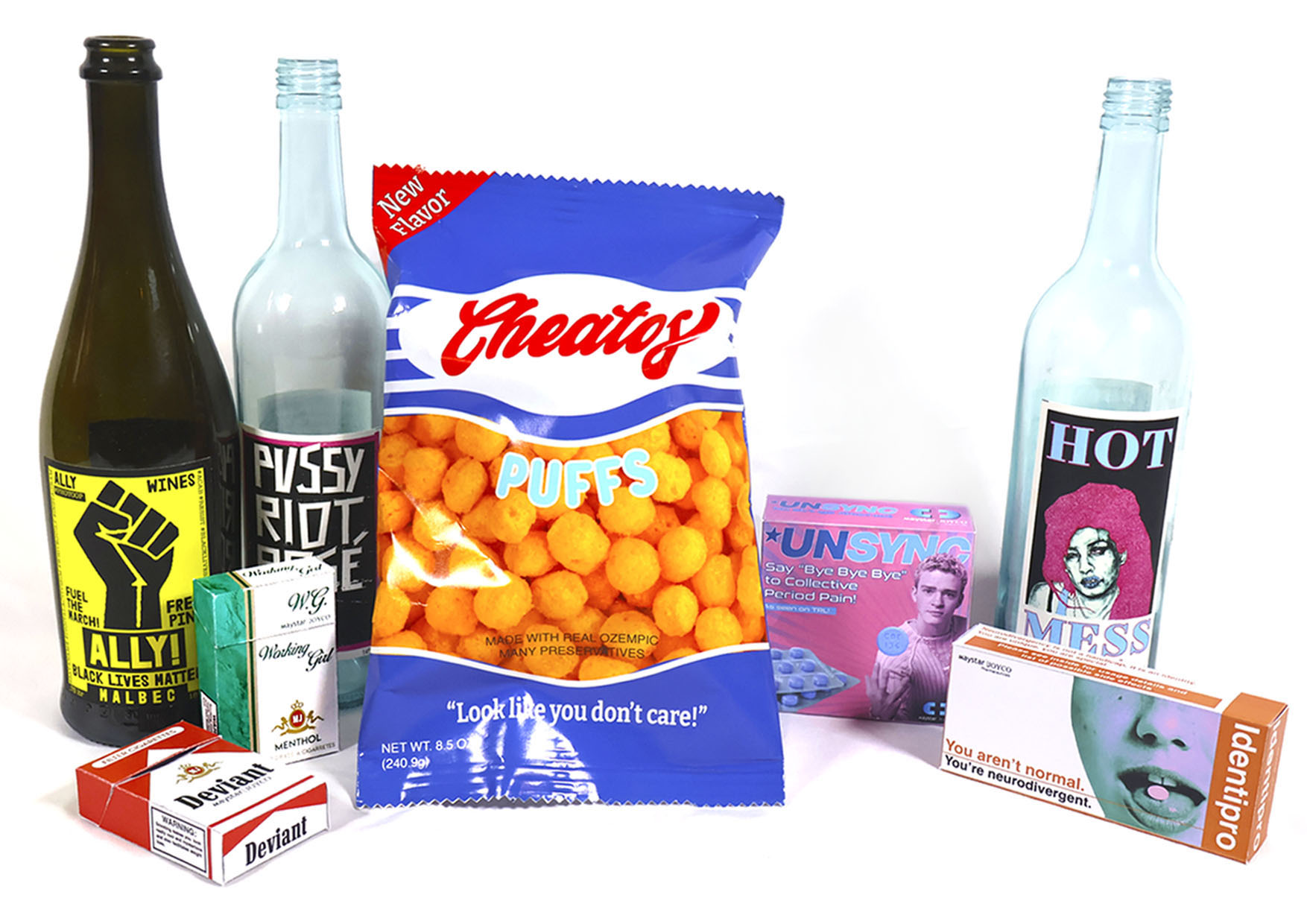
Nobody's Dead Yet, Products, by Kaitlin O’Connor
The historical anchor for much of her work harks back to 1929, when Edward Bernays, the so-called father of public relations and incidentally one of Freud’s nephews, had New York debutantes light cigarettes at the Easter Parade as “torches of freedom”. Smoking became shorthand for emancipation, and a generation of women bought their liberation by the packet. O’Connor treats the episode as a primal scene, the first proof that empowerment can be sold back to the supposedly empowered. Her work speaks back to the very concept of the PR stunt, updated for the age of wellness, diagnosis, and influencer selfhood.
Nowhere is her ability to meld graphic design, illustration, and performance together more ambitious than in Nobody’s Dead, Yet, set in the fictional corporate universe of Waystar-Joyco. Through satirical branding, product design, and character performance, O’Connor’s ongoing project explores the commodification of identity, health, and feminine empowerment under late capitalism. Despite her claims of being chaotic, she is a meticulous pattern recogniser and an astute observer of global trends, her art successfully mirroring the world it satirises as both critique and product.
Throughout Nobody’s Dead, Yet, each character in a growing cast is tethered to counterfeit pharmaceuticals, snacks and cosmetics. There is Sharon McAfee, a wine-mom turned MAGA insurrectionist, and an ADHD medication advertised as an accessory, ‘made so that you can tell people about it’. The conceit is an audition for a reality show, and the title borrows that genre’s logic: every week needs a catastrophe to hold our attention, so ‘I might kill one off’. O’Connor stages the manufactured sense of impending doom that keeps us scrolling.
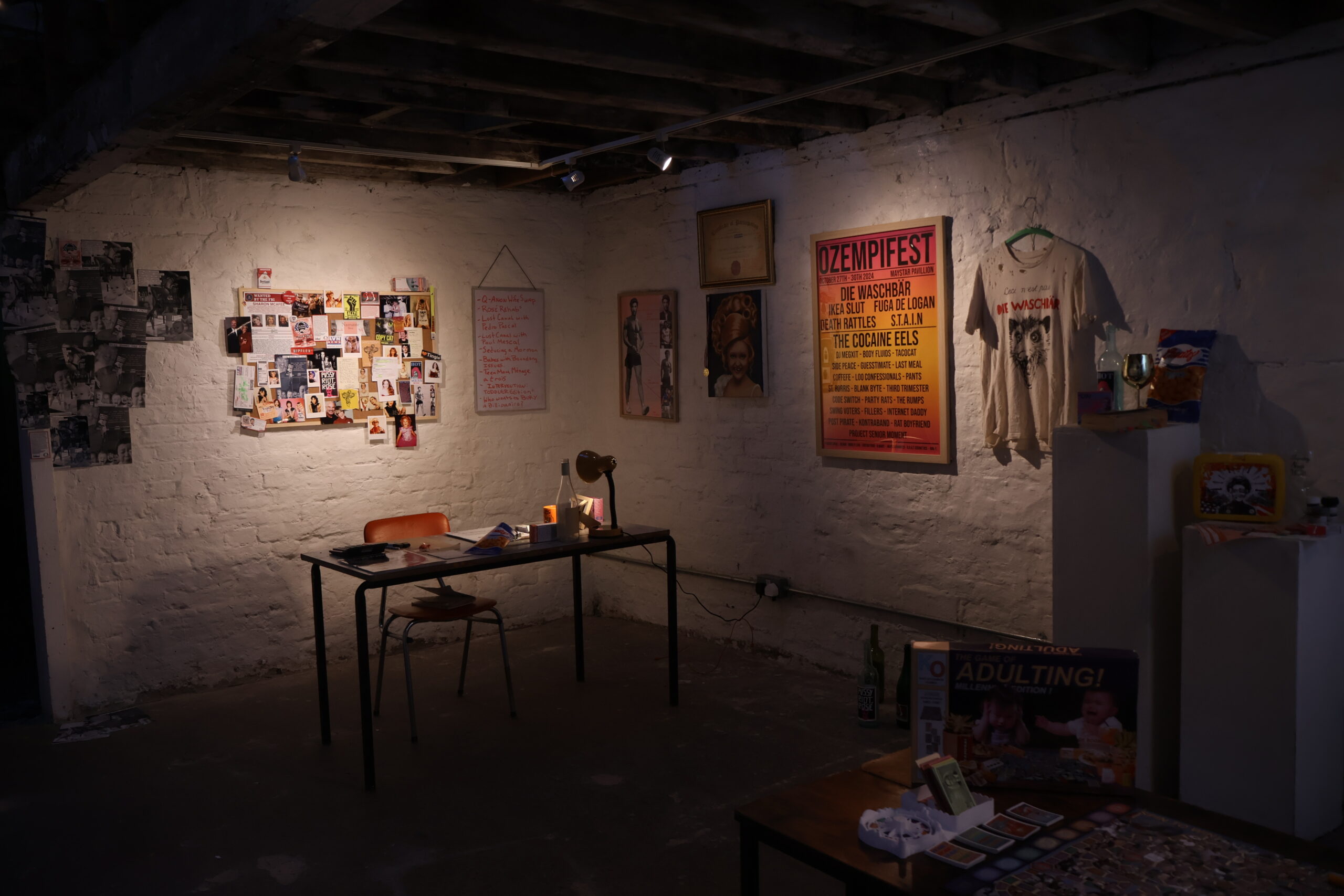
'Soft Sell' exhibition, by Kaitlin O’Connor, hARTslane, 2026
The project’s real engine, though, is not parody but mercy. O’Connor admits the characters began as vessels for her most ungenerous judgements of women she ideologically—and perhaps also aesthetically—disagrees with. But to invent a person in full, with products, dialogue and history, is also in some ways to shed that contempt. Her art is not afraid of changing its mind in its process, to move from critique to sympathy and back to critique. Everyone, it implicitly acknowledges, is trying their best. Nobody’s Dead, Yet, recalls Lena Dunham’s Girls, where the unlikeable heroines thicken into human beings the longer we stay with them. It is also why the work escapes the smugness that curdles so much satire. O’Connor swings at the cool girl she has also confessed to wanting to be, citing Desperately Seeking Susan’s seductive girl-crush longing.
These popular culture references are rampant across her work, usually as ornaments and symbols of politics, catastrophe, and satire, but also as inspiration. After all, she admits, comedy and horror are the best ways to talk about the things you can’t talk about. Perpetual Kittenhood, a physical board game that, by design, cannot be won, extends Nobody’s Dead, Yet’s diagnosis to a whole generation. Its title comes from a podcast analogy she picked up discussing Greta Gerwig’s Barbie: feral cats stop miaowing in adulthood, while domestic cats keep miaowing at us, much as millennials, raised as the first generation advertised to as children, never outgrew the language of need. Nostalgia is part of the millennial DNA, her work seems to say, flecked with memories of life without a phone or the internet while still being citizens of the digital age. The game charts pop culture, politics and catastrophe, from pandemic to economic collapse to authoritarian takeover. It is, she says cheerfully, ‘impossible to play,’ and she’s fine with that.
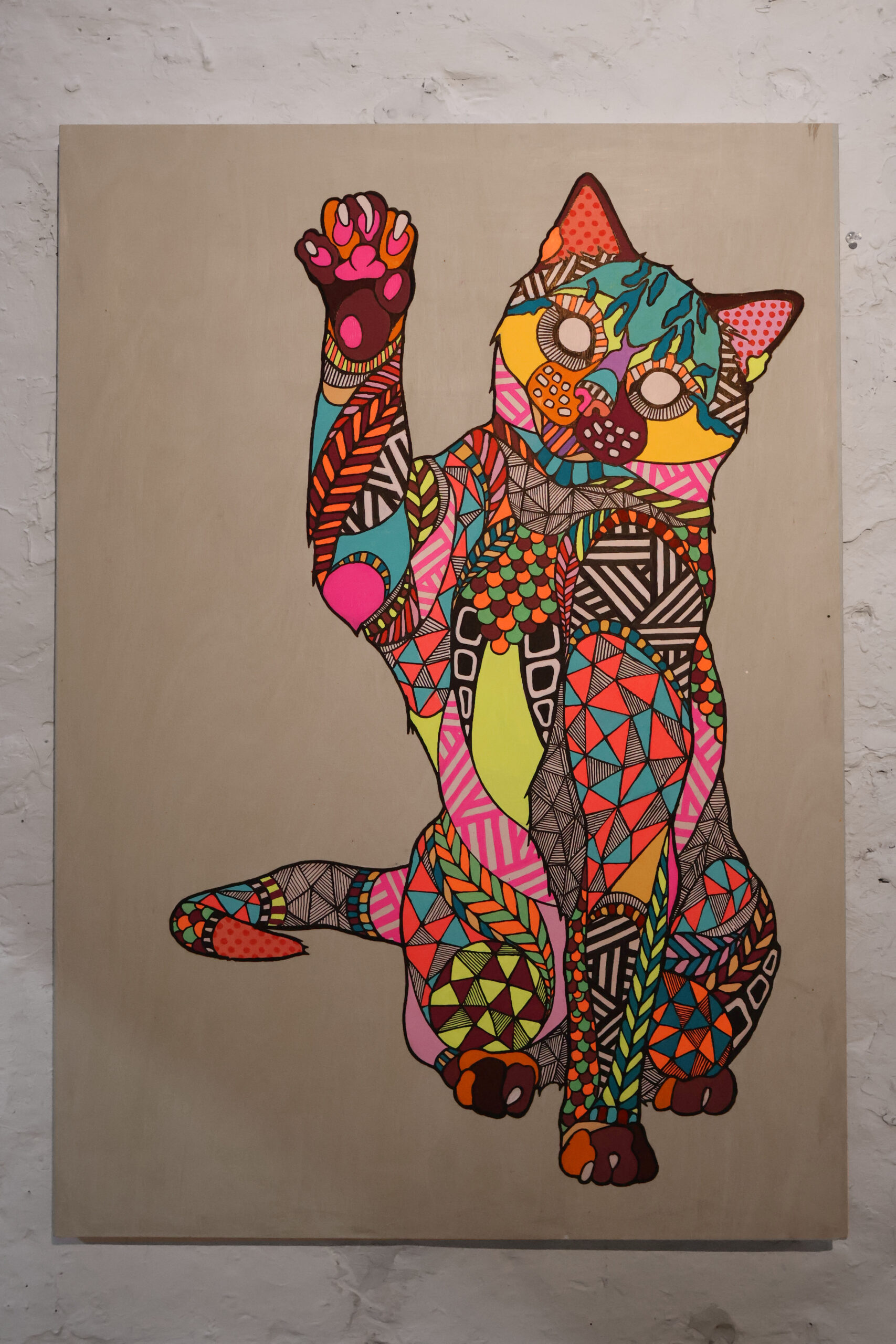
Neon Bodega Cats, by Kaitlin O’Connor
Perpetual Kittenhood holds a critically sound argument. The game has a distinguished ancestor in Elizabeth Magie’s The Landlord’s Game of 1904, the proto-Monopoly she designed as a critique of rent-seeking and unfettered capitalism before it was repackaged as its celebration. O’Connor’s game restores that critical lineage for the 2020s, making Lauren Berlant’s “cruel optimism” playable: she gamifies the millennial promise that school, work and diligence would eventually pay off, exposing an attachment to a fantasy that obstructs the very flourishing it pledges. Gen Z, she notes, inherited no such illusion, having been raised knowing things ‘have not been okay since the womb’. If the rules are always rigged, a game with no winning condition—as annoying as that may be—also feels refreshingly sincere.
If the board game is the diagnosis, her project Neon Bodega Cats gestures towards a cure. Painted in highlighter ink on paper, wooden panels and T-shirts, these portraits of New York’s shop cats grew out of her observations through volunteer work to spay and neuter the cats at her local bodega. The cats in her illustrations are rendered as neon saints, shopkeepers, and neighbourhood guardians, pops of colour collaged over each other in a feral patchwork. She hopes to expand these illustrations and wood panels into textiles and 3D prints. If Clement Greenberg dismissed kitsch as the counterfeit of feeling, O’Connor reclaims it as feeling that knows it is cheap, and means it anyway.
Identity has become in many ways an online project, one littered with diagnoses, buzzwords and avatars that stand in for self-expression. Yet, where some artists might prefer to specialise within comfortable creative categories, Kaitlin O’Connor contorts and expands into avenues less defined. ‘You can’t just be one thing,’ she says of her multidisciplinary practice. With tongue-in-cheek works that nevertheless allow for genuine tenderness, her playful and nostalgic satire enriches our contemporary vocabulary, showing us what illustration, graphic design, and performance are capable of when they join forces. Amid the Ozempic Cheetos, unwinnable board games, and cats painted in neon ink, O’Connor sells us everything but the verdict.